Best Way to Cut 4×4 Post: Easy Methods and Tools
To cut a 4×4 post cleanly, choose a circular saw for portability or a miter saw for precise crosscuts if your blade fits.
Mark all four sides with a speed square, wrapping the line fully for accuracy. Score each face with the saw, then finish cutting the center fibers using a handsaw or reciprocating saw to avoid splintering.
Secure the post firmly on sawhorses and keep the blade at full speed during cuts. You’ll find detailed tips on tool choice, marking, and finishing techniques ahead.
Key Takeaways
- Securely clamp the 4×4 post on sawhorses or workbench to prevent shifting during cutting and ensure safety.
- Mark a precise, square cut line on all four faces using a speed square to maintain accuracy.
- Score all four sides with a circular or miter saw before severing the center fibers to avoid binding.
- Use a multi-pass technique if the saw blade cannot cut through the entire 3.5″ thickness in one pass.
- Finish cutting fibers with a handsaw or reciprocating saw, then smooth edges with sandpaper or a block plane.
Choosing the Best Tool for Cutting 4×4 Posts

When choosing the best tool for cutting a 4×4 post, consider where and how you’ll be working.
Selecting the right tool depends on your workspace and how you plan to make the cut.
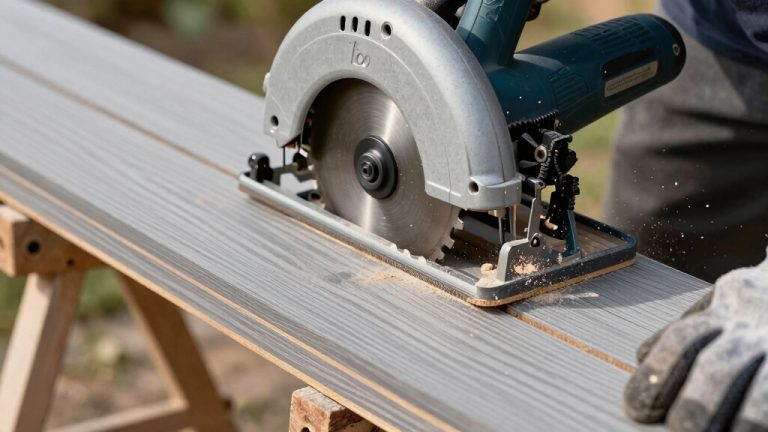
If you’re on sawhorses or a workbench, a circular saw is your most versatile option. It handles general cuts well and is portable.
In a workshop setting, a miter saw can offer clean crosscuts, but only if it has enough blade clearance. Many 10- or 12-inch blades won’t cut through a full 4×4 in one pass.
For trimming posts set in the ground, a circular saw remains practical. If you need to finish the cut after scoring multiple sides, a handsaw or reciprocating saw helps you cleanly sever the remaining fibers.
Choose your tool based on workspace, cut type, and the post’s position to ensure safety and precision. Corded saws with a 15-Amp motor and a 7-1/4″ blade provide the power and depth needed for efficient cuts on larger posts, making them a reliable choice for demanding tasks like cutting 4x4s with high cutting capacity.
How to Mark and Measure Your 4×4 Post for a Perfect Cut?
Alright, let’s get started!
First, you want to measure from one consistent reference edge. This way, you’ll ensure everything is uniform around the post.
Next, grab your speed square. It’s a handy tool that helps you mark a thin, precise line on all four faces of the post. Make sure to wrap that line fully around—it really helps avoid any alignment errors down the line.
Before cutting, make sure to check blade alignment to achieve the most precise results.
Accurate Line Marking
Mark all four faces of your 4×4 post carefully to guarantee a straight, square cut. Use a speed square or combination square to transfer your cut line consistently around the post, ensuring the line remains perfectly perpendicular to the edges.
Measure from one reference edge to keep the line aligned. Draw a thin, sharp pencil or utility knife line to increase visibility and precision. Wrap the line completely around the post rather than marking just one face, preventing measurement errors caused by misalignment.
Take your time to confirm all four lines meet squarely at the corners before cutting. This accurate line marking sets the foundation for a clean, professional cut and avoids the need for corrections later on. Using a crosscut sled with a stable base can further enhance the precision and safety of your cut.
Consistent Measurement Techniques
Although marking the lines accurately is essential, maintaining consistent measurements around your 4×4 post guarantees the cut stays square and even.
To make certain precision, always measure from the same reference edge on every face of the post. Use a speed square or combination square to transfer your measurement consistently around all four sides.
Wrap your marking line fully around the post, not just on one face, to avoid alignment errors.
Follow these steps for consistent measurements:
- Choose a fixed edge as your baseline for all measurements.
- Use a square tool to draw your cut line around the post’s entire perimeter.
- Double-check every mark before cutting to confirm uniformity.
This method prevents uneven cuts and keeps your post perfectly square. For optimal accuracy and ease, consider using a speed square with laser-engraved markings to ensure precise and clear measurements on your workpiece.
How to Cut 4×4 Posts With a Circular Saw?
Position your 4×4 post securely on sawhorses or a workbench, ensuring it won’t shift during the cut.
Mark the cut line clearly on all four faces using a speed square for accuracy.
Use a speed square to mark the cut line precisely on all four sides for perfect accuracy.
Set your circular saw’s blade depth about ¼ inch deeper than the post thickness to achieve a clean cut.
Place the saw shoe flat against one face and make the first cut slowly and steadily.
Rotate the post 90 degrees and repeat the cut on each side, scoring all four faces.
Keep the waste side free to avoid pinching the blade.
Once scored, you’ll need to sever the remaining fibers carefully to complete the cut.
Always wear safety gear and let the blade reach full speed before cutting for the best results.
For added precision and stability, consider using a featherboard when making your cuts.
How to Cut 4×4 Posts With a Miter Saw?
Cutting a 4×4 post with a miter saw? Here’s what you need to keep in mind.
First off, ensure your blade size and guard clearance can accommodate the post. You want to make sure it fits safely for a full cut.
Next, it’s really important to clamp or support the post firmly. This prevents any movement during the cut, which can lead to mistakes or even accidents.
And hey, if your saw can’t handle the cut in one go, don’t worry! Just use a multi-pass technique. You can rotate or flip the post to finish the cut cleanly. It’s all about taking your time and being careful!
Also, always remember to wear appropriate safety equipment to protect yourself during the cutting process.
Blade Size And Clearance
To cut a 4×4 post cleanly with a miter saw, you need to make certain your saw’s blade diameter and guard clearance can accommodate the full thickness of the post.
Many standard 10- or 12-inch blades don’t fully reach through a true 4×4, causing incomplete cuts. Here’s what to check before you start:
- Blade Diameter: Choose a blade large enough, often 12 inches or more, to slice through the entire 3.5-inch thickness.
- Guard Clearance: Make sure the saw’s blade guard won’t interfere with the post, allowing the blade to reach the bottom edge without obstruction.
- Cutting Capacity: Verify your saw’s maximum vertical and horizontal cutting capacities align with the post size.
Confirming these factors helps you achieve a clean, one-pass cut, avoiding multiple passes or additional tools. Additionally, understanding the impact of blade size on cutting capacity can improve your overall cutting efficiency.
Post Support And Clamping
Securely clamping your 4×4 post before cutting with a miter saw guarantees accuracy and safety throughout the process.
Start by positioning the post flat against the saw’s fence, ensuring it sits squarely. Use a sturdy clamp to hold the post firmly in place. This prevents any movement or shifting during the cut, which could cause inaccuracies or kickback.
If your miter saw lacks a built-in clamp, employ a separate bar clamp or quick-release clamp. Also, support the post’s length with a stable workbench or sawhorse to avoid binding the blade.
Keep the cut line clearly visible and free from obstructions. This setup maintains a consistent angle and depth, allowing you to execute clean, precise cuts every time while minimizing risk.
Additionally, using a miter saw with effective clamping mechanisms enhances stability and cut precision when working with larger stock like 4×4 posts.
Multi-Pass Cutting Technique
In situations where your miter saw blade can’t cut all the way through a 4×4 post in a single pass, you’ll need to rely on a multi-pass cutting technique. This method involves carefully scoring the post from multiple angles to avoid binding or uneven cuts.
Follow these steps for a clean, accurate cut:
- Cut one face of the post, aligning the blade precisely on your marked line.
- Rotate or flip the post 90 degrees and repeat the cut on the adjacent face.
- Complete all four sides, then use a handsaw or reciprocating saw to sever the remaining center fibers along the kerf.
Ensure the post is securely clamped throughout to prevent shifting. Keep the blade at full speed before each pass for the best results. Always wear safety glasses and other protective gear when performing multi-pass cuts to protect yourself from debris and dust.
Finishing 4×4 Cuts With Handsaws and Reciprocating Saws
When you’ve scored all four faces of the 4×4 post with a circular or miter saw, you’ll often find that the center wood fibers remain uncut.
To finish, use a sharp handsaw or reciprocating saw to carefully sever these fibers along the kerf lines.
Make certain the post is fully supported to prevent splintering or binding as you cut through.
Follow the scored lines precisely to maintain a clean, square edge.
A handsaw offers better control and less tear-out, while a reciprocating saw speeds up the process but requires a steady hand.
After cutting, check the edge for roughness and smooth it lightly with sandpaper or a block plane for a crisp finish.
This cleanup guarantees your cut is both functional and visually neat.
Always secure the workpiece firmly during cutting to maintain stability and prevent accidents.
Essential Safety Tips and Setup for Cutting 4×4 Posts
Before you start cutting a 4×4 post, make sure you firmly clamp or position it on stable sawhorses or a workbench to prevent any movement. A secure setup keeps the post steady and reduces the risk of kickback or binding.
Always wear safety glasses and hearing protection to guard against flying debris and loud noise.
Follow these essential safety tips:
- Position the cut line between supports so the waste piece falls freely without pinching the blade.
- Allow the saw blade to reach full speed before cutting to guarantee a cleaner, controlled cut.
- Stop the saw completely before rotating or repositioning the post to avoid accidents.
Frequently Asked Questions
What Type of Blade Is Best for Cutting Treated Wood 4×4 Posts?
You’ll want a carbide-tipped blade designed specifically for treated wood or lumber.
These blades resist corrosion from chemicals in the wood and maintain sharpness cutting dense fibers.
Choose a blade with 40 to 60 teeth for a smooth, clean cut that minimizes splintering.
Avoid blades meant for metal or plastic, as they won’t cut treated wood effectively.
Keep the blade sharp and clean to improve performance and safety.
How Do Weather Conditions Affect Cutting a 4×4 Post Outdoors?
Weather conditions impact your cutting by affecting wood moisture and tool performance.
Wet or damp wood swells, causing tougher cuts and more tear-out.
Rain or high humidity can make the saw blade slip or clog with sap.
Cold weather may stiffen your tools and slow battery-powered saws.
Always check the wood’s dryness, keep blades sharp and dry, and avoid cutting in heavy rain or icy conditions to guarantee clean, safe cuts.
Can I Cut a 4×4 Post Without Power Tools Safely?
Yes, you can cut a 4×4 post safely without power tools by using a sharp handsaw or a bow saw.
Secure the post firmly on sawhorses or a stable surface to prevent movement.
Mark your cut line clearly on all sides with a square for accuracy.
Saw steadily along the line, maintaining control to avoid splintering.
Take breaks if needed to keep your energy steady and wear safety glasses to protect your eyes.
What Are the Common Mistakes to Avoid When Cutting 4×4 Posts?
Don’t channel a medieval knight and swing wildly; avoid rushing the cut or forcing the saw.
You’ll want to mark all four sides accurately to keep the cut square.
Never cut a post unsupported; it can bind your blade or splinter.
Don’t set blade depth too shallow or too deep, and avoid uneven feed rates that cause burning or wandering.
Finally, always wear safety gear and secure the post firmly before cutting.
How Do I Dispose of or Recycle Leftover 4×4 Wood Scraps?
You can dispose of leftover 4×4 wood scraps by checking local recycling centers that accept untreated lumber.
If the wood is untreated, you might repurpose scraps for garden stakes, firewood, or craft projects.
Avoid throwing treated wood in regular trash due to chemicals. For treated scraps, contact your waste management service for hazardous disposal guidelines.
Keep scraps dry and clean for easier recycling or reuse. Consider donating usable pieces to community workshops or schools.
Final Thoughts on Cutting 4×4 Posts Safely
Cutting a 4×4 post might seem like taming a wild stallion, but with the right tools and careful measurements, you’ll master it swiftly.
Whether you choose a circular saw for speed or a miter saw for precision, marking clearly and following safety steps guarantees a clean cut every time.
Like a craftsman shaping wood, your attention to detail turns a simple task into solid, lasting work.
Stay sharp and steady; your perfect cut awaits.