Is Bamboo Stronger Than Wood? Strength & Durability Compared
You’ll find bamboo generally outperforms wood in tensile strength, often twice as strong due to its dense, fiber-rich outer culm layer.
Its hollow, grass-based structure provides exceptional tension and bending resistance, with strength varying by species, culm part, and moisture content.
Bamboo’s impressive strength-to-weight ratio also surpasses many woods, making it ideal for lightweight, high-strength applications.
Exploring further reveals how its unique anatomy and mechanical properties influence performance in various construction scenarios.
Key Takeaways
- Bamboo typically has tensile strength up to twice that of common construction woods, ranging from 100 to 800 MPa compared to wood’s 50 to 100 MPa.
- Bamboo’s hollow, fiber-dense outer wall provides superior axial strength and bending resistance compared to wood’s uniform cellular structure.
- Compressive strength of bamboo can exceed softwoods like Douglas fir by about 20%, with bending strength often matching or surpassing wood.
- Bamboo offers a higher strength-to-weight ratio due to its dense outer fibers and relatively low weight compared to many woods.
- Mechanical properties vary by bamboo species, culm part, and moisture content, influencing strength but generally outperforming wood in tensile and flexural applications.
How Bamboo’s Structure Creates Unique Strength?

Although bamboo is technically a grass, its unique structural composition gives it mechanical properties that differ markedly from wood.
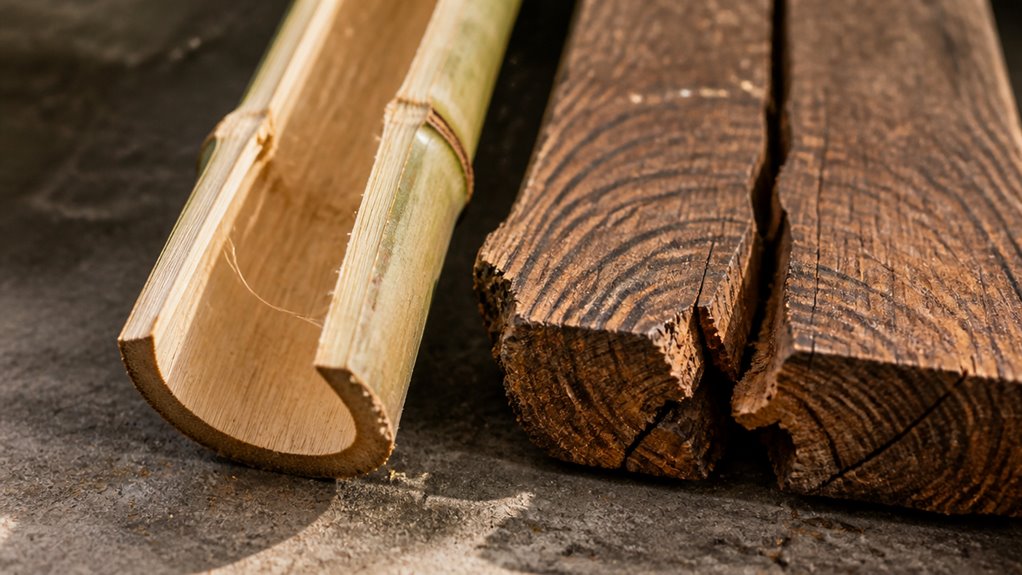
You’ll notice that bamboo features a hollow culm with a dense, fiber-rich outer wall, unlike wood’s more uniform cellular structure.
This outer fiber bundle concentration provides bamboo with exceptional axial strength, especially in tension and bending.
You must consider that bamboo’s strength varies appreciably from the outer layers to the inner core due to fiber density gradients.
Also, bamboo’s node structures act as natural reinforcement points, enhancing flexural performance.
Unlike wood, which distributes strength more evenly, bamboo’s mechanical properties depend heavily on culm location and orientation relative to the grain.
When selecting materials, you’ll want to factor in these structural distinctions to optimize bamboo’s unique strength advantages.
However, when working with wood materials, it is important to consider potential health risks such as skin and respiratory irritation caused by compounds found in certain hardwoods like purpleheart.
Is Bamboo Stronger Than Wood in Tensile Strength?
How does bamboo compare to wood when it comes to tensile strength? Bamboo typically exhibits tensile strength values ranging from 100 to 800 MPa, markedly higher than common construction woods, which average around 50 to 100 MPa.
This difference stems from bamboo’s dense fiber bundles concentrated near the outer culm, enhancing axial load capacity. When analyzing tensile properties, consider:
Bamboo can exhibit roughly twice the tensile strength of many woods.
Outer bamboo layers possess higher fiber density and strength than inner layers.
Tensile strength varies by species, age, and moisture content.
Bamboo’s tensile capacity supports its use as a structural material.
Wood’s tensile strength is more uniform but generally lower in magnitude.
Your choice between bamboo and wood should factor in these tensile characteristics for structural applications.
Additionally, many woods like hackberry offer moderate strength suitable for indoor, moderate-stress applications but are generally weaker than bamboo.
Bamboo vs. Wood: Compression and Bending Strengths
When evaluating compression and bending strengths, bamboo often outperforms many common woods. It exhibits compressive strength values typically ranging from 20 to 65 MPa, with some engineered bamboo products reaching even higher.
Bamboo’s compressive strength can exceed that of softwoods like Douglas fir by about 20%, making it a competitive option for axial loads. In bending, bamboo’s modulus of rupture often falls between 50 and 250 MPa, reflecting its strong flexural capacity.
Its unique node structure and dense outer fibers contribute markedly to this performance. Laminated bamboo products further enhance bending stiffness and strength, sometimes matching or surpassing traditional wood-based structural materials.
Keep in mind, bamboo’s hollow culm and fiber orientation optimize axial compression and bending resistance. However, results vary with species and treatment.
For outdoor applications, choosing materials with excellent dimensional stability is crucial to resist warping and cracking under changing weather conditions.
Why Bamboo’s Strength Varies by Species and Culm Part?
Bamboo strength really varies from one species to another, and that’s mainly because of differences in fiber density and the structure of the culm.
It’s interesting to note that the outer culm tends to be much stronger. This is largely due to its denser fiber arrangement when compared to the inner layers.
So, if you’re considering bamboo for any structural applications, it’s important to keep these variations in mind.
Understanding how each species and part of the culm contributes to overall strength can really help you make the best choice for your project!
When selecting materials for outdoor use, considering durability and species is crucial to ensure long-lasting performance.
Species Influence On Strength
Species variation markedly influences bamboo’s mechanical strength, affecting both tensile and compressive properties.
When you analyze different bamboo species, you’ll find significant disparities in fiber density, wall thickness, and cell structure, which directly impact strength metrics.
For example, Moso bamboo often exhibits higher tensile strength than Guadua due to its denser fiber arrangement.
These species-specific traits affect how bamboo performs under load and influence its suitability for structural applications.
Fiber density varies by species, altering tensile strength.
Wall thickness differences impact compressive capacity.
Cellular composition influences stiffness and durability.
Species growth conditions affect moisture content and strength.
Age-related changes differ among species, modifying mechanical properties.
Understanding the species you work with lets you optimize bamboo’s structural potential accurately.
Similar to bamboo, wood species like Douglas Fir and Southern Yellow Pine show distinct differences in dimensional stability and strength that influence their best structural uses.
Outer Versus Inner Culm
Building on how species affect bamboo’s strength, understanding the variation within a single culm is equally important.
You’ll find that the outer culm layers exhibit markedly higher tensile and compressive strength than the inner layers due to denser fiber bundles concentrated near the surface.
This fiber density gradient means the outer wall can reach tensile strengths up to 800 MPa, while inner sections often fall well below that.
When you select bamboo for structural use, prioritizing outer culm material maximizes strength-to-weight performance.
The hollow, grass-based anatomy of bamboo creates this sharp contrast, unlike wood’s more uniform cellular distribution.
Recognizing these internal differences helps you predict and optimize bamboo’s mechanical behavior, ensuring you leverage its superior axial strength where it counts most in construction or product design.
However, when working with any wood-based material, it is important to take proper safety measures to avoid health risks and environmental harm.
How Bamboo’s Density and Weight Affect Its Strength-to-Weight Ratio?
A material’s density and weight play crucial roles in determining its strength-to-weight ratio, a key metric for structural applications. Bamboo’s relatively high density, especially in the outer culm, contributes to its impressive strength without excessive weight. This balance enhances its load-bearing efficiency compared to many woods.
Consider these factors:
Bamboo often has a higher density than softwoods but maintains a superior strength-to-weight ratio.
The dense fiber arrangement near the outer culm increases strength per unit mass.
Despite being heavier than some woods, bamboo’s structural performance justifies the weight.
Strength-to-weight ratio reflects not just absolute strength but how efficiently a material carries loads relative to its mass.
This ratio is critical in lightweight construction where minimizing weight while maximizing strength matters.
Thus, bamboo’s density and weight synergize to deliver exceptional strength efficiency.
Similarly, hardwoods like Purpleheart and Walnut provide varying balances of hardness, density, and workability, illustrating the diverse options in wood materials for strength and durability.
When to Use Bamboo Instead of Wood for Building Projects?
You should definitely consider choosing bamboo over wood when you need something lightweight yet strong, especially for those projects where tensile strength really matters. Bamboo has an incredible strength-to-weight ratio, which means it’s super effective in tension and bending. This makes it a fantastic choice for things like scaffolding, trusses, and modular components.
But it’s not just about picking bamboo because it looks good. You also need to think about some important factors. Things like the species of bamboo, its moisture content, the direction of the load, and how it’s treated can all play a big role in making sure your structure performs at its best. So, keep those in mind when you’re making your material selection!
Advantages Of Bamboo
Frequently chosen for its exceptional strength-to-weight ratio, bamboo offers distinct advantages over wood in construction projects that demand lightweight yet durable materials.
You’ll find bamboo beneficial when you need a material with superior tensile strength and comparable or better compressive and flexural properties.
Its hollow, fiber-dense culm structure provides excellent axial strength.
The outer layer’s fiber density enhances durability without adding excessive weight.
Bamboo’s rapid growth and renewability also make it a sustainable choice.
- Higher strength-to-weight ratio than many woods
- Superior tensile strength, often twice that of common woods
- Comparable or improved compressive and flexural strength
- Lightweight, facilitating easier handling and faster assembly
- Renewable and eco-friendly with faster growth cycles than timber
- For outdoor applications, materials with penetrating finishes can help maintain durability and resist moisture, enhancing bamboo’s longevity when used externally.
Ideal Project Applications
Often chosen for projects demanding high tensile strength and lightweight materials, bamboo excels where these attributes outweigh the more uniform structural properties of wood.
You should consider bamboo for tensile load-bearing elements like trusses, tension cables, and lightweight frameworks, taking advantage of its superior strength-to-weight ratio.
Bamboo’s flexural strength and bending resistance make it ideal for curved structures or laminated panels.
However, when uniform compression or dimensional stability is critical, wood may perform better.
Bamboo also suits temporary or modular constructions due to its rapid growth and renewability.
You’ll find bamboo advantageous in seismic zones, where flexibility and energy absorption matter.
Additionally, using pressure-treated wood or metal posts can enhance the durability of bamboo frameworks in outdoor projects.
Material Selection Factors
When selecting materials for building projects, understanding the specific mechanical and environmental demands is essential to determine whether bamboo offers advantages over wood.
You should consider bamboo when tensile strength is critical or when you need a high strength-to-weight ratio.
Bamboo suits applications requiring flexibility and bending resistance.
It’s also a good choice if you want sustainable, fast-renewable materials.
However, assess species, moisture content, and load direction carefully, as these factors affect performance markedly.
- Projects demanding high tensile strength
- Lightweight structural elements
- Flexible or curved components
- Sustainable and rapid-growth material needs
- Situations where compression loads are moderate
Additionally, protecting outdoor wood structures like pergolas requires UV resistance and waterproofing to ensure long-lasting durability.
Frequently Asked Questions
How Does Bamboo’s Environmental Impact Compare to Wood?
You’ll find bamboo’s environmental impact generally lower than wood’s due to its rapid growth rate and renewability.
Bamboo sequesters carbon efficiently and requires less water and pesticides.
However, harvesting methods and transportation can affect its footprint.
Wood often comes from slower-growing trees, making it less renewable short-term but sometimes sourced sustainably.
So, bamboo typically offers a more eco-friendly option if managed responsibly.
However, you should assess supply chain specifics.
What Treatments Improve Bamboo’s Durability Against Pests?
To improve bamboo’s durability against pests, you should apply treatments like borate preservatives. These penetrate fibers and resist insect attack and fungal decay.
Heat treatment and smoke curing reduce moisture and increase resistance. Chemical treatments such as copper-based solutions provide long-term protection.
Proper drying and surface sealing also help prevent infestation. Combining these methods optimizes bamboo’s lifespan and structural integrity in pest-prone environments.
Can Bamboo Be Recycled Like Wood Products?
You can recycle bamboo similarly to wood products, but with some distinctions.
Bamboo’s high tensile strength, up to 800 MPa, allows it to be repurposed efficiently in composite materials or flooring.
However, its hollow, fibrous structure requires specialized processing to separate fibers without damage.
Unlike wood, bamboo recycling often involves mechanical or chemical treatments to maintain performance.
How Long Does Bamboo Last in Outdoor Construction?
You can expect bamboo used in outdoor construction to last between 5 to 15 years, depending on treatment and environmental exposure.
Properly treated bamboo resists moisture, insects, and UV damage, extending its lifespan markedly.
Without treatment, it degrades faster due to fungal attack and pests.
Regular maintenance, such as sealing and avoiding direct ground contact, further improves durability.
What Are Common Bamboo Construction Standards or Codes?
You’ll find that common bamboo construction standards include ISO 22156 for structural bamboo, which specifies requirements for processing and grading.
In some countries, like Colombia and India, national codes regulate bamboo’s use in buildings, emphasizing treatment, durability, and structural performance.
Additionally, organizations like ASTM are developing bamboo-related standards.
Always make certain your bamboo complies with local building codes, as these address safety, load capacities, and treatment methods critical for reliable construction.
How Bamboo and Wood Compare in Structural Performance?
Think of bamboo and wood as two athletes in a strength contest.
Bamboo, with its hollow yet fibrous structure, often outpaces wood in tensile strength and flexibility, much like a sprinter with endurance.
However, wood’s solid mass can outperform bamboo in compression.
Your choice depends on the event: lightweight agility or solid force.
Understanding their unique traits helps you pick the right material, ensuring your project stands strong, balanced, and optimized for its purpose.