Rasp Plane vs Block Plane: Which Should You Choose?
You’ll want a rasp plane when you need fast, aggressive material removal, especially on curves and irregular shapes. It leaves a rough surface needing sanding.
A block plane excels at fine trimming, end-grain work, and producing smooth finishes with minimal cleanup. It’s ideal for precise fitting and chamfering.
Use the rasp for shaping and the block plane for detail and final smoothing. Keep going to uncover the key differences and best uses for each tool.

- Excellent Craftsmanship and Materials: The rasp plane main body is made of die-cast zinc alloy…
- Efficient Professional Tool: The saw teeth are dense and all have a small opening, when planing wood…
- Replaceable Blade & Firm Connection: JORGENSEN surform plane is firmly connected front to back…
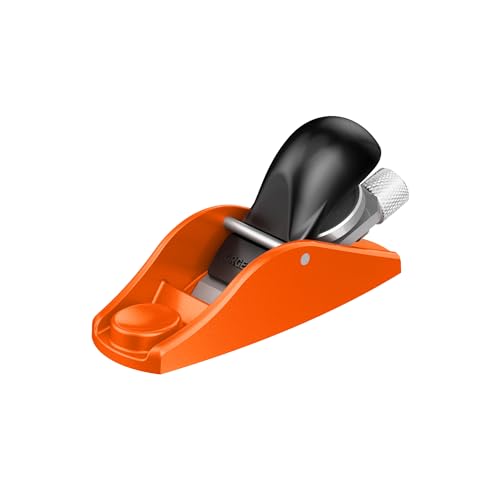
- Professional Level Blade: The blade is made of professional level O1 tool steel, improving cutting…
- Advanced Materials: The body is made of ductile iron to withstand heavy-duty use and is drop-tested…
- Adjustable Design: The cutting depth of this mini wood planer is adjustable, just turn the knob, you…
Key Takeaways
- Rasp planes use a toothed abrasive surface for aggressive, rapid material removal, ideal for shaping curves and rough contours.
- Block planes have a low-angle bevel-up blade that shaves thin wood curls, producing smooth surfaces with minimal sanding.
- Rasp planes leave a coarse finish requiring sanding, while block planes create cleaner edges ready for finishing.
- Rasp planes excel at rough shaping and curved surfaces; block planes are best for fine trimming and end-grain work.
- Use rasp planes first for shaping and block planes afterward for precise trimming and final smoothing.
What Is a Rasp Plane?

When you need to shape wood quickly, a rasp plane comes into play as a specialized tool designed for aggressive material removal.
Unlike a block plane that shaves thin wood chips, a rasp plane uses a toothed or perforated surface to abrade the wood.
This makes it ideal for rapid stock removal, especially on curves, edges, and small, irregular parts.
You’ll find it particularly effective for shaping rounded profiles and refining contours where precision isn’t the immediate goal.
The rasp plane’s coarse cutting action leaves a rough surface that usually requires sanding afterward.
Use it primarily for pre-sanding shaping and removing high spots rather than fine trimming or finish work.
Its strength lies in shaping rather than smoothing, making it essential for rough shaping tasks before you switch to finer tools.
For optimal use, ensure the tool is properly maintained and cleaned regularly to prevent rust and prolong its effectiveness, as described in Maintenance and Sharpening.
What Is a Block Plane?
A block plane is a handy tool you’ll find yourself reaching for quite often. It’s great for trimming end grain, chamfering edges, and doing those little touch-up tasks that make a big difference.
What makes it special is its low-angle, bevel-up blade design. This allows you to shave off thin, precise curls of wood, giving you a beautifully smooth surface finish. Whether you’re fitting joinery or just breaking sharp corners, this tool really shines when you need clean, accurate cuts. So, if you’re looking to elevate your woodworking game, a block plane is definitely worth having in your toolkit! Using proper safety tools like a push stick when working with similar woodworking equipment helps ensure precise control and reduces the risk of injury.
Purpose and Uses
A block plane serves as an essential woodworking tool designed primarily for trimming end grain, fine-tuning joints, and performing delicate touch-up work.
You’ll rely on it to chamfer edges, break sharp corners, and clean glue lines with precision. Its compact size makes it ideal for fitting doors, drawers, miters, and other joinery where tight tolerances matter.
Unlike coarser tools, the block plane shaves thin wood chips to leave a smooth, clean surface that requires minimal sanding.
You’ll often use it for final fitting tasks and finishing small parts, especially where visible surfaces demand crisp edges and a refined look.
Its versatility and control make it indispensable for detail work that calls for accuracy over rapid material removal.
Many block planes feature adjustable cutting depth to provide precise control over shaving thickness, enhancing accuracy in woodworking tasks.
Blade Design Features
Mastering the block plane’s effectiveness starts with understanding its blade design features.
You’ll find the blade set bevel-up, typically at a low bedding angle, allowing precise control and efficient cutting, especially on end grain. This design reduces the cutting angle, producing thin, clean shavings for a smooth finish.
The blade’s sharpness and angle are essential for minimal tear-out and fine trimming.
| Feature | Description |
|---|---|
| Blade Orientation | Bevel-up, low bedding angle |
| Cutting Angle | Typically 12° to 20° effective on end grain |
| Blade Thickness | Thin for delicate, precise cuts |
| Sharpening Ease | Straight bevel allows easy honing |
Ensuring proper blade sharpness is critical for safety and achieving the best results with a block plane.
This configuration makes block planes ideal for fine, detailed woodworking tasks.
Key Differences Between Rasp and Block Planes
Although both rasp and block planes shape wood, their fundamental differences lie in cutting action, surface finish, and typical applications.
Rasp planes use a toothed, abrasive surface to remove material aggressively. This makes them ideal for rough shaping, curves, and rapid stock removal.
Rasp planes feature a toothed surface perfect for aggressive material removal and shaping curves quickly.
In contrast, block planes employ a sharp, bevel-up blade that shaves thin wood chips. This delivers a smoother, more precise finish suited for end grain, chamfers, and fine trimming.
When using a rasp plane, expect a coarse surface that usually requires sanding afterward. A block plane produces cleaner edges and flush joints ready for finishing.
Choosing between them depends on whether you need quick shaping or detailed, accurate work. Each tool excels in distinct woodworking tasks.
For those interested, understanding tool maintenance and safety can greatly enhance the effectiveness and longevity of both rasp and block planes.
When to Choose a Rasp Plane?
You’ll want to grab a rasp plane when you need to remove material quickly. It’s especially handy for those uneven or curved surfaces that can be tricky to work with.
What’s great about its toothed blade is that it really shines when it comes to shaping contours that a block plane just can’t tackle efficiently.
For optimal shaping, start with coarse rasps for quick removal and then refine with finer files or sanding blocks to achieve a smooth finish suitable for contoured edges.
Rapid Material Removal
When you need to remove material quickly and shape wood aggressively, reach for a rasp plane. Its toothed surface abrades wood rapidly, allowing you to remove high spots and excess stock efficiently.
Unlike a block plane, which shaves thin, precise curls, a rasp plane excels at coarse shaping where speed matters more than fine finish. Use it to rough out profiles or adjust small, irregular parts before sanding.
This tool handles shaping tasks that would take much longer with a block plane’s sharp blade. Keep in mind, the rasp leaves a rough surface requiring further smoothing, so it’s best employed early in your workflow.
For rapid material removal where shaping takes priority over surface quality, a rasp plane is the practical and effective choice. Using the appropriate cutting speed can further enhance control and performance when shaping wood.
Shaping Curved Surfaces
Because curved surfaces require gradual, controlled shaping, you’ll find a rasp plane invaluable for this task.
Its toothed surface removes material aggressively, allowing you to form rounded profiles and smooth progressions that a block plane’s shaving action can’t achieve efficiently.
When you’re working on complex contours or narrow spaces, the rasp plane adapts easily. It lets you refine shapes without risking tear-out or uneven cuts.
While it leaves a rougher finish, you can rely on sanding afterward to achieve smoothness.
Use the rasp plane for initial shaping and shaping curves, especially when the priority is creating the correct form rather than a clean surface.
This approach saves time and effort before you switch to a block plane for precise trimming and final smoothing.
Regular maintenance, including cleaning and lubrication, ensures optimal tool performance and longevity.
When to Choose a Block Plane?
A block plane excels at fine trimming tasks where precision and a smooth finish are essential.
You’ll want to choose a block plane when working on end grain, as its low-angle blade slices cleanly without tearing fibers.
It’s ideal for chamfering edges, breaking sharp corners, and cleaning glue lines where accuracy matters.
When fitting doors, drawers, or joinery, the block plane lets you fine-tune dimensions to tight tolerances.
Its compact size makes it perfect for touch-up work on small parts and flush-trimming joints.
Avoid it for heavy shaping; use it after rough shaping to refine surfaces and edges.
Selecting a block plane guarantees you get a crisp, smooth finish on visible surfaces and joints, providing professional results in your woodworking projects.
For optimal results, ensure the blade is properly sharpened and the mouth is adjusted for fine, precise shavings.
Surface Finish: Rasp vs. Block Planes
You’ll often notice a distinct difference in surface finish between rasp planes and block planes.
When you use a block plane, the sharp bevel-up blade slices thin wood shavings, leaving a smooth, clean surface ideal for fine fitting and end-grain trimming. The surface is precise and ready for finishing without much additional work.
In contrast, a rasp plane removes material aggressively through its toothed surface, creating a rougher, coarser texture. This texture requires subsequent sanding to achieve a smooth finish.
You’ll find rasp planes excel at rapid shaping but don’t provide the refined surface block planes do. So, if surface quality matters immediately, rely on a block plane. If shaping speed is your priority, a rasp plane’s rough finish is a necessary trade-off.
For the best final results, pairing a block plane with an ergonomic sanding block designed for fine finishing can significantly enhance surface smoothness and reduce hand fatigue during sanding. ergonomic sanding block
Advantages of Rasp Planes for Shaping Curves
You know, a rasp plane really shines when it comes to removing material quickly. It’s super efficient for shaping curves, which is a big plus.
With its toothed surface, you get enhanced control, especially when you’re tackling those complex, rounded profiles.
And let’s be honest, when your project calls for precise contouring on intricate shapes, having a rasp plane in your toolkit is essential. It makes the whole process a lot smoother!
Efficient Material Removal
Harnessing the aggressive cutting action of rasp planes lets you remove material quickly and shape complex curves with ease.
Unlike block planes, rasp planes use toothed surfaces that abrade wood rather than shaving it, which accelerates stock removal.
This makes rasp planes ideal for rough shaping before finer tools take over.
You’ll find they excel on tight curves and irregular profiles where precision is secondary to speed.
| Feature | Rasp Plane Benefit |
|---|---|
| Cutting action | Aggressive material removal |
| Surface finish | Rough, requires sanding |
| Curve shaping | Handles complex curves easily |
| Work speed | Faster than block planes |
Use rasp planes when you need rapid, coarse shaping, saving time in early project stages.
Enhanced Curve Control
Although block planes excel at fine trimming and smoothing, rasp planes offer superior control when shaping curves.
Their abrasive teeth let you sculpt wood rapidly while maintaining precise contouring, especially on complex curves.
Here’s why rasp planes enhance curve control:
- They conform better to irregular shapes, allowing consistent material removal along curves.
- Their aggressive cutting action helps you shape tight radii without skidding or chatter.
- You can easily adjust pressure and angle to refine curves incrementally.
- Their design enables better access to concave and convex surfaces compared to flat block planes.
Ideal For Complex Shapes
When shaping complex curves and irregular profiles, rasp planes offer distinct advantages that make them indispensable. Their coarse, toothed surface quickly removes excess material, allowing you to sculpt intricate contours with control.
Unlike block planes, which excel at fine trimming, rasp planes handle aggressive shaping without binding. This makes them ideal for rounded edges and narrow spaces where precision shaping beats smooth finish.
| Feature | Benefit |
|---|---|
| Coarse toothed surface | Rapid material removal on curves |
| Compact design | Access to tight, irregular spaces |
| Aggressive shaping | Efficient high spot and excess removal |
| Versatility | Suitable for pre-sanding shaping work |
Using a rasp plane lets you shape complex profiles efficiently before refining with finer tools.
Advantages of Block Planes for End Grain
Block planes excel at slicing through end grain cleanly and efficiently, making them an essential tool for precise woodworking tasks. When you work with end grain, a low-angle block plane reduces tear-out and produces a smooth, clean surface that’s ready for finishing.
Here are key advantages you’ll appreciate:
- Reduced Tear-Out: The low cutting angle slices fibers cleanly, preventing splintering on end grain.
- Precision Control: Its compact size and sharp blade let you trim to exact tolerances.
- Smooth Finish: Unlike rasp planes, block planes leave minimal surface roughness, reducing sanding time.
- Versatile Use: Beyond end grain, you can perform chamfering and joint fit adjustments efficiently.
Using Rasp and Block Planes Together
Since shaping and finishing require different approaches, using rasp and block planes together lets you combine their strengths effectively.
Start with the rasp plane to remove excess material quickly and define curves or contours roughly. Its coarse teeth excel at shaping edges and smoothing uneven surfaces, especially on complex or small parts.
Once you achieve the desired profile, switch to the block plane for precision trimming and fine finishing. The block plane’s sharp blade shaves thin curls, producing a smooth surface suitable for fitting joints, chamfers, or end grain work.
Using both tools in sequence streamlines your workflow. The rasp plane handles aggressive stock removal and shaping, while the block plane refines the shape and cleans the surface for a crisp, professional finish.
This combination maximizes efficiency and accuracy in woodworking.
Tips for Choosing the Right Plane
Mastering the use of both rasp and block planes means understanding which tool fits each stage of your project. To choose the right plane, consider the following:
Mastering rasp and block planes means knowing the right tool for every project stage.
- Use a rasp plane for rapid material removal and shaping curves or contours where surface smoothness is less critical.
- Opt for a block plane when working on end grain, fine trimming, chamfering edges, or fitting joints where precision and a smooth finish matter.
- Select a low-angle block plane specifically for slicing end grain cleanly and reducing tear-out.
- Sequence your work by starting with a rasp plane for rough shaping, then switch to a block plane for refining and final smoothing.
Frequently Asked Questions
How Do I Maintain and Sharpen a Rasp Plane?
To maintain and sharpen your rasp plane, first clean it thoroughly after use to prevent clogging. Use a wire brush or file to remove debris from the teeth.
When sharpening, employ a small, fine triangular file to gently re-cut each tooth’s edge, maintaining the original tooth pattern. Avoid over-filing, which can dull its aggressiveness.
Regular cleaning and careful sharpening keep your rasp plane effective for quick, precise shaping tasks.
Can a Block Plane Be Used on Metal or Plastic Materials?
You can use a block plane on some plastics, especially softer types like acrylic or PVC. It requires a very sharp blade and careful control to avoid chipping or melting.
However, block planes aren’t suitable for metal. The blade and design aren’t made for cutting metals and will dull quickly or get damaged. For metal, you should use tools specifically designed for metalworking, like files or metal planes.
What Safety Precautions Should I Take When Using These Planes?
Measure twice, cut once. Always inspect your plane blades before use to make sure they’re sharp and secure.
Wear safety glasses to protect your eyes from wood chips. Keep your hands clear of the cutting path and use firm, controlled strokes to avoid slips.
Work on a stable surface and clamp your workpiece securely. After use, retract or cover blades to prevent accidental cuts.
Maintain a clean workspace to reduce hazards.
Are There Specific Brands Known for High-Quality Rasp or Block Planes?
You’ll find Lie-Nielsen and Veritas are top-tier brands for block planes, offering precision and durability.
For rasp planes, Nicholson and Stanley are well-regarded for their aggressive, reliable shaping tools.
These brands use quality steel and ergonomic designs, ensuring consistent performance.
When selecting, consider your specific needs: choose Lie-Nielsen or Veritas for fine trimming and fitting, and Nicholson or Stanley if you want efficient material removal on curves and contours.
How Do Plane Blade Angles Affect Cutting Performance?
Blade angles directly impact cutting efficiency and finish quality. A lower blade angle reduces the cutting bevel, allowing you to slice end grain cleaner and with less tear-out.
Higher angles produce more aggressive cuts, better for hardwoods but risk rougher surfaces. Adjusting the angle helps you balance smoothness and material removal speed.
For precise, fine work, you’ll want a lower-angle blade. For rapid shaping, a steeper angle works best.
- Excellent Craftsmanship and Materials: The rasp plane main body is made of die-cast zinc alloy…
- Efficient Professional Tool: The saw teeth are dense and all have a small opening, when planing wood…
- Replaceable Blade & Firm Connection: JORGENSEN surform plane is firmly connected front to back…
- Professional Level Blade: The blade is made of professional level O1 tool steel, improving cutting…
- Advanced Materials: The body is made of ductile iron to withstand heavy-duty use and is drop-tested…
- Adjustable Design: The cutting depth of this mini wood planer is adjustable, just turn the knob, you…
Final Thoughts on Choosing Between Rasp and Block Planes
When deciding between a rasp plane and a block plane, remember each excels in different tasks. Rasp planes shape curves efficiently, while block planes handle end grain with precision.
You might think one tool could replace the other, but their unique designs serve distinct purposes. Using them together guarantees best results.
Choose based on your project’s demands, and you’ll achieve cleaner, more accurate work every time, avoiding frustration from using the wrong plane.
Last update on 2026-11-11 / Affiliate links / Images from Amazon Product Advertising API