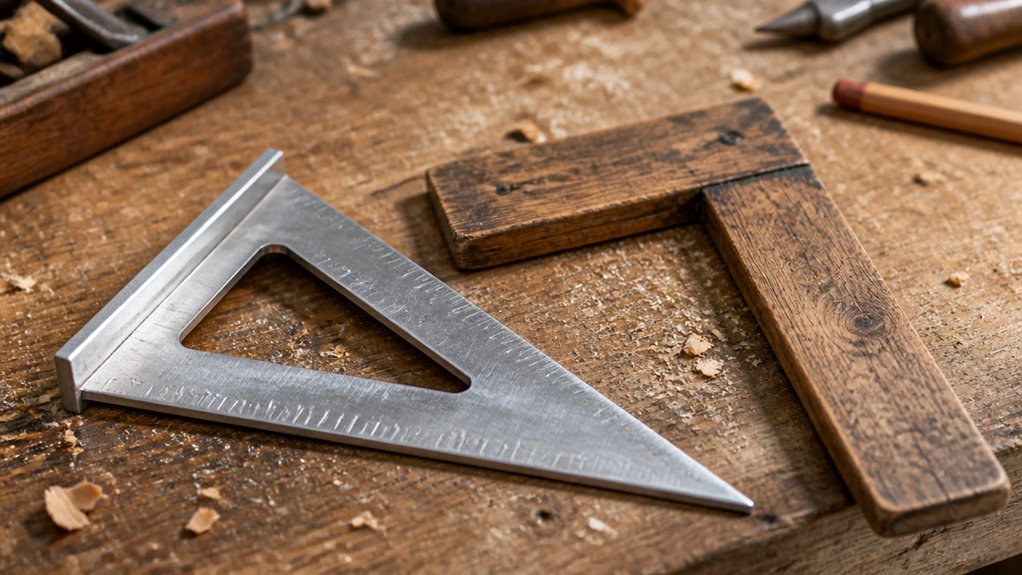
Speed Square vs Rafter Square: Key Differences Explained
You’ll find a speed square is compact and ideal for quick 90° and 45° angle markings on smaller lumber.
This makes it perfect for fast, repetitive tasks. A rafter square is larger, offering longer edges for precise layout on wide boards and complex framing jobs.
The speed square fits in your pocket for portability. Meanwhile, the rafter square provides greater accuracy and stability over big cuts.
Understanding these differences helps you pick the right tool for your project needs.
Key Takeaways
- Speed squares are compact (around 7 inches), portable tools ideal for quick 90° and 45° angle markings on smaller lumber.
- Rafter squares are larger (about 12 inches), providing extended edges for marking wide lumber and long, precise cuts.
- Speed squares feature built-in degree and pitch scales for roof and stair layout, but rafter squares offer greater stability on big projects.
- Portability favors speed squares for everyday, repetitive tasks, while rafter squares suit framing and complex roof layouts requiring accuracy.
- Choosing between them depends on project size, precision needs, and trade-offs between convenience and extended measurement capability.
Speed Square vs Rafter Square: Side-by-Side Comparison
| Feature | Speed Square | Rafter Square |
|---|---|---|
| Main Purpose | Quick angle marking and everyday carpentry layouts | Larger framing layouts and longer, precise markings |
| Tool Type | Triangular carpentry layout tool | Larger triangular or framing-style square |
| Typical Size | Around 7 inches | Around 12 inches or more |
| Shape | Compact triangular design | Larger triangular design |
| 90-Degree Marking | Yes | Yes |
| 45-Degree Marking | Yes | Yes |
| Angle Measurement | Built-in pivot point works like a protractor | Often includes similar angle-measuring features |
| Degree Scale | Built-in degree scale | May include degree scale |
| Roof Pitch Scale | Helps with roof and rafter layouts | Often includes roof pitch markings |
| Scribing Notches | Allows quick, repetitive line marking | Often includes scribing notches |
| Edge Flange | Holds the square against the board edge | Provides similar edge alignment on models with a flange |
| Material | Aluminum, steel, or high-impact plastic | Often made from heavier metals |
| Durability | Metal versions resist wear and job-site damage; plastic versions are less durable | Heavier metal construction offers durability for demanding framing work |
| Portability | Lightweight and pocket-friendly | Larger and heavier, usually carried in a tool bag |
| Everyday Use | Excellent for frequent, repetitive tasks | Less convenient for quick everyday carrying |
| Small Lumber | Ideal for studs, narrow boards, and smaller materials | Can be used, but its larger size may be unnecessary |
| Wide Lumber | Limited by its shorter edge | Better reach and stability on wide boards |
| Long Cut Marking | May require repositioning several times | Longer edge supports continuous marking |
| Saw Guide | Useful for guiding circular saws during crosscuts | Longer edge can help with extended layout and cutting tasks |
| Roofing Applications | Suitable for quick roof pitch and angle markings | Better suited to larger and more complex roof layouts |
| Framing Applications | Works well for smaller framing tasks | More practical for extensive framing and wide stock |
| DIY Projects | Excellent for quick home repairs and small woodworking projects | Better for larger carpentry and construction projects |
| Accuracy | Accurate for smaller materials and quick layouts | Greater stability and accuracy on wide stock |
| Main Advantage | Compact size, portability, and fast angle marking | Longer edges, greater stability, and extended measuring capability |
| Main Limitation | Shorter edge limits its usefulness on wide lumber | Bulkier, heavier, and less portable |
What Is a Speed Square vs a Rafter Square?

When you hear the terms speed square and rafter square, you might assume they refer to two different tools, but they’re often used interchangeably. Both names describe a triangular carpentry layout tool designed for marking 90-degree and 45-degree angles.
The term “speed square” usually refers to the branded, pocket-sized version developed in 1925, favored for quick measurements and saw guides. Meanwhile, “rafter square” can be a generic label for the same tool or sometimes for larger, framing-style squares.
This overlap creates confusion, but fundamentally, they share the same purpose: assisting with layout tasks like squaring lumber and marking cuts, especially in roof framing. Whether called a speed square or rafter square, you’re working with a versatile, essential carpenter’s measuring tool.
Modern speed squares often feature enhancements like laser-etched markings for improved precision and durability on job sites.
Key Features of Speed and Rafter Squares
Although speed squares and rafter squares look similar, their key features make them invaluable for different tasks.
Speed squares and rafter squares may appear alike, but each is designed for unique, essential tasks.
You’ll find a speed square with a 90-degree corner and a 45-degree edge that lets you mark angles quickly. Its pivot point works like a built-in protractor, helping you measure and mark precise angles effortlessly.
Degree and roof pitch scales simplify layout work, especially for rafters. Notches let you scribe repeated lines fast. The flange holds the square firmly against the board edge for accuracy.
Rafter squares often share these features but come larger, better suited for wide lumber and longer marks. While the speed square excels in portability and quick jobs, the rafter square’s size makes it practical for more extensive framing and roofing tasks.
Using tools like featherboards can enhance safety and precision when making cuts guided by these squares, by maintaining consistent pressure and preventing kickback during cutting. This highlights the importance of workpiece stability in woodworking.
Speed vs Rafter Square Size Differences
Because size directly affects usability, understanding the differences between speed squares and rafter squares is key to choosing the right tool for your project.
Speed squares are typically compact, around 7 inches, making them easy to carry in your pocket. They’re perfect for quick, everyday tasks like marking studs or guiding saw cuts.
Rafter squares, on the other hand, are larger, often about 12 inches, and heavier. They’re better suited for framing wide stock or longer layout marks.
This size difference influences portability and the scope of work you can tackle. If you need precision on smaller materials or quick layouts, a speed square fits the bill.
For bigger projects requiring longer measurements, a larger rafter square provides more surface area and stability, making your job easier and more accurate.
Choosing tools with the right material quality can significantly enhance durability and performance in woodworking tasks.
Angle Marking and Layout Uses for Speed and Rafter Squares
Since accurate angle marking is essential in carpentry, you’ll find both speed squares and rafter squares indispensable for layout tasks.
Accurate angle marking is crucial in carpentry, making speed and rafter squares essential for precise layouts.
The speed square’s 90-degree corner and 45-degree edge let you quickly mark right and common angles. Its pivot point acts like a protractor, so you can scribe precise angles, roof pitches, and stair layouts with ease.
You’ll use these tools to square lumber, mark cut lines, and guide saws efficiently. While the compact speed square excels in quick, repetitive markings and crosscuts, a larger rafter square gives you longer edges for wide stock and framing layouts.
Both tools have scribing notches to speed up repetitive lines, but you’ll pick the size based on your project’s scale and the surface you’re working on.
For enhanced precision and safety during cuts, using a crosscut sled as a stable platform can complement these layout tools effectively.
Materials and Durability of Speed and Rafter Squares
You rely on speed and rafter squares not only for accuracy but also for how well they hold up under regular use.
Most speed squares are made from aluminum or steel, offering a strong, rust-resistant surface that stands up to rough job site conditions.
Some models use high-impact plastic, which is lighter but less durable.
Rafter squares, often larger, tend to be crafted from heavier metals, providing extra durability for framing and roofing tasks where more force is applied.
The material choice affects not only longevity but also weight and resistance to bending.
With proper care, a metal speed or rafter square resists warping and maintains precise edges, ensuring consistent measurements over time.
Plastic versions may wear faster but can still serve well for light to moderate use.
Choosing tools with durable blade materials like carbide-tipped or high-speed steel can significantly enhance the longevity of your equipment.
Portability Differences Between Speed and Rafter Squares
When choosing between a speed square and a rafter square, portability often comes down to size and weight.
The speed square is compact, typically around 7 inches, making it easy to slip into your pocket or tool belt. In contrast, the larger rafter square, often 12 inches or more, demands more carrying space and usually fits better in a tool bag.
Consider these portability factors:
- Speed squares are lightweight and pocket-friendly for quick jobs.
- Rafter squares are bulkier, better suited for wide or long stock.
- Carrying a speed square on your belt is convenient for frequent use.
- Rafter squares often require a dedicated spot in your toolkit due to size.
Your choice depends on how mobile and accessible you need the tool to be. Additionally, selecting the right tool for your project, much like choosing the appropriate hand plane type, can greatly enhance efficiency and results.
Which Tool Is Best for Roofing and Framing Projects?
Although both speed squares and rafter squares serve similar functions, the best choice for roofing and framing projects depends on the scale and specific demands of your work.
If you’re handling smaller jobs or need quick, repetitive measurements, a speed square’s compact size and built-in pitch scales make it ideal. It fits easily in your pocket and helps mark angles and cuts efficiently.
Perfect for small tasks, speed squares offer quick, accurate angle marking with convenient portability.
However, for larger framing tasks, especially with wide lumber or complex roof layouts, a bigger rafter square or framing square offers longer edges for more accurate, extended measurements.
These larger tools provide improved stability and versatility for big projects, but they’re less portable.
For precise cuts and measurements in roofing and framing, it’s essential to use tools that complement your miter saw setup and ensure safety during operation.
When to Use a Speed Square for Quick DIY Tasks?
Frequently, a speed square proves invaluable for quick DIY tasks thanks to its compact size and multifunctional design. You’ll find it especially handy when you need fast, accurate measurements without hauling out bulky tools.
Here are four practical situations to reach for your speed square:
- Marking precise 90-degree or 45-degree angles on lumber for cutting.
- Guiding your circular saw for clean, straight crosscuts.
- Quickly scribing repeated lines using the built-in notches.
- Checking squareness on smaller projects where portability matters.
Its small size lets you carry it in your pocket, making it accessible whenever the job demands speed and accuracy. For everyday carpentry and simple framing, the speed square is your go-to tool. The Swanson S0101 model, made with die-cast aerospace-grade aluminum, offers durability and precision in a compact 7-inch size.
Why Size Matters for Cutting Large Lumber?
When you’re tackling large lumber, the size of your square really matters. The length of its edge plays a big role in how straight and accurate your cuts turn out.
Sure, a smaller speed square is super easy to carry around, but it mightn’t give you the control you need when working with wide stock. It’s kind of a trade-off, right? You want something that’s portable, but you also need that precision for layout and cutting. Additionally, working at the optimal table saw height can significantly improve your cutting accuracy and reduce fatigue during long projects.
Edge Length Impact
Because cutting large lumber requires accurate, long straight lines, the edge length of your square plays a crucial role in the quality and ease of your work.
A short edge can force you to make multiple measurements or marks, increasing errors and slowing your progress.
Larger squares provide a longer straight edge, making single-pass marking simpler and more precise. Consider these points when choosing your tool:
- Longer edges reduce the need for repositioning during layout.
- A bigger square supports marking across wide boards effortlessly.
- Extended edges help maintain consistent angles over long cuts.
- Smaller squares might cause more guesswork and misalignment on large lumber.
Choosing the right edge length guarantees cleaner, faster cuts and minimizes mistakes on big projects. Also, ensuring you measure and mark the long board accurately before cutting will improve your overall results.
Tool Portability Limitations
In handling large lumber, the size of your square directly affects how easily you can maneuver and mark your cuts. A smaller speed square fits comfortably in your pocket and lets you work quickly on studs or narrow boards, but it struggles with wide stock.
When you need to mark long, continuous lines, a compact square forces you to reposition repeatedly, slowing your workflow. Larger rafter squares provide extended edges that let you draw straight lines across wider boards without shifting the tool.
However, their size makes them less convenient to carry around, especially if you prefer minimal gear. Ultimately, you’ll weigh portability against practicality: smaller squares offer quick handling, but bigger squares handle large lumber marking tasks more efficiently without frequent adjustments.
Accuracy On Wide Stock
You’ll often find that using a larger square markedly improves accuracy on wide stock. When working with large lumber, size matters because a longer edge gives you better control and more reliable straight lines.
Here’s why a bigger square helps:
- It spans the full width, reducing guesswork and the need to reposition.
- The extended edge lets you mark longer cuts cleanly and consistently.
- A larger tool provides a stable reference, minimizing movement during layout.
- It improves visibility and precision, especially on wide boards or panels.
While a speed square is great for quick tasks, a larger rafter square or framing square is your best bet for wide stock. It guarantees your cuts stay accurate and your project fits perfectly.
Choosing the Right Square for Your Carpentry Needs
Selecting the right square for your carpentry work depends largely on the type of projects you tackle and the level of precision you need.
If you work mostly on small, quick layouts or need portability, a speed square fits perfectly. For larger framing or roofing jobs, a bigger rafter square or framing square offers better reach and accuracy on wide stock.
| Feature | Speed Square |
|---|---|
| Size | Compact (around 7″) |
| Best for | Quick layouts, portability |
| Material | Aluminum, steel, plastic |
| Limitation | Shorter edge length |
Choose based on your task size and how often you need precise angle markings. The right tool streamlines your work and improves accuracy.
Frequently Asked Questions
Can a Speed Square Be Used for Metalworking Projects?
Yes, you can use a speed square for metalworking projects, especially for marking right angles and 45-degree cuts on metal pieces.
Its durable metal or high-impact plastic build helps it withstand the demands of metal layout. Just be sure you’re working with clean, flat surfaces for accuracy.
Keep in mind its smaller size might limit marking larger metal sheets. For big projects, consider a larger square or framing tool.
How Do You Maintain and Clean a Speed Square or Rafter Square?
To maintain and clean your speed square or rafter square, wipe it down after each use with a dry cloth to remove dust and debris.
For stubborn dirt or resin, use mild soap and water, then dry it thoroughly to prevent rust.
Apply a light coat of machine oil on metal parts to avoid corrosion.
Store it in a dry place, preferably in a tool pouch or box, to keep it protected and ready to use.
Are There Digital or Electronic Versions of Speed Squares?
When it comes to digital speed squares, you won’t find many traditional electronic versions.
Some tools incorporate digital angle finders or laser guides to boost accuracy.
Think of it like adding a flashlight to a carpenter’s toolbox. It doesn’t replace the square but enhances your precision.
These hybrid tools help you measure and mark angles faster, especially in tricky layouts.
Can a Speed Square Replace a Combination Square?
No, a speed square can’t fully replace a combination square.
You’ll find the speed square great for quick 90-degree and 45-degree markings, roof pitches, and saw guides.
However, it lacks the adjustable ruler and level features of a combination square.
If you need precision measuring, marking inside angles, or checking depth, the combination square is more versatile.
Keep both tools handy for different tasks to work efficiently.
What Safety Tips Should Be Followed When Using These Squares?
Always secure your workpiece before marking or cutting to avoid slips.
Don’t rush; accurate placement of the square is vital for safe, clean cuts.
Keep your fingers clear when guiding saws along the square’s edge.
Inspect your square for damage or wear that could affect precision.
Finally, store your square properly to prevent warping or dents.
This ensures it stays reliable and safe for every project you tackle.
Choosing the Right Square for Your Project
When it comes to choosing between a speed square and a rafter square, don’t overcomplicate it. Grab the right tool or face endless frustration.
The speed square is your lightning-fast sidekick for quick, precise angles. The rafter square handles big, complex cuts like a pro.
Using the wrong one feels like wrestling a bear with your bare hands. Pick wisely, and your projects will practically build themselves.