How to Install Cabinet Doors? DIY Step-by-Step Guide
You’ll start by measuring and marking hinge positions precisely, usually 3 inches from the top and bottom. Drill pilot holes carefully to avoid splitting wood. Use the right tools for 35mm hinge cups if applicable.
Attach hinges to doors, mount plates on cabinets, and clip or screw hinges in place. Then fine-tune adjustments for vertical, horizontal, and depth alignment.
Master these steps, and you’ll guarantee smooth, flush cabinet doors. Keep going to explore detailed tips and troubleshooting.
Key Takeaways
- Measure and mark hinge positions precisely on doors and cabinet frames using jigs and templates for consistent alignment.
- Drill pilot holes carefully with appropriate bit sizes and depths to prevent wood splitting and ensure secure screw placement.
- Attach hinges to doors first, then mount plates on cabinet frames, maintaining proper overlay and reveal gaps.
- Position doors on frames, clip hinges onto mounting plates, and use adjustment screws to fine-tune vertical, horizontal, and depth alignment.
- Tighten all screws securely after adjustments and periodically check and re-tighten to maintain door fit and prevent sagging.
Tools and Materials Needed
Before you begin installing cabinet doors, gather all essential tools and materials to guarantee a smooth process. You’ll need power tools like a convertible powered screwdriver with an LED for tight spaces, a Makita 18V right angle impact driver, and a right angle drill to handle confined areas efficiently.
For precise trimming and adjustments, use a Grex 23ga pin nailer and an oscillating multi-tool. Secure components with clamps and jigs, such as a 90-degree corner clamp jig and a Cabinet Door Mounting Jig to support doors during drilling. The 90 Degree Corner Clamp Jig is especially useful for producing accurate 90 degree corners and holding pieces securely during assembly. Maintaining a clean, clutter-free workspace enhances focus and efficiency during installation.
Don’t forget hardware installation jigs for consistent knob and pull placement. Measure and mark accurately with tools like a Bosch 12V laser and centering punch. Stock screws, nails, dowel pins, and polyurethane glue for secure joints and sealing. Consider incorporating customizable height workstations to improve ergonomics and comfort throughout the installation process.
Measuring and Marking for Hinge Placement
When installing cabinet doors, accurately measuring and marking hinge placement is crucial to guarantee smooth operation and proper alignment.
Begin by drawing a straight reference line parallel to the hinge edge, then mark top and bottom hinge centers about 2–4 inches from edges. For doors with three hinges, position the middle hinge equidistant between top and bottom. It is also important to determine door overlay by measuring how much the door covers the cabinet frame to select the correct hinge type and ensure a proper fit. Incorporating adjustable features during installation can help achieve better cutting precision when fitting doors.
Use manufacturer specs or a template to set the horizontal cup center offset (Dimension C) to make certain proper door reveal and overlay. Double-check all marks vertically and horizontally to avoid cumulative error before drilling.
| Door Height (inches) | Hinge Count | Top/Bottom Offset (inches) |
|---|---|---|
| ≤ 36 | 2 | 2–3.5 |
| 36–60 | 3 | 2–3.5 |
| 60–84 | 4 | 2–3.5 |
Preparing and Drilling the Cabinet Doors
Although marking hinge placement sets the foundation, preparing and drilling your cabinet doors demands equal attention to detail to guarantee a professional fit.
Start by thoroughly cleaning your cabinet doors and face frames, removing grease and old hardware residue. Ensuring the surface is clean and dry helps the wood filler adhere properly if repairs are needed.
Confirm the cabinet assembly is secure and surfaces are level for consistent alignment.
Use a pencil and straightedge to mark hinge positions accurately, employing a hinge jig if available for uniformity.
Select the appropriate drill bit—1/16-inch for softwoods or 3/32-inch for hardwoods—and drill pilot holes at marked centers, limiting depth to ¼ inch to prevent wood splitting.
Filling any holes from previous hinges and applying finishes as needed ensures a clean surface and improves the final appearance.
Additionally, having your 35mm hinge holes drilled professionally can save time and guarantee compatibility with most soft-close hinges.
Finally, inspect door sizing and make certain all markings support proper hinge installation before proceeding.
Attaching Hinges and Mounting Doors
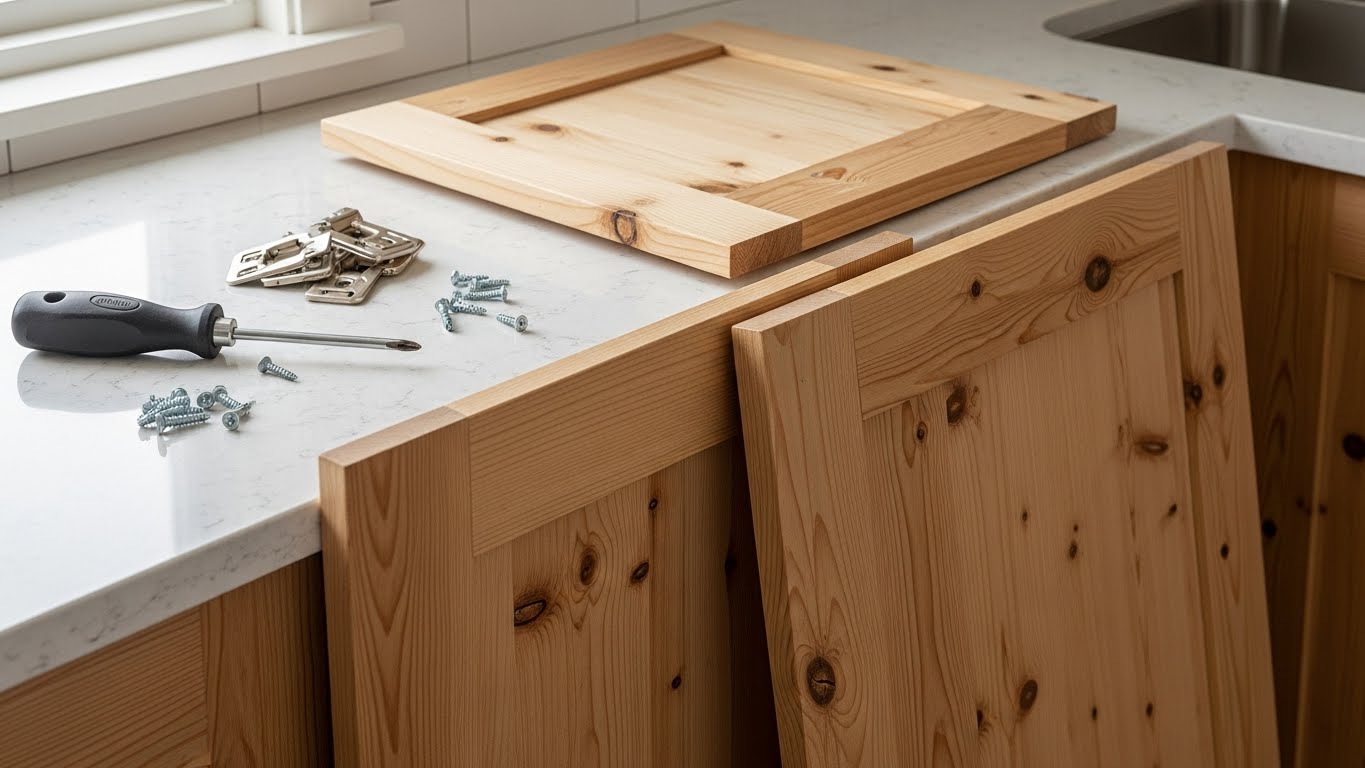
To get started, first, you’ll want to securely fasten the hinge cups into the pre-drilled holes on your cabinet doors. Just make sure the screws are snug, but be careful not to over-tighten them. You don’t want to risk damaging the material, right? Use #6 wood screws for cabinet door installation, and always drill pilot holes before driving screws to avoid splitting the wood. Using the right tools, such as a pocket hole jig, can help ensure precise and sturdy joints.
Once you’ve got that done, it’s time to position the doors against the cabinet frame. Take your time to carefully align them. Consistent reveal gaps are key here, so pay attention! Employing adjustable guides on jigs can assist with achieving accurate alignment.
After you’ve got everything lined up just right, go ahead and mark where the mounting plates need to go, and install them.
Doing this precise alignment will really help you achieve smooth door operation, and trust me, it’ll give you that professional finish you’re aiming for!
Securing Hinge Cups
Secure the hinge cups firmly by first ensuring each cup is fully seated in its drilled hole, with the screw ears flush against the door surface. Using plywood with a high ply count can help maintain hole integrity and prevent damage during installation.
Loosely insert screws to allow small adjustments, then tighten progressively to prevent cup distortion.
Use screws recommended by the manufacturer, selecting lengths that bite securely without penetrating the door face.
Avoid overtightening, which can damage the door or hinge. Test-fit each hinge cup before final fastening to confirm full seating.
It is best to drill hinge holes before applying finish to allow for any necessary repair of imperfections around the hinge area.
| Step | Emotion Evoked |
|---|---|
| Proper seating | Confidence |
| Controlled tightening | Care and precision |
| Using correct screws | Assurance |
Aligning Door Placement
To line up your cabinet doors correctly, begin by marking hinge positions carefully on both the doors and cabinet frame. Space hinges 3 inches from the top and bottom of the door, or 100 mm for most standard doors. It is important to ensure the cabinet frame is stable and level to avoid misalignment during installation.
On the cabinet side panel, mark a vertical line 2 ¼ inches from the front corner, aligning mounting plates 37 mm from the edge for overlays or adjusted for inset doors. Wedge the door in place, maintaining a 1/16 inch gap, and hold it against the frame to mark screw holes for hinge plates.
Attach hinges to doors first, drilling pilot holes with a 7/64-inch bit. It is important to drill 35 mm cup holes for European style hinges to ensure proper fit before installing screws. Using self-tapping screws can help secure the hinges firmly while allowing adjustments.
Mount plates slightly loose initially, then clip or screw hinges onto plates. Finally, use adjustment screws to fine-tune side, height, and depth for perfect alignment.
Adjusting Door Alignment and Fit
Fine-tune your cabinet doors by adjusting their vertical, horizontal, and depth positions to guarantee perfect alignment and smooth operation.
Adjust cabinet doors vertically, horizontally, and in depth for flawless alignment and effortless function.
Start by loosening the middle screws on each hinge to raise or lower the door, using slotted mounting holes for vertical shifts. Vertical adjustment is achieved by loosening screws in the middle of each hinge to enable movement. Using tools with LED cut line indication can help ensure precise alignment during installation.
For horizontal alignment, adjust the center and front screws on the hinges to slide the door closer to or away from the cabinet and adjacent doors.
Finally, correct depth by turning the rear screw to eliminate door lean and assure a flush close.
Turn offset PZ2 screws clockwise to raise European hinges.
Slide doors horizontally by loosening center hinge screws.
Adjust front screws to narrow gaps between doors.
Tighten all screws periodically to maintain fit and prevent loosening over time.
Troubleshooting Common Installation Issues
If your cabinet doors are misaligned, the first thing you should do is check the hinge placement. Sometimes, just adjusting the screws can really help with the overlay and gaps. A quick inspection before repairs can save you time and prevent worsening small problems.
Now, if you’ve got some loose screws—especially in particleboard—it’s a good idea to reinforce those holes. You can use wood dowels or even toothpicks with a bit of glue before you reinstall the screws. This will help ensure a nice, firm hold. Don’t wait too long to address these issues.
Taking care of them promptly can prevent door sagging and will help keep everything operating smoothly. Additionally, maintaining proper clearance and setback around the doors can significantly improve alignment and function.
Misaligned Doors Fixes
Start by inspecting the hinges closely to spot any uneven alignment. Open the door fully to get a clear view. Regular checks ensure ongoing accuracy and optimal performance, which is essential for avoiding future alignment problems.
If you notice misalignment, reposition the hinges using the adjustment screws to shift the door horizontally. Loosen the mounting screws in the slotted holes to adjust the door vertically at both the top and bottom hinges. Tightening any loose screws before adjusting can often restore proper alignment without further steps loose hinge screws.
Always adjust both doors at the same time if you’re working with double doors to keep consistent gaps. After making these adjustments, test the door’s closure to guarantee smooth operation. Positioning the door securely during adjustments helps maintain professional craftsmanship and prevents damage.
- Open the door fully for hinge inspection
- Shift hinges horizontally with adjustment screws
- Loosen screws to move door vertically
- Adjust both doors simultaneously for gap consistency
These steps will correct most misalignment issues efficiently.
Loose Screw Solutions
Address loose screws promptly to maintain your cabinet doors’ stability and function.
First, inspect screws for backing out or damage, then gently wiggle doors to detect play at hinges. Loose cabinet hinges are often caused by screws gradually working loose from repeated opening and closing. Properly pre-drilling pilot holes can help prevent screw loosening and wood splitting.
Tighten screws with the correct screwdriver, avoiding overtightening that strips holes.
If screws are stripped or holes enlarged, fill damaged holes with glue-coated toothpicks or wood filler, let dry, then reinsert screws.
For more durable repairs, drill out holes and insert hardwood dowels or metal threaded inserts.
Replace screws with slightly larger diameters if wood allows.
Use thread-locking compound on metal hinges to prevent repeat loosening.
Prevent future issues by pre-drilling pilot holes and using appropriate screws matched to your cabinet material and hinge type.
Frequently Asked Questions
Can I Install Cabinet Doors Without a Power Drill?
Yes, you can install cabinet doors without a power drill. For sliding doors, cut grooves for the door to slide in smoothly; no drilling needed.
If you prefer hinged doors, use a manual Forstner bit and hand tools to create hinge cup holes and pilot holes precisely. Sticky pads can support sliding doors’ bottoms, and gauge blocks help align screws when pre-drilling by hand.
This approach keeps installation precise without power tools.
What Types of Finishes Work Best on Cabinet Doors?
You’ll find paint offers vast color options and an opaque, smooth finish, especially when primed and sealed with polyurethane or conversion varnish for durability.
If you want to showcase wood grain, staining with a clear topcoat like conversion varnish adds protection without hiding natural beauty.
For low-maintenance, moisture-resistant surfaces, laminate or thermofoil works well.
Choose finishes based on your desired look, durability needs, and maintenance preferences for the best results.
How Do I Choose Between Soft-Close and Standard Hinges?
You should choose soft-close hinges if you want quieter, gentler door closing that reduces wear and prevents slamming, especially in busy kitchens or homes with kids.
They cost more upfront but save on repairs.
Standard hinges work if you’re on a budget or for low-traffic areas where noise and slam impact aren’t concerns.
Consider installation complexity and durability; high-quality hydraulic soft-close hinges offer better longevity than basic spring self-close or standard hinges.
Can I Install Cabinet Doors on Non-Wood Cabinets?
You know what they say: measure twice, cut once. Yes, you can install cabinet doors on non-wood cabinets as long as your measurements are spot on.
Use concealed hinges with Forstner bits for precise holes, and pre-drill screw holes to avoid splitting particleboard or laminate. A mounting jig helps align everything perfectly.
Clamp surfaces for stability, attach hinges to doors first, then secure plates inside the cabinet for a sturdy, clean fit.
How Do I Remove Cabinet Doors Without Damaging Them?
To remove cabinet doors without damaging them, open the door fully and support its bottom firmly with your hand or knee.
For traditional hinges, unscrew the frame-side screws first using a cordless drill, then lift the door and hinge assembly away gently.
For concealed hinges, press the release clip or button carefully and slide the door out.
Always keep a steady grip, remove screws slowly, and lay doors on a padded surface to avoid scratches or dents.
Take Your Cabinet Doors from DIY to Professional Finish
Installing cabinet doors might seem like a simple task until you realize that perfectly aligned hinges and smooth door swings don’t just happen by magic.
But now that you’ve measured, drilled, attached, and adjusted with care, you’re almost a pro. Just remember, if your doors don’t close right away, it’s not you; it’s the cabinet testing your patience. With these steps, you’ll get those doors hanging flawlessly, even if it takes a little trial and error.