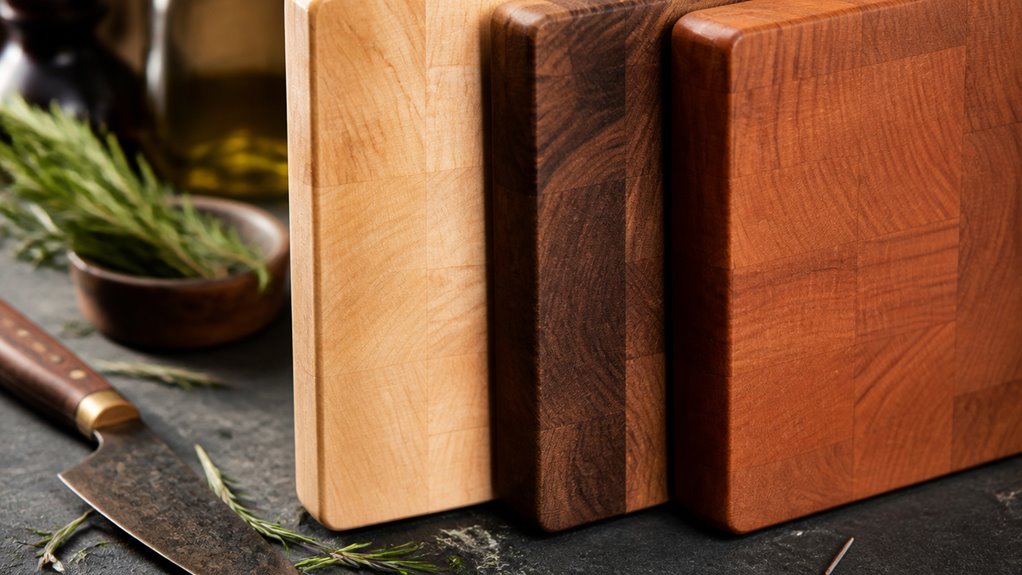
What Type of Wood Is Best for a Cutting Board: Expert Guide
For a cutting board, choose hardwoods with a Janka rating between 900 and 1500 for durability and knife protection.
Hard maple (1450) offers excellent wear resistance. Walnut (1150) balances beauty and blade friendliness, while cherry (900) is gentler on knives with a warm tone.
End-grain construction boosts lifespan and self-healing, while closed-grain woods resist bacteria. Avoid open-grain species like oak.
Proper maintenance with food-safe oils guarantees longevity. Explore these factors to optimize your board’s performance.
Key Takeaways
- Hard maple, walnut, and cherry are top hardwood choices with ideal Janka hardness (900-1500) balancing durability and knife preservation.
- End-grain construction offers superior self-healing, durability, and knife protection compared to edge-grain boards.
- Closed-grain woods like hard maple and walnut resist bacteria infiltration, ensuring safer, more hygienic cutting surfaces.
- Bamboo is eco-friendly and durable but may dull knives faster due to silica content.
- Regular maintenance with food-grade mineral oil prevents cracking and prolongs cutting board lifespan.
Why Hard Maple Is the Standard for Cutting Boards?

Though many hardwoods suit cutting boards, hard maple stands out as the industry standard due to its ideal balance of density and durability.
With a Janka hardness rating of 1450, hard maple offers exceptional resistance to knife marks without dulling blades excessively.
Its closed-grain structure minimizes bacterial infiltration and prevents grime buildup, ensuring hygienic food preparation.
When you select hard maple, you benefit from a surface that withstands heavy use while maintaining a clean, smooth finish.
Additionally, its neutral, light color simplifies maintenance and enhances kitchen aesthetics.
End-grain hard maple boards further improve durability by allowing wood fibers to self-heal after cuts, extending board lifespan.
This combination of hardness, grain tightness, and maintenance ease makes hard maple the precise choice for professional and home cutting boards alike.
To keep your hard maple board in optimal condition, regular application of food-grade finishes provides essential protection against drying, cracking, and water damage.
How Walnut Combines Beauty and Knife-Friendly Durability?
When you choose walnut for your cutting board, you get a material that balances aesthetic appeal with practical durability.
Walnut ranks around 1150 on the Janka Hardness Scale, offering a medium hardness that protects your knife edges better than harder woods like maple. Its closed-grain structure resists bacteria and moisture, making it hygienic and long-lasting.
The deep, rich color and smooth texture provide a visually pleasing surface that ages gracefully with use.
| Feature | Walnut Cutting Board |
|---|---|
| Janka Hardness | ~1150 (moderate hardness) |
| Knife Friendliness | Softer on blades, preserves sharpness |
| Grain Structure | Closed grain, resists bacteria |
| Visual Appeal | Dark, rich tones, elegant patina |
Walnut’s combination of beauty and durability guarantees a practical, attractive kitchen tool. Its moderate hardness also helps reduce blade dulling while offering resistance to warping and cracking with proper maintenance.
What Makes Cherry Wood a Softer, Warmer Cutting Board Option?
Cherry wood is an excellent choice for a cutting board, and here’s why.
First off, it sits lower on the Janka Hardness Scale, around 900. This means it’s softer than both maple and walnut, which is great news for your knives since it’s gentler on their edges.
Plus, cherry wood features a fine, closed grain that not only adds to its durability but also gives you a smooth cutting surface.
You’ll appreciate how easy it’s to work with.
And let’s not forget about the aesthetics! The rich reddish-brown tones of cherry wood create a warm and inviting look, making your kitchen feel even more welcoming.
Cherry Wood Hardness
Cherry wood offers a unique blend of softness and warmth that makes it an appealing choice for cutting boards. With a Janka hardness rating around 900, cherry is softer than maple or walnut, which means it’s gentler on your knives, reducing edge dulling.
Its moderate density still provides durability, but you’ll notice more surface wear over time compared to harder woods. This balance suits you if you prioritize knife care and a softer feel under your hands. For finishing cherry wood cutting boards, an oil-based finish can enhance durability while maintaining the wood’s natural warmth.
| Property | Cherry Wood |
|---|---|
| Janka Hardness | ~900 lbf |
| Knife Friendliness | High (gentle on edges) |
| Durability | Moderate (wears faster) |
This hardness profile positions cherry as a technically sound, knife-friendly option in the cutting board market.
Warm Aesthetic Appeal
How does wood evoke warmth and softness beyond its physical properties? Cherry wood’s rich reddish-brown hues and fine, closed grain create an inviting visual warmth that feels softer than harder woods.
Its Janka hardness of about 900 lbf places it at the lower end of the ideal range, making it gentler on knives while enhancing tactile comfort.
You’ll appreciate cherry wood’s warm aesthetic appeal due to:
Smooth texture from tight grain, reducing roughness and splinters.
Natural color deepening over time, adding character and warmth.
Subtle luster that diffuses light softly, preventing harsh reflections.
Compatibility with finishes that enhance its warm tones without masking the wood’s inherent beauty.
Choosing cherry means embracing a cutting board that’s visually and physically softer, complementing both function and kitchen ambiance. Using penetrating oils as finishes can further deepen cherry’s warm hues while preserving its natural grain and texture.
Why Wood Hardness Matters for Knives and Boards?
When you’re choosing a cutting board, it’s essential to look for wood hardness that falls between 900 and 1500 on the Janka scale. Why? Well, this range strikes a great balance between durability and keeping your knife edges sharp.
If the wood is too hard, you’ll find your knives dulling much quicker than you’d like. On the flip side, if the board is too soft, it won’t hold up over time and will wear out fast. Using the right adhesive with waterproof and food-safe properties ensures your cutting board stays durable and safe for kitchen use.
Ideal Hardness Range
Because the hardness of wood directly affects both knife longevity and board durability, selecting a cutting board within the ideal Janka hardness range of 900 to 1500 is essential.
Woods below 900 are too soft, leading to deep scoring and bacterial buildup. Above 1500, the wood becomes excessively hard, dulling knives prematurely.
This balanced range guarantees your board withstands repetitive use without sacrificing blade sharpness.
Consider these points:
Hard maple (1450 Janka) offers superior wear resistance with minimal knife impact. Walnut (1150 Janka) balances hardness and blade protection effectively. Cherry (900 Janka) is gentler on knives but less durable. Bamboo, at 1380 Janka, is durable but may dull knives faster due to silica content.
Choosing wood in this range optimizes cutting board performance and knife maintenance. Regular application of mineral oil treatments can also help preserve the wood’s integrity and extend the life of your cutting board.
Knife Edge Preservation
When selecting a cutting board, understanding wood hardness is essential for preserving your knife’s edge and ensuring the board’s durability. Woods with a Janka hardness between 900 and 1500 strike the perfect balance. They are hard enough to resist deep cuts but soft enough to minimize blade dulling.
For instance, hard maple rates at 1450, offering durability without excessive wear. Walnut’s 1150 provides gentler contact, preserving your knife’s sharpness longer. Cherry, at 900, is softer, reducing blade impact but less durable overall.
| Wood Type | Janka Hardness | Knife Edge Impact |
|---|---|---|
| Hard Maple | 1450 | Durable, moderate wear |
| Walnut | 1150 | Knife-friendly, softer |
| Cherry | 900 | Gentle on blades, less tough |
Additionally, black walnut’s natural oils create a moisture-resistant barrier that helps protect both the board’s integrity and blade sharpness.
Board Durability Factors
Although wood hardness directly affects knife edge preservation, it also plays a crucial role in the overall durability of the cutting board itself.
When selecting wood, you must balance hardness to ensure the board resists deep cuts and warping without excessively dulling knives.
Hard maple’s 1450 Janka rating offers excellent wear resistance, while walnut’s 1150 rating balances durability and knife friendliness.
Cherry’s softer 900 rating reduces blade wear but wears faster.
Consider these factors:
Hardness between 900–1500 Janka guarantees prime durability and knife protection.
End-grain construction enhances self-healing and durability.
Closed-grain woods prevent bacterial buildup and extend board life.
Softer woods score easily, reducing longevity and hygiene.
Using oils with deep penetration and moisture resistance can further protect wooden cutting boards from drying and cracking.
End-Grain vs. Edge-Grain: Which Cutting Board Lasts Longer?
Understanding the differences between end-grain and edge-grain cutting boards is essential if you want a durable surface that protects both your knives and your investment.
End-grain boards display the wood’s fibers vertically, allowing knife blades to slide between fibers rather than cutting across them.
This self-healing property reduces visible wear and extends the board’s lifespan.
Edge-grain boards expose the wood fibers horizontally, making them less resilient to deep cuts and more prone to visible scratches.
While edge-grain boards are typically more affordable and easier to maintain, end-grain boards last longer under frequent use due to superior resistance to knife marks and warping.
Choosing end-grain maple maximizes durability and knife protection, balancing hardness and resilience for long-term kitchen performance.
For any repairs or maintenance, using an epoxy wood filler can help extend the life of your cutting board by filling cracks and reinforcing damaged areas.
Safe, Non-Toxic Woods for Cutting Boards
Choosing the right wood grain and construction type markedly impacts a cutting board’s durability and knife friendliness. Equally important is selecting wood that guarantees safe food preparation.
You want dense, closed-grain hardwoods that resist bacterial infiltration and don’t release toxins. Woods like hard maple, walnut, and cherry fit these criteria well due to their tight grain and natural antimicrobial properties.
Avoid woods with open pores or chemical treatments, which compromise hygiene. Key considerations for safe, non-toxic cutting board woods include:
- Dense, closed-grain hardwoods to prevent bacterial harboring.
- Naturally non-toxic, food-safe wood species without irritants.
- Avoidance of chemically treated or resinous woods.
- Sufficient hardness to resist scoring while protecting knives.
Selecting such woods assures a hygienic, durable cutting surface. Additionally, understanding the importance of wood hardness and durability helps in choosing materials that withstand rigorous use and maintain their integrity over time.
Why You Should Avoid Open-Grain Woods Like Oak for Food Safety?
When working with cutting boards, you should steer clear of open-grain woods like oak. Their porous structure traps food particles and bacteria, creating a persistent hygiene risk.
Oak’s large pores increase contamination potential, making thorough cleaning difficult. This raises the risk of cross-contamination. Closed-grain hardwoods like maple and walnut reduce this risk by limiting absorption and microbial growth.
| Wood Type | Grain Structure | Food Safety Impact |
|---|---|---|
| Oak | Open-grain | High bacteria retention |
| Hard Maple | Closed-grain | Low bacteria retention |
| Walnut | Closed-grain | Natural antimicrobial effect |
Choosing closed-grain woods guarantees safer, more sanitary cutting boards for food prep.
Cost and Sustainability of Cutting Board Woods
Although premium hardwoods like maple, walnut, and cherry dominate cutting board selections due to their durability and performance, their costs and sustainability vary markedly. When choosing, you need to balance budget with environmental impact.
Walnut, priced around $15 per board foot, is the priciest option, while maple and cherry are more affordable due to domestic sourcing under US forestry regulations. Bamboo stands out as an eco-friendly, cost-effective alternative despite being a grass, offering rapid renewability.
Rubberwood provides a budget hardwood choice with adequate hardness. Walnut commands a premium price but offers longevity and beauty. Maple and cherry benefit from sustainable domestic forestry.
Bamboo regenerates quickly, guaranteeing excellent sustainability. Rubberwood balances cost and durability for everyday use. Selecting wood wisely guarantees you get performance without compromising ecological responsibility.
How to Maintain Your Wooden Cutting Board for Lasting Performance?
Understanding the cost and sustainability of cutting board woods sets the stage for proper care that maximizes their lifespan and performance.
To maintain your wooden cutting board, clean it with mild soap and warm water immediately after use. Avoid soaking or dishwasher cleaning to prevent warping.
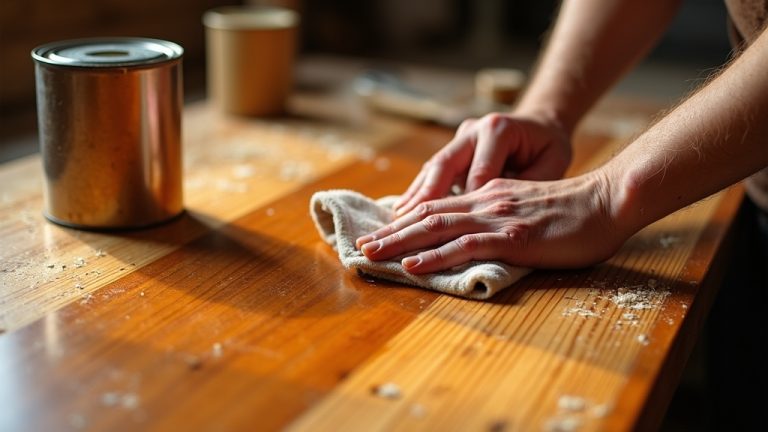
Regularly apply food-grade mineral oil to seal the wood, preserving moisture balance and preventing cracks. Sand rough areas lightly before oiling.
Store the board upright in a dry environment to reduce moisture absorption.
| Step | Action | Result |
|---|---|---|
| Clean | Mild soap, warm water | Removes bacteria & debris |
| Oil | Food-grade mineral oil | Maintains moisture, prevents drying |
| Sand | Fine-grit sandpaper | Smooths surface, extends life |
| Store | Upright, dry place | Prevents warping & mold growth |
Frequently Asked Questions
Can I Use Reclaimed Wood for a Cutting Board Safely?
You can use reclaimed wood for a cutting board, but only if it’s hardwood, untreated, and free from contaminants.
Avoid wood previously exposed to chemicals, paint, or finishes that could leach toxins.
Make sure it has a Janka hardness between 900 and 1500 to balance durability and knife-friendliness.
Properly clean, sand, and seal reclaimed wood with food-safe mineral oil to maintain hygiene and longevity.
Without these precautions, reclaimed wood poses health risks.
How Do Wood Cutting Boards Compare to Plastic in Hygiene?
You might think wooden boards are old-fashioned relics, but they actually outperform plastic in hygiene.
Wood’s natural antimicrobial properties inhibit bacteria growth, unlike plastic, which can harbor germs in knife grooves.
End-grain wood boards self-heal, closing cuts that trap food particles, enhancing cleanliness.
Though plastic is dishwasher-safe, repeated knife marks create bacteria hotspots.
With proper maintenance, regular oiling and hand washing, wood cutting boards remain safer and more durable than plastic alternatives.
What Is the Best Wood Finish for Cutting Board Protection?
You’ll want to use food-safe mineral oil as the best wood finish for cutting board protection. It penetrates the wood, preventing moisture absorption and warping without leaving toxic residues.
Avoid vegetable oils, which can go rancid. For added durability, consider a beeswax and mineral oil blend to create a water-resistant barrier.
Regular reapplication keeps your board conditioned, prolonging its lifespan and maintaining a sanitary, knife-friendly surface.
Are There Specific Woods to Avoid for Allergy Reasons?
You might imagine allergies only from foods, but certain woods can trigger reactions too.
You should avoid oak and teak; oak’s open pores harbor allergens and bacteria, while teak may cause irritation due to its natural oils.
Softwoods like pine and cedar also pose risks since they easily score, trapping allergens.
Stick to hardwoods like maple or walnut, as they’re less likely to cause allergic reactions and guarantee safer food prep surfaces.
How Often Should I Replace My Wooden Cutting Board?
You should replace your wooden cutting board when deep grooves, cracks, or warping compromise its surface, typically every 3 to 5 years with regular use.
Inspect it frequently for bacteria-harboring damage. Proper maintenance, like oiling monthly, extends lifespan.
However, once sanitation becomes difficult or knife marks accumulate excessively, it’s time to replace.
End-grain boards last longer but still require careful monitoring to guarantee food safety and peak performance.
Find the Right Hardwood for Your Cutting Board
Choosing the right wood for your cutting board is like selecting the perfect tool for a delicate craft. Hard maple offers unmatched durability. Walnut blends beauty with knife-friendliness, and cherry provides a softer, warm touch.
Prioritize hardwoods with tight grains. Avoid open-grain woods like oak, and maintain your board meticulously to guarantee longevity. With the right choice and care, your cutting board becomes a precision instrument, protecting both your knives and your kitchen’s hygiene.