Best Rated Stud Finder for Finding Framing Behind Drywall
Stud finders need to match your wall material and depth so you can locate framing before mounting a shelf or TV. The display matters too: some show stud edges, while others show the center and full width.
The trade-off is between a quick read at the wall and more detailed feedback. A scanner with a smartphone display maps studs, pipes and wiring up to 4 inches (10 cm) deep, but you’ll need a compatible phone and app. A standalone finder keeps the display on the tool.
For a simple drywall scan, you can choose a no-calibration finder. For more demanding jobs, other scanners handle plaster and lath or distinguish between metal types.
Quick answer: WALABOT DIY 2 M leads because it detects wood studs, metal studs and nail plates through drywall, plywood and OSB. For finding stud edges on drywall, choose the FOLAI Multifunctional Wall Scanner, which uses an LCD and audible warning to indicate edges and centers.
| Image | Name | Editor's Rating | Price |
|---|---|---|---|
|
Walabot DIY 2 M Advanced Wall Scanner & Stud Finder | For iO...
|
|
|
|
Franklin Sensors ProSensor M210 13-Sensor Stud Finder, Live ...
|
|
|

|
Stud Finder Wall Scanner 5 in 1 Multifunctional Upgraded Sma...
|
|
|

|
FNIRSI WD-01 6 in 1 Rechargeable Stud Finder Wall Scanner, P...
|
|
|

|
Zircon® StudSensor™ A100 Stud Finder w/Live Wire Detection
|
|
Stud Finder Specs at a Glance
| Product | Stud detection depth | Power | Detected materials |
|---|---|---|---|
| WALABOT DIY 2 M | Up to 4 inches (10 cm) deep | Built-in rechargeable battery | Wood studs, metal studs & nail plates |
| Franklin Sensors ProSensor M210 | Up to 1.7 in | Two AA batteries required, not included | Wood and metal studs |
| FOLAI Multifunctional Wall Scanner | Up to 1.5 inches (38mm) | 1 AA batteries required. (included) | wooden studs, metal pipes and live AC wires |
| FNIRSI wd-01 Wall Scanner | Up to 1.5” deep | Rechargeable mode | wood, metal and AC wires |
| Zircon StudSensor A100 | Up to 1 1/2 in. deep | one fresh 9V alkaline battery | Wood and metal stud edges |
| Bosch GMS120-27 Wall Scanner | — | included AA batteries | Wood studs, metal framing, copper pipes |
| MOCITA SH402 Wall Scanner | Up to 38mm deep | Battery Powered | wood, metal, AC wire |
| NOTANY Electronic Stud Detector | — | Battery Powered | Wood, Metal, AC Live Wire, Joists & Pipes |
10 Stud Finders for Confident Wall Scans
Before you hang a shelf or mount a TV, you need to know what’s behind the drywall. Compare these stud finders by scan depth, display, and detection features.
1. WALABOT Smartphone-Connected Wall Scanner for Mapping Studs, Pipes and Wiring
Best Overall
- SEE INSIDE YOUR WALLS: Transform your smartphone into an advanced visual radar system. The Walabot...
- MULTI-MATERIAL DETECTION: Accurately locates wood studs, metal studs & nail plates, PVC, PEX, ABS...
- SEAMLESS SMARTPHONE INTEGRATION: Fully compatible with iOS and Android smartphones. Connects...
The essentials:
- Detection up to 4 inches (10 cm) deep
- Compatible with iOS and Android smartphones
- Built-in Wi-Fi network
- Built-in rechargeable battery
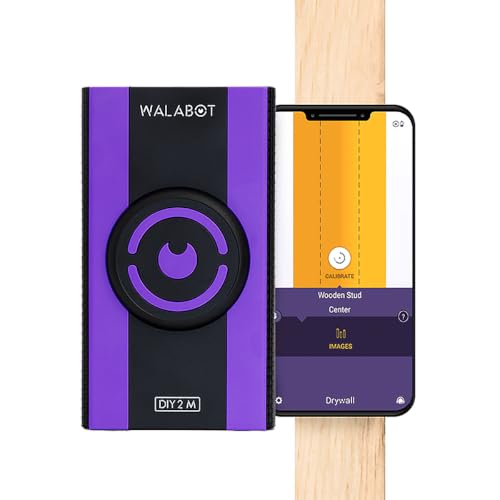
You see a visual map of hidden objects instead of relying on a single alert. The WALABOT scanner connects to your smartphone and uses radar to show studs, pipes and wiring behind drywall, plywood and OSB.
Scan up to 4 inches (10 cm) deep to locate wood studs, metal studs and nail plates, along with pipes and electrical wiring. That view gives you more context before you drill to hang a TV, fit cabinets or trace plumbing.
Connect through the built-in Wi-Fi network; you don’t need an external Wi-Fi connection. It works with iOS and Android smartphones, and its built-in rechargeable battery powers the scanner without draining your phone.
Choose Images Mode for simplified graphics or Expert Mode to view raw radar data in real time. Smooth gliding strips help you move the scanner across the wall as you map the area for a project.
Best for: Remodelers mapping studs, plumbing and wiring behind walls before drilling or opening up a work area.
What we like:
- Shows a visual map of objects behind walls.
- Scans drywall, plywood and OSB.
- Offers simplified and raw-data viewing modes.
- Uses a rechargeable battery separate from your phone.
Worth knowing: You need a compatible smartphone and the dedicated Walabot app to see the visual feedback.
2. Franklin Sensors ProSensor M210 Stud Finder with 13 Sensors and Full-Width Display
Best for Viewing Stud Width
- ACCURATE: More sensors = More accuracy. Conventional electronic stud finders have 1 or 2 sensors...
- EASY: No calibration is required. Simply press and hold the button to begin scanning. Unlike other...
- SHOWS FULL WIDTH OF STUDS: Unlike magnetic stud finders that only find screws, the ProSensor M...
The essentials:
- 13 sensors
- Deep detection of up to 1.7 in
- Finds both wood and metal studs
- Live wire detection
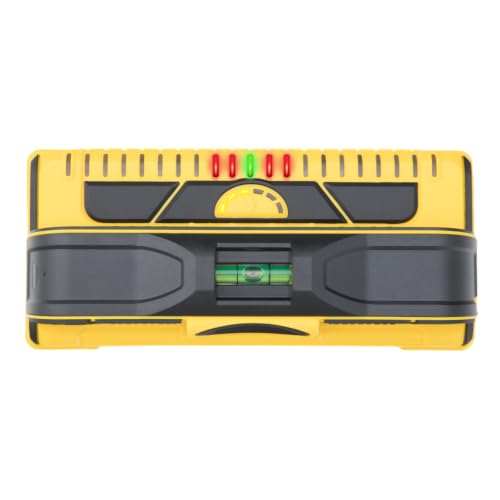
At the wall, lining up a shelf bracket or fixture, you need to know where a stud starts and ends before you drill. The Franklin Sensors ProSensor M210 uses 13 sensors to show the full width of studs on its LED display, including double studs.
Watch the LEDs as you scan: the display shows the stud’s width, and the middle LED turns green at the center. That gives you a clearer target for placing a mounting point than a tool that only locates screws.
Press and hold the button to start scanning; no calibration is required, so you can begin anywhere, even over a stud. Its deep detection reaches up to 1.7 in, and it finds both wood and metal studs.
Live wire detection adds another check before you drill, while the built-in bubble level helps you keep a line straight. It’s compatible with rechargeable batteries, but it requires two AA batteries, which aren’t included.
Best for: DIYers who want to locate full stud widths before mounting fixtures.
What we like:
- LED display shows full stud widths and double studs.
- Green center LED marks the stud’s center.
- Scans without calibration.
- Includes live wire detection and a built-in bubble level.
Worth knowing: You’ll need to supply two AA batteries before scanning.
3. FOLAI Wall Scanner for Stud Centers and Edges with LCD and WireWarning Alarm
Best for Finding Stud Edges
- Extremely Accurate and Consistent - Our stud detectors are professionally designed and equipped with...
- 5 scan modes up to 60mm deep - Our versatile stud locator quickly and easily locates wooden studs...
- Don't worry about drilling into live wires - WireWarning detects up to 2 inches (51 mm) deep and is...
The essentials:
- 5 scan modes up to 60mm deep
- Stud mode detects drywall up to 1.5 inches (38mm)
- WireWarning detects up to 2 inches (51 mm) deep
- Large LCD display
1.5 inches (38mm) is the stud-mode depth, giving you a clear limit when scanning drywall before marking a shelf or picture location. FOLAI’s wall scanner uses a large LCD display and audible warning to indicate stud centers and edges.
Use the edge readings to mark the stud’s boundaries, then place a fastener where your project needs it. The scanner has 5 scan modes up to 60mm deep for locating wood, metal, and live AC wires behind walls, floors, and ceilings.
WireWarning detects live wires up to 2 inches (51 mm) deep and remains on in StudScan, DeepScan, and MetalScan modes. That gives you a wire alert while you scan for a stud, so you can pause and check the area before drilling.
For extra layers of drywall, DeepScan reaches the same stud-mode depth of 1.5 inches (38mm). Start with StudScan to locate an object, then use MetalScan to help tell whether a reading is a wood stud, metal stud, or pipe. It requires 1 AA battery (included).
Best for: DIYers marking stud edges before hanging shelves or pictures.
What we like:
- LCD and audible alerts indicate centers and edges.
- WireWarning stays active in three scan modes.
- Five modes cover wood, metal, and live AC wire detection.
Worth knowing: Choose another scanner if you need stud detection deeper than 1.5 inches (38mm).
4. FNIRSI Wall Scanner with Positioning Hole, Six Detection Modes and Rechargeable Power
Best for Marking Wall Targets
- Newest Upgraded Stud Finder - FNIRSI stud finder have Newly Designed Positioning Hole which can...
- 6-in-1 DETECTION: The wall detector provides users with more detection needs. Exact scan mode...
- 6-in-1 DETECTION: Non-Ferrous Metal scan detects metal (Copper) up to 3.9'' deep; Ferrous Metal scan...

The essentials:
- Depth scan mode up to 1.5” deep
- Non-Ferrous Metal scan detects metal (Copper) up to 3.9” deep
- Ferrous Metal scan detects metal (Iron) up to 4.7” deep
- AC scan detects live unshielded AC wires up to 2” deep
A positioning hole lets you mark detected edges and centers directly on a wall or floor, so you can keep track of a target as you plan a mounting point. FNIRSI also separates copper and iron detection into different metal modes.
For framing, Depth scan mode finds wood and metal stud edges and centers up to 1.5” deep. Non-Ferrous Metal scan detects copper up to 3.9” deep, while Ferrous Metal scan detects iron up to 4.7” deep.
AC scan detects live unshielded AC wires up to 2” deep. The LCD display and sound alarm signal detection, and rechargeable mode means you can recharge the scanner instead of replacing batteries.
Best for: Installers marking detected targets directly on walls or floors before drilling.
What we like:
- Positioning hole makes detected targets easier to mark.
- Separate modes detect copper and iron.
- Depth scan locates stud edges and centers up to 1.5” deep.
Worth knowing: Choose another scanner if you need copper detection at the same depth as iron; copper detection reaches 3.9” deep, compared with 4.7” for iron.
5. Zircon StudSensor A100 Edge Finder with Deep Scan and Live-Wire Alerts
Best for Hanging Wall Fixtures
- Accurate Edge Finding for DIY Projects: Zircon StudSensor A100 helps locate wood and metal stud...
- Correct Calibration for Better Scans: Hold scanner flat against the wall, then press and hold the...
- Two Scanning Modes: StudScan Mode finds stud edges up to 3/4 in. deep for standard scans, while...
The essentials:
- StudScan Mode locates wood and metal stud edges up to 3/4 in. deep
- DeepScan Mode reaches up to 1 1/2 in. deep
- WireWarning Detection identifies live, unshielded AC wiring up to 2 in. deep
- LCD screen, audio tone, SpotLite Pointer
Find wood and metal stud edges before you mount a TV, shelf, mirror, or cabinet. Zircon’s A100 pairs an LCD screen, audio tone, and SpotLite Pointer to show when you’ve located an edge.
Choose StudScan Mode for edges up to 3/4 in. deep, or DeepScan Mode for edges up to 1 1/2 in. deep behind thicker wall surfaces. Hold the scanner flat against the wall and scan slowly after calibration.
WireWarning Detection identifies live, unshielded AC wiring up to 2 in. deep in both modes. A low battery indicator alerts you when power is too low for proper scanning; the unit requires one fresh 9V alkaline battery, which isn’t included.
Because it finds stud edges, scan for both edges before marking the center point for your fixture.
Best for: Homeowners locating framing before hanging mirrors, shelves, cabinets, or TVs.
What we like:
- Two scan modes for different wall depths
- SpotLite Pointer helps mark detected edges
- Live-wire alerts work in both modes
Worth knowing: You’ll need to locate both stud edges to mark the center.
6. Bosch GMS120-27 Wall Scanner for Jobsite Stud, Metal, Pipe and Wire Detection
Best for Construction Jobsites
- PRO-GRADE MULTI-FUNCTION DETECTION: Stop guessing, start knowing with this stud finder wall scanner...
- ESCANER DE PARED PROFESIONAL: El detector de madera en paredes definitivo para el profesional...
- ABSOLUTE PRECISION & CONFIDENCE: This wall stud finder helps find the exact center of the stud. The...
The essentials:
- IP54-rated dustproof and water-resistant body
- Shock-absorbing rubber casing
- Center indication and material identification
- Detects wood studs, metal framing, copper pipes, and live AC electrical wiring
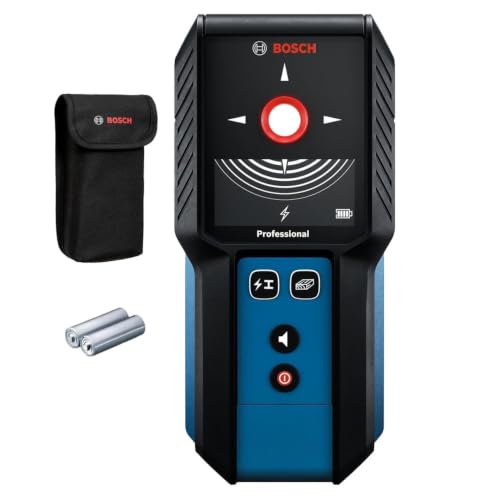
Dust and water exposure can complicate work on an active construction site. The Bosch GMS120-27 has an IP54-rated dustproof and water-resistant body and shock-absorbing rubber casing for jobsite use.
Scan drywall to detect wood studs, metal framing, copper pipes, and live AC electrical wiring. Center indication and material identification help you locate a target and see what the scanner detects.
The color-coded marking ring gives visual feedback as you scan and transfer a detected position to the wall. Included AA batteries let you power it without buying a separate battery first.
At 13.76 ounces, it weighs more than the HART scanner, so choose a lighter option if keeping tool weight down is your priority.
Best for: Electricians and remodelers scanning walls on active construction sites.
What we like:
- Detects wood studs, metal framing, copper pipes, and live AC wiring.
- Indicates object centers and identifies materials.
- Uses a dustproof, water-resistant body with shock-absorbing rubber casing.
Worth knowing: Choose a lighter scanner if the 13.76-ounce weight doesn’t suit your work.
7. MOCITA Wall Scanner with Three Stud Depths for Plaster and Lath Surfaces
Best for Plaster Walls
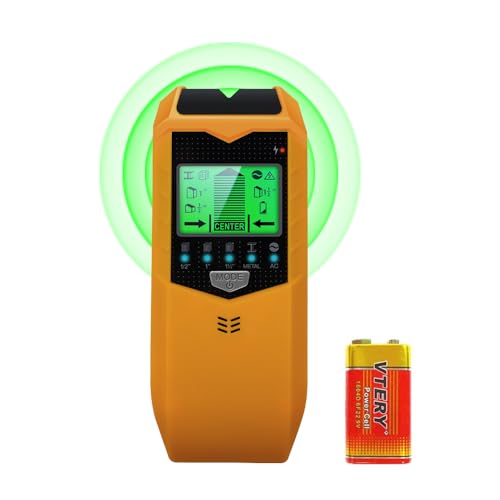
- Accurate - This MOCITA stud finder SH402 newly upgraded with intelligent micro-sensor chip can...
- 5 in 1 Detection - This stud detector provides 5 modes for accurate needs. 1/2” stud scan mode...
- Visual Screen & Audio Alarm - This wall scanner comes with HD LCD display and sound alarm, so that...
The essentials:
- 1/2” stud scan mode locates wood and metal studs up to 13mm deep
- 1” mode locates up to 25mm
- 1.5” mode locates up to 38mm deep
- HD LCD display and sound alarm
Instead of tapping along a plaster wall and guessing where framing sits, you can scan for wood and metal studs with the MOCITA SH402. It lists plaster, lath, drywall, and other surfaces as compatible, making it a practical option for older walls.
Choose from three stud-scan depths: 1/2” mode locates studs up to 13mm deep, 1” mode reaches up to 25mm, and 1.5” mode reaches up to 38mm. The HD LCD display and sound alarm show and signal when you’re near a target.
An ergonomic anti-slip handle gives you a steadier grip as you scan. It’s battery powered and also has metal and live AC wire detection modes for checking other objects behind a wall.
Best for: Homeowners checking plaster, lath, or drywall before hanging shelves or a TV.
What we like:
- Three stud depths cover different scanning needs.
- Works on plaster and lath, as well as drywall.
- Visual and audio alerts help you track a target.
Worth knowing: Press the scan button to calibrate whenever you change modes.
8. NOTANY 7-in-1 Wall Scanner for Studs, Pipes and Accurate Fixture Alignment
Best for Aligning Wall Fixtures

- Stud Finder Wall Scanner: This stud finder not only reliably detects wooden beams, joists, metal...
- Multi-Wall Stud Finder: This nail detector wall scanner has 3 detection modes: foreign object...
- Enhanced Accuracy: Unlike typical stud finder wall detectors that only have one or two sensors, the...
The essentials:
- Foreign object scanning up to 1.5 inches
- Metal scanning up to 4.72 inches
- AC power scanning up to 1.97 inches
- Four high-precision sensors
DIYers lining up a shelf or TV can scan for framing, then use the laser level and bubble level ruler to position the fixture. NOTANY combines these alignment tools with scanning for wood, metal, pipes, and live AC wires.
Choose foreign object scanning up to 1.5 inches, metal scanning up to 4.72 inches, or AC power scanning up to 1.97 inches. Four high-precision sensors detect edges and centers, while the audible alarm signals a target.
The 2-inch high-backlight LCD display shows center and signal-grid information, along with battery status. The scanner weighs 6.56 ounces, so you can hold it against the wall as you scan.
Use it on drywall, painted drywall, wood substrates, light textured walls, or wallpaper. Keep it flat, move steadily, and scan from more than one direction to compare results.
Best for: Homeowners positioning shelves or TVs who want scanning and alignment tools in one device.
What we like:
- Laser and bubble level ruler for fixture positioning
- Three scanning modes with different detection depths
- LCD display and audible target alert
Worth knowing: Calibrate before each measurement, and don’t rely on it for thick walls, wet walls, concrete, brick, or plaster with metal mesh.
9. HART Professional Stud Finder for Quick Drywall Scans with 9 Sensors
Best for Quick Drywall Scans
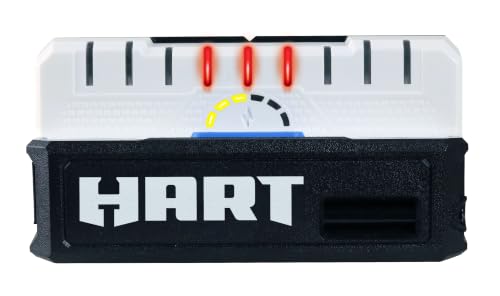
- ACCURATE: More sensors = More accuracy. Conventional stud finders have 1 or 2 sensors. The HART...
- EASY: One mode finds it all! The HART Professional adjusts for a variety of depths, materials, and...
- DISPLAYS FULL STUDS: The HART Professional displays the center and edges of studs simultaneously...
The essentials:
- 9 sensors
- One mode finds it all
- No calibration required
- Displays the center and edges of studs simultaneously
Stud centers and edges show on the wall at the same time, so you can mark a mounting spot without making repeated passes. Nine sensors feed the display, and one mode adjusts to different depths, materials, and textures.
Press and hold the button to start scanning; no calibration is required, and you can begin even over a stud. The finder works through drywall and sheetrock, making it handy when you’re positioning a shelf or TV.
HART includes Live Wire Detection and a pencil caddy. It runs on AAA batteries, which aren’t included, and weighs 5.28 ounces.
Best for: Homeowners who want quick scans through drywall or sheetrock before mounting something on the wall.
What we like:
- Shows stud centers and edges simultaneously.
- Scans in one mode without calibration.
- Lets you start scanning over a stud.
Worth knowing: Choose another option if you need a finder compatible with rechargeable batteries.
10. POROMETISTO DSF05 Wall Scanner for Identifying Metal, Wood Studs, and Live Wires
Best for Checking Metal Types

- 【Handheld Detector】This Stud Finder & Scanner can quickly identify foreign objects such as...
- 【All in one Wall Detector Scanner】This professional Wall Detector Scanner can detects Ferrous...
- 【Operating Method】After powering on, use the Toggle switch to select Depth or Exact Mode. Press...
The essentials:
- Ferrous metals (1.5in/38mm)
- Non-Ferrous (0.78in/20mm)
- Live AC wires (1.5in/38mm)
- Wood Deep (1.50in/38mm) & Exact (0.78in/20mm)
At the wall before drilling a shelf bracket, you can scan for metal, wood studs, pipes, and live AC wires. The DSF05 gives you separate depth figures for ferrous and non-ferrous metals.
Ferrous metals scan to 1.5in/38mm, while non-ferrous metals scan to 0.78in/20mm. Its LCD displays the material, location, and depth signal, so you can check what the scanner detects as you move it across the wall.
Choose Deep or Exact mode with the toggle switch, then wait for the green light before scanning slowly. A centered icon and continuous buzzer mark a target; sweep back and forth to refine its position. Wood detection is 1.50in/38mm in Deep mode and 0.78in/20mm in Exact mode.
POROMETISTO includes a 9V battery and portable storage bag, so you can keep the scanner and its accessories together between jobs.
Best for: DIYers checking metal types before drilling into walls.
What we like:
- Separate ferrous and non-ferrous metal detection depths.
- LCD shows material, location, and depth signal.
- Also detects wood and live AC wires.
Worth knowing: Its non-ferrous detection depth is shallower than its ferrous detection depth.
What Mattered in the Comparison?
Stud detection depth, detected materials, and power source mattered most. Scan depth determines how far into a wall a finder can look, while material detection tells you whether it identifies wood, metal, or live wires. Power matters when you’re choosing between rechargeable models and replaceable batteries.
The comparison is based on manufacturer-published specifications and product details. If you’re hanging a shelf, a stud-edge finder gives you a straightforward way to locate framing. If you need a broader view behind the wall, a smartphone-connected scanner maps studs, pipes, and wiring.
Choose a Stud Finder That Fits Your Wall and Your Job

The right stud finder for your project needs to work with the wall in front of you and show the information you need to mark a mounting point. Scan depth, target type and display style all matter when you’re choosing a tool for shelves or a TV mount.
Match Scan Depth to the Wall
Scan depth tells you how far behind the surface a finder can detect a target. It’s a useful first check if you’re working with thick drywall, because a shallow stud mode won’t reach as far as a deeper one.
The Zircon StudSensor A100 has a StudScan mode for wood and metal stud edges up to 3/4 in. deep and a DeepScan mode that reaches up to 1 1/2 in. The MOCITA SH402 has three stud-scan depths and works on surfaces including plaster and lath.
For a deeper scan, choose the WALABOT DIY 2 M, which detects up to 4 inches (10 cm) deep through drywall, plywood and OSB. Check the depth for the target you need, not just the largest number on the tool: metal, wire and stud modes can have different limits.
Check Which Materials Each Mode Detects
Finding a stud is one task; checking for metal or live wiring is another. A scanner with separate detection modes gives you more ways to examine the area before you mark a mounting point.
The FNIRSI wd-01 has a non-ferrous mode that detects copper up to 3.9” deep and a ferrous mode that detects iron up to 4.7” deep. Its AC mode detects live unshielded AC wires up to 2” deep. Those limits apply to different targets, so switching modes changes what you’re looking for.
Need to check both framing and other objects? Choose a scanner that detects the materials relevant to your job. The Bosch GMS120-27 identifies wood studs, metal framing, copper pipes and live AC electrical wiring. Don’t assume a stud-depth figure applies to wire detection, too.
Choose How You Want to See the Stud
A finder’s display affects how you turn a scan into a pencil mark. Some show an edge or center; others show the width of the stud or a visual map of objects behind the wall.
The Franklin Sensors ProSensor M210 uses 13 sensors and an LED display to show full stud widths, including double studs. The HART Professional Stud Finder displays centers and edges simultaneously. By contrast, the Zircon A100 locates edges, so you’ll need to find both before marking the center.
For a shelf bracket, choose the display you’ll find easiest to read while marking the wall. Pick the WALABOT DIY 2 M if you want a visual map of studs, pipes and wiring; its feedback requires a compatible smartphone and the dedicated Walabot app.
Look at Calibration, Marking and Power
Small handling details matter when you’re moving between scan locations. Consider whether you want no calibration, a way to mark a target on the wall, or a rechargeable tool instead of replaceable batteries.
The HART Professional Stud Finder needs no calibration, while the MOCITA SH402 requires you to press its scan button to calibrate whenever you change modes. The FNIRSI wd-01 has a positioning hole for marking detected edges and centers, plus rechargeable power.
Before you choose, check what you’ll need at the wall. The Franklin Sensors ProSensor M210 takes two AA batteries, which aren’t included, and it’s compatible with rechargeable batteries. The Zircon A100 uses one fresh 9V alkaline battery and has a low-battery indicator.
Keep Reading
- Best Laser Level Tripod for Stable, Precise Setup
- Best Anchor for Drywall: Top Picks for Strong Holds
- Best Laser Level Options for Precise and Easy Measurements
Frequently Asked Questions
Can a stud finder work on plaster and lath walls?
Yes, a stud finder can work on plaster and lath walls if it’s compatible with those surfaces. Choose a scanner that names both materials rather than assuming every drywall scanner works the same way on an older wall.
The MOCITA SH402 works on plaster and lath, as well as drywall. It has three stud-scan depths for locating wood and metal studs, plus an LCD display and sound alarm.
When you change modes, press the scan button to calibrate the MOCITA before taking another reading.
How deep should a stud finder scan through drywall?
A stud finder should scan deep enough to reach the framing behind your drywall. Check the stud-detection depth rather than relying on a scanner’s deepest metal or wire setting, since those limits can differ.
The Zircon StudSensor A100 locates wood and metal stud edges up to 3/4 in. deep in StudScan Mode. Its DeepScan Mode reaches up to 1 1/2 in. deep, giving you another setting when you need a deeper scan.
For thick drywall, choose a stud finder with a deeper scan mode that reaches the framing.
How do you find the center of a stud with a stud finder?
You can find the center of a stud with a stud finder that displays its center, or by finding both edges with an edge finder. Either approach gives you a point to mark before positioning your shelf bracket or fixture.
The HART Professional Stud Finder displays the center and edges of studs simultaneously in one mode, with no calibration required. The Zircon StudSensor A100 instead locates the edges, so you’ll need both before marking the center.
Check which kind of indication your scanner gives before you mark the wall.
Do stud finders need batteries or charging?
Stud finders need a power source, which can be replaceable batteries or a rechargeable battery, depending on the model. Think about which setup you prefer before you start a wall-mounting job.
The Franklin Sensors ProSensor M210 requires two AA batteries and is compatible with rechargeable batteries. The WALABOT DIY 2 M has a built-in rechargeable battery instead, while the HART Professional Stud Finder isn’t compatible with rechargeable batteries.
Check your scanner’s battery requirements before the job so you have the right power source ready.
Do you need a phone to use a stud finder?
No, you don’t need a phone for every stud finder. Some show readings on a built-in display, while a smartphone-connected scanner puts a visual map on your phone instead.
The WALABOT DIY 2 M uses a compatible smartphone and the dedicated Walabot app to show studs, pipes, and wiring. It works with iOS and Android smartphones and has a built-in Wi-Fi network.
If you’d rather read the result directly on the tool, choose a scanner with its own display.
Match Your Scanner to Your Wall
For a visual map of studs, pipes and wiring, choose the smartphone-connected WALABOT. If you’re lining up a shelf bracket and want to see the full stud width, pick the Franklin Sensors ProSensor M210. For plaster and lath, choose the MOCITA SH402.
Before deciding, check the stud scan depth against your wall thickness. If the framing sits deeper than the scanner’s reach, you may miss it when marking your mounting point.
{“@context”:”https://schema.org”,”@graph”:[{“@type”:”FAQPage”,”mainEntity”:[{“@type”:”Question”,”name”:”Can a stud finder work on plaster and lath walls?”,”acceptedAnswer”:{“@type”:”Answer”,”text”:”Yes, a stud finder can work on plaster and lath walls if it’s compatible with those surfaces. Choose a scanner that names both materials rather than assuming every drywall scanner works the same way on an older wall. The MOCITA SH402 works on plaster and lath, as well as drywall. It has three stud-scan depths for locating wood and metal studs, plus an LCD display and sound alarm. When you change modes, press the scan button to calibrate the MOCITA before taking another reading.”}},{“@type”:”Question”,”name”:”How deep should a stud finder scan through drywall?”,”acceptedAnswer”:{“@type”:”Answer”,”text”:”A stud finder should scan deep enough to reach the framing behind your drywall. Check the stud-detection depth rather than relying on a scanner’s deepest metal or wire setting, since those limits can differ. The Zircon StudSensor A100 locates wood and metal stud edges up to 3/4 in. deep in StudScan Mode. Its DeepScan Mode reaches up to 1 1/2 in. deep, giving you another setting when you need a deeper scan. For thick drywall, choose a stud finder with a deeper scan mode that reaches the framing.”}},{“@type”:”Question”,”name”:”How do you find the center of a stud with a stud finder?”,”acceptedAnswer”:{“@type”:”Answer”,”text”:”You can find the center of a stud with a stud finder that displays its center, or by finding both edges with an edge finder. Either approach gives you a point to mark before positioning your shelf bracket or fixture. The HART Professional Stud Finder displays the center and edges of studs simultaneously in one mode, with no calibration required. The Zircon StudSensor A100 instead locates the edges, so you’ll need both before marking the center. Check which kind of indication your scanner gives before you mark the wall.”}},{“@type”:”Question”,”name”:”Do stud finders need batteries or charging?”,”acceptedAnswer”:{“@type”:”Answer”,”text”:”Stud finders need a power source, which can be replaceable batteries or a rechargeable battery, depending on the model. Think about which setup you prefer before you start a wall-mounting job. The Franklin Sensors ProSensor M210 requires two AA batteries and is compatible with rechargeable batteries. The WALABOT DIY 2 M has a built-in rechargeable battery instead, while the HART Professional Stud Finder isn’t compatible with rechargeable batteries. Check your scanner’s battery requirements before the job so you have the right power source ready.”}},{“@type”:”Question”,”name”:”Do you need a phone to use a stud finder?”,”acceptedAnswer”:{“@type”:”Answer”,”text”:”No, you don’t need a phone for every stud finder. Some show readings on a built-in display, while a smartphone-connected scanner puts a visual map on your phone instead. The WALABOT DIY 2 M uses a compatible smartphone and the dedicated Walabot app to show studs, pipes, and wiring. It works with iOS and Android smartphones and has a built-in Wi-Fi network. If you’d rather read the result directly on the tool, choose a scanner with its own display.”}}]},{“@type”:”ItemList”,”name”:”Stud Finder for Finding Framing Behind Drywall”,”numberOfItems”:10,”itemListElement”:[{“@type”:”ListItem”,”position”:1,”name”:”WALABOT Smartphone-Connected Wall Scanner for Mapping Studs, Pipes and Wiring”},{“@type”:”ListItem”,”position”:2,”name”:”Franklin Sensors ProSensor M210 Stud Finder with 13 Sensors and Full-Width Display”},{“@type”:”ListItem”,”position”:3,”name”:”FOLAI Wall Scanner for Stud Centers and Edges with LCD and WireWarning Alarm”},{“@type”:”ListItem”,”position”:4,”name”:”FNIRSI Wall Scanner with Positioning Hole, Six Detection Modes and Rechargeable Power”},{“@type”:”ListItem”,”position”:5,”name”:”Zircon StudSensor A100 Edge Finder with Deep Scan and Live-Wire Alerts”},{“@type”:”ListItem”,”position”:6,”name”:”Bosch GMS120-27 Wall Scanner for Jobsite Stud, Metal, Pipe and Wire Detection”},{“@type”:”ListItem”,”position”:7,”name”:”MOCITA Wall Scanner with Three Stud Depths for Plaster and Lath Surfaces”},{“@type”:”ListItem”,”position”:8,”name”:”NOTANY 7-in-1 Wall Scanner for Studs, Pipes and Accurate Fixture Alignment”},{“@type”:”ListItem”,”position”:9,”name”:”HART Professional Stud Finder for Quick Drywall Scans with 9 Sensors”},{“@type”:”ListItem”,”position”:10,”name”:”POROMETISTO DSF05 Wall Scanner for Identifying Metal, Wood Studs, and Live Wires”}]}]}Last update on 2026-11-26 / Affiliate links / Images from Amazon Product Advertising API