Hardwood vs Plywood: Which Should You Choose?
When deciding between hardwood and plywood, choose hardwood for strength, natural grain, and superior wear resistance, especially in narrow, load-bearing parts like furniture legs.
Plywood offers greater dimensional stability and flatness across large panels, making it ideal for cabinet sides and wide surfaces.
Hardwood resists moisture better but costs more, while plywood provides cost-effective versatility but needs sealed edges to prevent damage.
To understand their differences in appearance, cost, and maintenance, explore further insights below.

- 💯 Included are 5 Black Walnut 5 Cherry and 5 Hard Maple 3/4″ x 2″ x 12″
- ✔️Beautiful Grain
- 🔥 Perfectly Kiln Dried
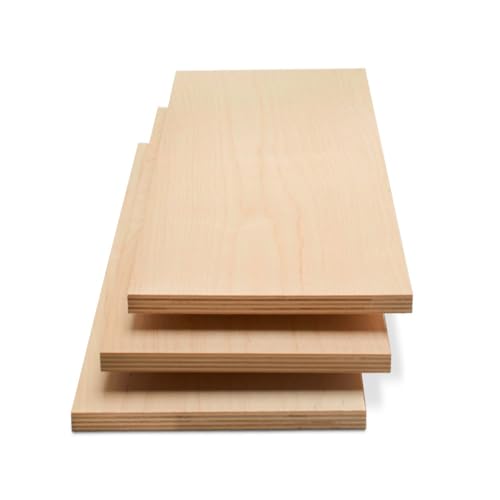
- STRONG, DURABLE, HEAVY-DUTY – These craft wood pieces of multi-coated Baltic Birch plywood offer…
- BEAUTIFUL WOOD, BEAUTIFUL PROJECT- Baltics-grown birch plywood is prized by woodworkers everywhere…
- CHOOSE LASER CUTTER WOOD – The layers of the Baltic Birch sheets of thick plywood are designed to…
Key Takeaways
- Hardwood offers superior strength, natural grain, and durability for load-bearing and high-traffic applications.
- Plywood provides greater dimensional stability and resistance to warping over wide surfaces due to cross-laminated veneer layers.
- Hardwood’s dense fibers resist dents, scratches, and water absorption better than plywood, enhancing longevity in moisture-prone areas.
- Plywood is more cost-effective, with smooth, uniform surfaces ideal for large panels but requires edge sealing to prevent damage.
- Finishing hardwood requires careful sanding for natural grain, while plywood benefits from quicker sanding and water-based polyurethane finishes.
Hardwood or Plywood: Side-by-Side Comparison
| Feature | Hardwood | Plywood |
|---|---|---|
| Material Type | Solid wood from angiosperm trees | Engineered wood made from cross-laminated veneers |
| Construction | Single, continuous piece of wood | Multiple thin wood veneers bonded in layers |
| Common Species | Oak, maple, birch, walnut, cherry | Oak, maple, poplar, birch, walnut veneers |
| Strength | Generally stronger in narrow, load-bearing applications | Offers strength in sheet form and distributes stress across layers |
| Dimensional Stability | More likely to expand and contract with humidity | Cross-laminated layers reduce expansion and contraction |
| Warping Resistance | More susceptible to movement across wide boards | Better at maintaining flatness across large panels |
| Load-Bearing Performance | Suitable for furniture legs and structural beams | Suitable for stable panels, shelving, and subfloors |
| Surface Durability | Dense fibers resist dents and scratches | Durable when finished properly, but edges can be vulnerable |
| Moisture Resistance | Generally better resistance to water absorption and decay | Resistance varies by grade, adhesive, and edge protection |
| Decay Resistance | Some species, such as oak and walnut, have natural decay-resistant properties | Core layers may weaken or delaminate with repeated moisture exposure |
| Edge Durability | Solid edges resist impacts and can be sanded after minor damage | Exposed edges can chip, wear, or delaminate |
| Surface Appearance | Unique, continuous natural grain patterns | Smooth, uniform surface with a hardwood veneer appearance |
| Grain Visibility | Grain extends through the solid wood | Grain appearance depends on the thin face veneer |
| Surface Smoothness | Requires careful sanding to achieve a uniform finish | Typically offers a more uniform surface for finishing |
| Finishing Requirements | Careful sanding, acclimation, and suitable protective finishes | Often benefits from quick sanding, edge sealing, and water-based polyurethane |
| Cost | Usually more expensive, depending on species and grade | Generally more cost-effective for large panels |
| Price Examples | Some solid hardwood lumber exceeds $10 per board foot | Hardwood plywood may cost $35 to $150 per 4 × 8-foot, 1/2-inch sheet |
| Best Applications | Furniture legs, flooring, structural beams, and decorative pieces | Cabinet sides, wardrobe backs, shelving, subfloors, and wall sheathing |
| Humidity Response | Can swell, shrink, or crack as moisture levels change | Better at maintaining shape under humidity fluctuations |
| Maintenance | Requires humidity control and appropriate protective finishes | Requires surface care, prompt repairs, and protection of exposed edges |
| Environmental Considerations | Impact depends on wood sourcing and production | Engineered construction may reduce embodied carbon per volume, but adhesives and manufacturing affect its footprint |
| Main Advantage | Natural beauty, strength, and surface wear resistance | Dimensional stability, flatness, and affordability |
| Main Limitation | Higher cost and greater movement with humidity | Vulnerable edges and cores, particularly when moisture protection is inadequate |
What Hardwood and Hardwood Plywood Are Made From?

Understanding the composition of hardwood and hardwood plywood is essential when choosing materials for your project. Hardwood comes from angiosperm trees like oak, maple, birch, walnut, and cherry, providing solid wood lumber. This lumber is a single, continuous piece of wood, prized for its natural grain and density.
Hardwood plywood is an engineered sheet product made by bonding thin wood veneers in cross-laminated layers. You’ll typically see species such as oak, maple, poplar, birch, or walnut used both in the face and core layers.
The cross-lamination in plywood enhances dimensional stability, while the face veneer offers the desired hardwood appearance. By understanding these fundamental differences in material structure, you can better select the appropriate hardwood or plywood for cabinetry, furniture, or other woodworking needs.
Additionally, kiln drying hardwood lumber reduces moisture content to improve dimensional stability and minimize warping or cracking during use.
Hardwood vs Plywood: Strength and Stability
Although solid hardwood generally offers greater strength in narrow, load-bearing applications, plywood excels in stability across wide surfaces due to its cross-laminated veneer layers. When you choose between them, consider these technical points:
Hardwood’s solid grain provides superior strength for beams or legs under direct load. Plywood’s cross-ply construction minimizes expansion, contraction, and warping over large spans.
Wide panels like cabinet sides stay flatter with plywood, reducing the risk of deformation. Hardwood boards react more to humidity fluctuations, causing potential dimensional changes.
Plywood’s engineered layers distribute stress evenly, enhancing overall surface stability.
You’ll find plywood preferable for flat, broad components requiring consistent shape, while hardwood shines in slender, load-critical parts demanding raw strength. This balance guides your material choice for structural integrity and precision in woodworking projects.
Additionally, selecting lumber with the right grain characteristics can influence strength and stability in your final project.
Which Is More Durable: Hardwood or Plywood?
When it comes to durability, hardwood definitely shines in a few key areas. It offers superior surface wear resistance and does a great job of protecting against water and decay. This makes hardwood a fantastic choice for high-use and exposed applications.
On the flip side, plywood can be a bit tricky. While it’s durable overall, it can struggle with edge damage and core wear if it’s not finished properly. So, if you’re considering plywood, just keep that in mind.
Understanding these trade-offs really helps you pick the right material for your project’s specific needs. Whether you lean towards hardwood or plywood, it all depends on what you’re looking to achieve! Plywood also retains about 86% of its original strength after wet-dry cycles, making it more resilient in moisture-prone environments than some alternatives like OSB with lower retention rates, which is an important factor to consider for long-term durability and performance in humid or coastal areas (moisture resistance).
Surface Wear Resistance
Evaluating surface wear resistance means looking closely at how hardwood and plywood hold up under daily use and exposure to impacts.
When you choose between these materials, consider that hardwood’s dense fibers provide superior resistance to dents and scratches. This makes it ideal for high-traffic surfaces.
Plywood offers good durability, especially when finished properly, but its layered construction can be vulnerable at edges and exposed cores.
Hardwood resists surface dents better due to solid wood density.
Plywood’s cross-laminated layers reduce warping, but edges can wear faster.
Hardwood plywood balances smooth surface durability with cost-effectiveness.
Poor finishing on plywood increases susceptibility to surface damage.
For long-term wear, hardwood generally outperforms plywood in maintaining appearance.
Additionally, hardwood’s superior strength and impact resistance make it a preferred choice in demanding environments.
Water And Decay
When exposed to moisture and varying environmental conditions, hardwood generally outperforms plywood in resisting water damage and decay.
Solid hardwood’s dense cellular structure slows water absorption, reducing swelling and fungal growth risk.
In contrast, plywood’s layered construction uses adhesives that may weaken or delaminate if frequently exposed to moisture, especially non-marine grades.
Hardwood species like oak and walnut have natural tannins and oils that inhibit decay, enhancing durability in damp environments.
While hardwood plywood offers moderate resistance, its core layers remain vulnerable if edges or surfaces aren’t properly sealed.
To maximize lifespan, you’ll need to apply water-resistant finishes on hardwood and ensure plywood edges are well protected.
Ultimately, solid hardwood provides superior decay resistance, making it the preferred choice for applications prone to moisture exposure.
Applying a durable water-repellent finish such as spar urethane can further protect hardwood furniture from moisture and UV damage.
Edge And Core Durability
Protecting the edges and core of wood products plays a significant role in their overall durability. When you compare hardwood and plywood, you’ll find key differences in how they handle edge and core wear.
Hardwood, being solid wood, boasts dense, durable edges resistant to dents and chipping. Plywood’s layered construction offers stability, but its edges can be vulnerable if left unfinished.
Consider these points for durability:
Hardwood edges resist impact better due to solid fiber continuity. Plywood core layers can delaminate if exposed to moisture or damage. Hardwood plywood edges require careful sealing to prevent core exposure.
Solid hardwood recovers better from minor edge damage with sanding. Plywood’s cross-laminated core improves panel stability but weakens raw edge toughness.
Ultimately, hardwood edges tend to be more durable, but plywood cores need proper protection to last. Proper edge sealing is essential for plywood to ensure long-term resistance to moisture and structural integrity.
Appearance and Finishing: Hardwood vs Plywood
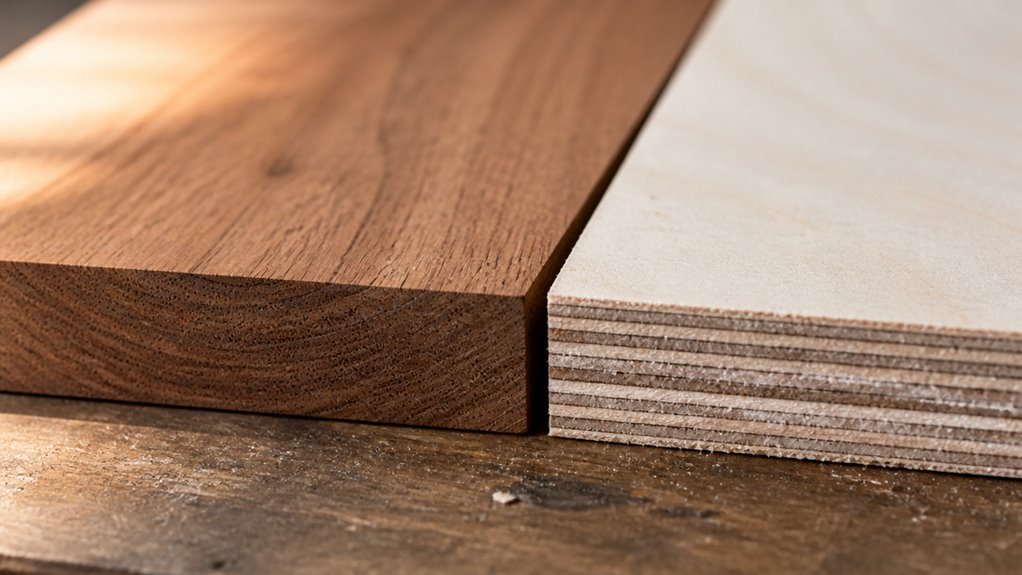
When it comes to appearance, solid hardwood really stands out. You’ll see those unique natural grain patterns that change with each species, which adds a lot of character to any finished piece. It’s almost like each piece tells its own story!
On the other hand, hardwood plywood has its own charm. It provides a smoother, more uniform surface because of its layered construction and veneer faces. This consistency can be great if you’re looking for a sleek finish. So, when you’re deciding between the two, keep these differences in mind. They can really influence the overall look and feel of your project! For enhancing natural wood surfaces like these, choosing the right finish is key to balancing protection and aesthetic appeal.
Natural Grain Differences
The natural grain of hardwood offers distinct visual character that plywood can only approximate through its face veneers.
When you work with solid hardwood, you see continuous grain patterns running through the thickness, showcasing unique knots, rays, and growth rings.
Hardwood plywood, however, relies on a thin veneer layer, which limits the depth of grain visibility and can lead to repeating patterns in larger sheets.
Consider these points when choosing:
- Hardwood grain varies widely by species and board cut (flat, quarter, rift).
- Plywood grain appearance depends on veneer quality and matching techniques.
- Hardwood grain reflects natural growth anomalies, enhancing uniqueness.
- Plywood veneers may show glue lines and edge layering upon close inspection.
- Finishing techniques like staining and sealing behave differently on solid grain versus veneers.
This impacts your project’s aesthetic authenticity and finishing approach. When applying veneer to curved surfaces, it is essential to select flexible, paper-backed veneer to maintain the natural flow of grain and prevent cracking.
Surface Smoothness Comparison
Since the natural grain of hardwood and plywood veneers affects their visual depth and texture, surface smoothness plays a key role in finishing outcomes.
Hardwood’s solid surface can have minor imperfections like pores and grain variation, which require careful sanding to achieve uniform smoothness. You’ll need finer grit abrasives and consistent pressure to avoid unevenness.
Plywood, on the other hand, offers a more uniform surface thanks to its thin, cross-laminated veneers. This makes sanding quicker and produces a consistently smooth finish ideal for laminates or paints.
However, exposed edges in plywood can feel rough unless sealed or edge-banded. When finishing, hardwood provides a tactile natural feel. Plywood’s smoothness supports efficient, clean coatings, especially in cabinetry and furniture where flawless surfaces matter.
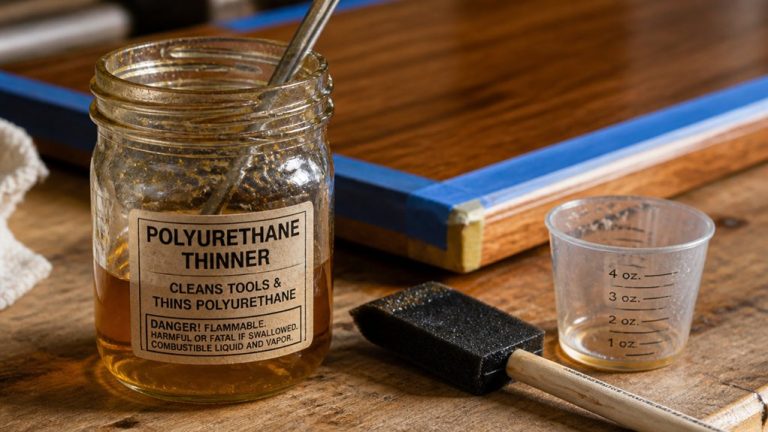
For durable protection and enhanced appearance on plywood surfaces, finishes like water-based polyurethane are often preferred due to their fast drying times and clear, tough films.
Cost Comparison of Hardwood and Plywood
Although hardwood offers unmatched aesthetic and structural qualities, you’ll often find its cost markedly higher compared to plywood.
When budgeting your project, consider these key cost factors:
Solid hardwood lumber prices vary widely depending on species and cut, often exceeding $10 per board foot.
Hardwood plywood sheets typically range from $35 to $150 per 4×8 sheet at 1/2 inch thickness, depending on species and grade.
Standard plywood options can be more affordable, with prices between $12 and $120 per sheet, offering budget-friendly alternatives.
Premium hardwood plywood provides a cost-effective way to achieve hardwood appearance without the full expense of solid wood.
Installation and finishing costs may rise with hardwood due to required precision and potential waste from defects.
Understanding these cost dynamics helps you select the right material for your budget and design goals.
Additionally, considering the dimensional stability of hardwood species can influence long-term maintenance costs and project durability.
When to Choose Hardwood?
If you need materials that deliver superior strength and natural beauty for visible, load-bearing components, hardwood is often your best choice.
Hardwood, sourced from angiosperm trees like oak or maple, provides dense, solid wood with excellent load capacity in narrow applications such as furniture legs, flooring, or structural beams.
Its natural grain offers premium aesthetics unmatched by engineered panels.
You should choose hardwood when durability and resistance to dents, scratches, and moisture matter, especially in high-traffic or decorative settings.
However, be aware hardwood is prone to movement with humidity changes, so precise acclimation and finishing are essential.
When your project demands a strong, visually appealing, and long-lasting solution for narrow or structural elements, hardwood’s performance and appearance make it the most advantageous material.
When to Choose Plywood?
When working on wide surfaces that require consistent flatness and dimensional stability, plywood offers distinct advantages over solid hardwood.
You’ll want to choose plywood when:
- Fabricating large panels like cabinet sides or wardrobe backs that must resist warping.
- Building furniture or shelving where smooth, uniform surfaces matter for finish quality.
- Needing a cost-effective alternative to hardwood with comparable strength in sheet form.
- Constructing subfloors, wall sheathing, or wide interior joinery requiring stability across broad spans.
- Seeking material that minimizes expansion and contraction due to humidity changes.
Plywood’s cross-laminated veneer layers reduce movement and maintain flatness better than solid wood.
This makes it ideal for applications where surface integrity and dimensional consistency are critical over large areas.
Environmental Impact of Hardwood and Plywood
Because hardwood plywood production relies heavily on raw material extraction and energy-intensive manufacturing, you should consider its environmental footprint carefully.
Raw material extraction accounts for over 60% of environmental impacts, including deforestation and habitat disruption.
Manufacturing processes contribute nearly 30%, driven primarily by natural gas and electricity use, while transportation adds about 11%.
Adhesives, waxes, and resins used in plywood add roughly 18% to combined raw material and transport impacts.
Compared to solid hardwood, plywood’s engineered cross-laminated structure can reduce embodied carbon per volume, but it still depends on sustainable sourcing and efficient production.
When choosing between hardwood and plywood, assess suppliers’ environmental product declarations.
Look at factors like life-cycle global warming potential and emissions to make an informed, ecologically responsible decision.
Tips for Maintaining Hardwood and Hardwood Plywood
Understanding the environmental footprint of hardwood and plywood sets the stage for proper care that extends their lifespan and maintains performance.
To keep hardwood and hardwood plywood in top condition, you need to manage moisture, prevent damage, and apply appropriate finishes.
Control indoor humidity between 30-50% to reduce wood expansion or contraction.
Clean surfaces regularly with a damp cloth; avoid harsh chemicals that degrade finishes.
Apply polyurethane or oil-based sealants to protect hardwood and plywood edges from moisture and wear.
Use furniture pads and avoid dragging heavy items to prevent dents and scratches.
Inspect joints and veneers periodically, repairing loose layers or chips promptly to prevent further damage.
Following these steps preserves structural integrity and appearance, reducing waste and environmental impact over time.
Frequently Asked Questions
Can Hardwood Plywood Be Recycled or Repurposed After Use?
You can recycle or repurpose hardwood plywood, but it requires care. The adhesives and resins used in manufacturing complicate recycling.
Mechanical recycling or downcycling into composite materials is common. For repurposing, you can salvage sheets for smaller projects, furniture, or cabinetry if edges and surfaces remain intact.
Avoid burning due to toxic fumes from adhesives. Proper disposal or reuse helps reduce environmental impact while extending the plywood’s lifecycle effectively.
How Do Humidity Levels Specifically Affect Hardwood Versus Plywood?
Humidity can throw a wrench in the works for hardwood because it naturally expands, contracts, and warps as moisture levels change.
You’ll notice solid hardwood boards swelling or shrinking, which may cause gaps or cracking over time.
Plywood, on the other hand, uses cross-laminated layers that resist these dimensional changes much better, maintaining flatness and stability.
Are There Health Concerns With Adhesives Used in Plywood?
Yes, you should be aware that adhesives in plywood often contain formaldehyde-based resins, which can off-gas volatile organic compounds (VOCs).
Prolonged exposure to these VOCs may cause respiratory irritation, headaches, or allergic reactions.
To minimize risks, choose plywood labeled as low-emission or CARB-compliant.
Ensure good ventilation during and after installation, and use sealants or finishes to reduce off-gassing.
Proper handling and storage also help limit exposure.
What Tools Are Best for Cutting Hardwood Plywood?
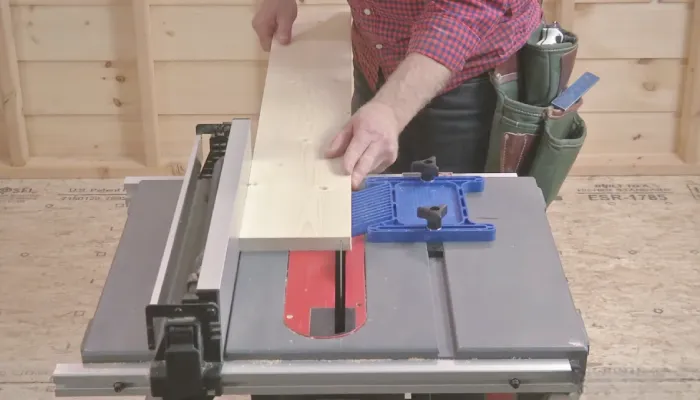
You’ll want to use a circular saw or table saw with a fine-toothed carbide blade designed for plywood to get clean cuts without splintering.
A straightedge guide helps maintain precision.
For intricate shapes, a jigsaw with a fine blade works well.
Always score the cut line first to reduce tear-out.
Clamping the plywood firmly and cutting slowly guarantees smooth, accurate edges, letting you handle hardwood plywood efficiently and cleanly.
How Long Does Hardwood Plywood Typically Last in Cabinetry?
You can expect hardwood plywood cabinetry to last 20 to 30 years or more with proper care. Its layered construction resists warping and maintains stability, especially in humidity changes.
However, durability depends on the quality of adhesives, finish, and edge protection. To maximize lifespan, seal edges well and avoid prolonged moisture exposure.
Routine maintenance like cleaning and timely repairs also help keep your cabinets functional and attractive for decades.
- 💯 Included are 5 Black Walnut 5 Cherry and 5 Hard Maple 3/4″ x 2″ x 12″
- ✔️Beautiful Grain
- 🔥 Perfectly Kiln Dried
- STRONG, DURABLE, HEAVY-DUTY – These craft wood pieces of multi-coated Baltic Birch plywood offer…
- BEAUTIFUL WOOD, BEAUTIFUL PROJECT- Baltics-grown birch plywood is prized by woodworkers everywhere…
- CHOOSE LASER CUTTER WOOD – The layers of the Baltic Birch sheets of thick plywood are designed to…
Final Thoughts on Choosing Between Hardwood and Plywood
Imagine the rich grain of hardwood glowing under your touch, offering timeless strength and elegance. Plywood stands firm with layered resilience and cost-effective versatility.
You’ll choose hardwood for lasting beauty and durability in high-traffic spaces, or plywood when stability and budget matter most. Understanding their makeup, strength, and care helps you make smart, lasting decisions for your projects.
Balancing performance, appearance, and environmental impact with precision and confidence is key.
Last update on 2026-10-31 / Affiliate links / Images from Amazon Product Advertising API