What Is a Track Saw Used for: Easy Step-by-Step Guide
You use a track saw to make clean, straight cuts on sheet goods and large panels with ease. Its guide rail keeps the blade perfectly aligned, letting you avoid manual steering and heavy lifting.
You can adjust blade depth to match material thickness and even start plunge cuts anywhere on the workpiece. Track saws are great for ripping, crosscutting, beveling, and trimming various materials right where they lie.
Keep going to find out how they boost precision and portability on the job.
Key Takeaways
- A track saw is used to make straight, clean cuts on sheet goods and large panels with precise blade alignment via a guide rail.
- It enables plunge cuts, allowing users to start cutting anywhere on the workpiece for increased flexibility.
- Ideal for rip cuts, crosscuts, bevel cuts, and miter cuts on various materials including plywood, MDF, and flooring.
- Its portability and compact design allow on-site cutting without relocating heavy or bulky materials, improving workflow efficiency.
- Integrated dust extraction and secure locking features ensure cleaner cuts and safer operation during construction and remodeling tasks.
What’s a Track Saw and How Does It Work?

If you’ve ever struggled to make long, straight cuts with a handheld saw, a track saw can really step up your game.
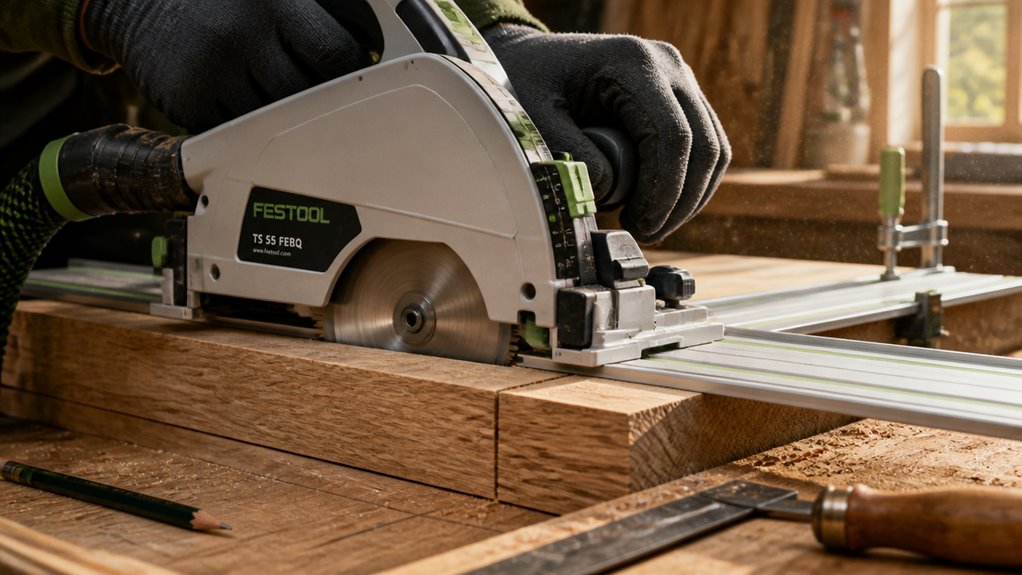
It uses a guide rail that keeps the blade perfectly aligned, so you get straight, clean cuts every time.
You simply place the track on your material, lock it down, and run the saw along the rail.
This setup eliminates the guesswork and manual steering needed with a circular saw.
The blade’s depth adjusts to match your material thickness, and many models allow plunge cuts, letting you start cuts anywhere on the workpiece.
You’ll find this tool invaluable when working with sheet goods or large panels, especially where space or setup for bigger saws isn’t practical.
For even more precise cuts, using a track saw with a precision track saw square ensures perfectly square results every time.
Why Use a Track Saw Instead of a Table Saw?
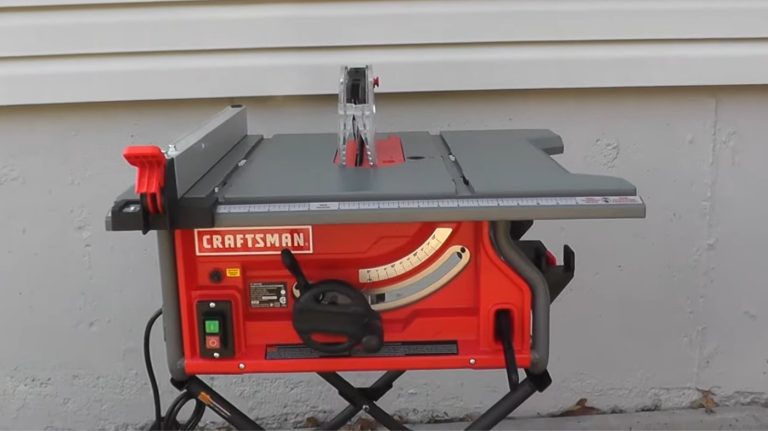
When your workspace is limited or you need to cut large sheets on-site, a track saw offers clear advantages over a table saw.
You don’t need a large, fixed setup or infeed and outfeed space to handle full sheets. Instead, you bring the saw to the material, reducing heavy lifting and transport hassles.
The track guarantees straight, accurate cuts without constant manual guidance, which can be tough on a table saw when working in tight or mobile environments.
It’s also easier to control dust and minimize tear-out, giving cleaner edges that reduce sanding.
For small shops, garages, or job sites, the track saw’s portability and precision make it a more practical choice than a bulky table saw that requires a dedicated space.
Using quick-release clamps with a track saw can further enhance workflow efficiency and secure cuts.
What Types of Cuts Can a Track Saw Make?
How exactly can a track saw expand your cutting options? It lets you perform rip cuts, crosscuts, bevel cuts, and miter cuts with high precision.
The guide rail guarantees your cuts stay straight and consistent, whether you’re cutting long sheet goods or trimming smaller boards. You can also make plunge cuts, which start in the middle of a panel, giving you flexibility that’s hard to match with other saws.
Many track saws handle large-angle cuts accurately, making them ideal for oversized or awkwardly shaped pieces. This versatility means you can tackle a wide range of tasks, from breaking down plywood sheets to fine-tuning edges, without switching tools or setups.
This streamlines your workflow and boosts your control over every cut. Using blades with different tooth counts allows you to balance between smooth finishes and faster cutting speeds depending on your project needs.
Which Materials Can You Cut With a Track Saw?
Track saws cut through a wide variety of materials, making them versatile tools for many projects. You can rely on a track saw to slice plywood, MDF, and melamine with clean, straight cuts.
It also handles particleboard, OSB, and hardboard efficiently. For softer materials like foam board or drywall, a track saw delivers precision without tearing. You can even cut large glued-up panels or slabs accurately without moving the material to a stationary saw.
| Material | Typical Use |
|---|---|
| Plywood | Cabinetry, shelving |
| MDF | Furniture, moldings |
| Melamine | Cabinets, countertops |
| Particleboard | Low-cost furniture |
| Hardboard | Backing panels, crafts |
Choose the right blade for each material to guarantee clean cuts and extend blade life. For enhanced precision and safety when making narrow or repetitive cuts, consider using a thin rip guide accessory designed to stabilize the workpiece.
Track Saws in Construction and Remodeling
Track saws really shine when it comes to trimming doors. They make it easy to get that perfect fit without any guesswork, which is a huge time-saver.
And when you’re dealing with flooring cuts—whether it’s laminate, hardwood, or vinyl—these saws deliver clean and accurate results. You can trust them to do the job right every time.
Plus, if you need to cut wall and floor sheathing on-site, a track saw speeds up the process and ensures precision. It’s a game-changer for any construction or remodeling project!
For enhanced accuracy and versatility, many professionals complement track saws with tools featuring precise angle control and laser guides to achieve flawless cuts.
Door Trimming Precision
Achieving a perfect fit for doors often requires precise trimming. A track saw makes this task straightforward.
You can quickly shave off small amounts from the door edge to guarantee it swings smoothly without sticking. The guide rail keeps your cuts straight and consistent, eliminating guesswork and frustration.
Unlike handheld saws, the track saw controls depth and angle. This way, you avoid damaging the door or frame.
With a track saw, you can:
- Achieve clean, splinter-free edges
- Trim doors on-site without relocating heavy panels
- Maintain tight tolerances for seamless installation
- Save time by reducing trial-and-error adjustments
Choosing the right blade with the proper kerf thickness ensures cleaner cuts and reduces material waste.
This precision tool helps you deliver professional results every time you trim doors during remodeling or new construction.
Flooring Cut Applications
Cutting flooring materials like laminate, hardwood, and vinyl demands accuracy to guarantee a flawless fit. A track saw helps you achieve clean, straight cuts without splintering, essential for tight seams and professional results.
Its guide rail makes certain your cuts stay perfectly aligned, whether you’re trimming planks to length or sizing them to fit irregular spaces. You can make precise rip cuts and crosscuts quickly on-site, avoiding the hassle of moving heavy flooring pieces to a stationary saw.
The tool’s portability lets you cut materials right where they’ll be installed, saving time and reducing mistakes. Plus, depth adjustment helps you avoid cutting too deep into subfloors or underlayment, preserving the integrity of your flooring system during installation.
For enhanced precision and safety, many professionals use specialized jigs with features like measurement adjustability and edge stability to complement their track saw work.
On-Site Sheathing Cuts
After handling flooring cuts on-site, you can apply similar precision when working with wall and floor sheathing. A track saw lets you make straight, clean cuts right where the panels need fitting, avoiding wasted time moving heavy sheets. You’ll appreciate how easily it handles large plywood or OSB sheets, producing smooth edges without splintering.
With a track saw, you can cut sheathing panels accurately to size in tight job sites. You can reduce material waste by making precise rip and crosscuts. You can work safely and efficiently without bulky stationary saws. You can finish framing prep faster with clean, professional cuts.
Using a track saw for on-site sheathing guarantees your installation is precise and efficient, improving overall build quality. Proper sealing and installation quality critically affect the long-term durability of both plywood and OSB panels, making precision cuts essential for moisture resistance.
Why Portability Matters for Track Saws?
When you need to work on-site or in tight spaces, portability becomes a key advantage of track saws. You can easily carry the saw and guide rail to wherever the material lies, avoiding heavy lifting or moving bulky sheets.
This mobility lets you make precise cuts directly on the job, saving time and effort. The compact design fits in your vehicle and tight work areas, making it ideal for remodeling or small workshops.
| Benefit | Why It Matters |
|---|---|
| Easy transport | Carry between sites effortlessly |
| Space-saving | Fits in small work areas |
| On-site cutting | Cuts material without relocation |
| Quick setup | Ready to use immediately |
Portability means you stay efficient and flexible in any location. Many track saws also feature integrated dust extraction to help maintain a clean workspace while working on-site.
Key Features When Choosing a Track Saw
Although many track saws look similar, choosing the right one comes down to specific features that match your work style and project needs. Focus on what’ll make your cuts easier, safer, and more accurate.
Choosing the right track saw hinges on features that enhance ease, safety, and precision in your cuts.
Consider these key features when selecting your track saw:
- Track length and compatibility: Longer rails give you flexibility for bigger cuts.
- Blade depth adjustment: Guarantees clean cuts matching various material thicknesses.
- Dust collection system: Keeps your workspace cleaner and improves visibility.
- Safety features: Secure locking mechanisms and reliable controls protect you during use.
Additionally, considering fence systems with three-point locking can enhance precision and safety in your cutting tasks.
Frequently Asked Questions
How Do You Maintain and Clean a Track Saw?
To maintain and clean your track saw, unplug it first.
Remove dust and debris from the blade, motor vents, and guide rail using a brush or compressed air.
Wipe the track with a damp cloth to keep it smooth and free of buildup.
Regularly check blade sharpness and replace it when dull.
Lubricate moving parts lightly if recommended by the manufacturer.
Store your saw and track in a dry place to prevent rust and damage.
Can a Track Saw Be Used for Metal Cutting?
You can use a track saw for metal cutting, but it’s not ideal without the right blade and setup.
Standard track saws are designed for wood and sheet goods, so you’ll need a metal-cutting blade and possibly slower speeds.
Also, make certain proper safety gear and dust extraction.
For thick or hard metals, a dedicated metal saw or angle grinder is safer and more effective.
Don’t push your track saw beyond its intended purpose.
What Safety Gear Is Recommended When Using a Track Saw?
You should always wear safety glasses to protect your eyes from flying debris and ear protection to guard against loud noise.
A dust mask or respirator helps keep dust out of your lungs, especially when cutting materials like MDF or drywall.
Gloves can protect your hands but make sure they don’t interfere with your grip.
Also, wear sturdy footwear and avoid loose clothing that could get caught in the saw.
How Do You Store and Transport Track Saw Rails?
Think of your track saw rails as delicate rulers. Store them flat or hang them to avoid warping or bending. Use a protective case or wrap them in a soft cloth to prevent scratches during transport.
Carry rails parallel to your body, securing them with straps or bungee cords if you’re loading them onto a vehicle. Keeping rails straight and scratch-free guarantees your cuts stay crisp and accurate every time you work.
Are There Specific Brands Known for Track Saw Reliability?
Yes, brands like Festool, Makita, and DeWalt are well-known for track saw reliability.
Festool leads with precision and durability but comes at a higher price.
Makita offers solid performance and good value, while DeWalt balances power and affordability.
When choosing, consider your budget, cutting needs, and rail compatibility.
These brands have a proven track record, so you’ll get consistent, accurate cuts without frequent breakdowns or maintenance headaches.
Track Saw for Furniture and Home Remodeling Projects
When you glide a track saw along its rail, imagine slicing through wood like a hot knife through butter—clean, straight, and effortless.
Whether you’re remodeling your kitchen or crafting custom furniture, this tool gives you precision without the bulk of a table saw.
Its portability means you can take that smooth cut anywhere, turning tough jobs into simple tasks.
With the right track saw, you’re equipped to make every cut count.


![Best Tape Measure for Woodworking: Top Picks for [year]](https://woodhandy.com/wp-content/uploads/2025/08/top_woodworking_tape_measures_2af4j-768x432.jpg)