Poplar vs Maple: Strength, Weight & Price Differences Explained
You’ll find maple particularly harder and denser, offering superior strength and durability for heavy-use items like flooring and tool handles.
Poplar, being lighter and softer, excels in intricate joinery and paint-grade work due to its ease of machining.
Maple resists dents and wears well but costs more, while poplar is budget-friendly but may require extra prepping for smooth finishes.
Understanding these differences helps you pick the best wood tailored to your project’s demands and finish expectations.
Key Takeaways
- Maple is significantly harder and denser than poplar, offering superior strength and durability for heavy-use applications.
- Poplar is lighter and softer, making it easier to machine and ideal for painted, intricate, or lightweight projects.
- Maple’s higher density provides better wear resistance and longevity, especially for floors, tool handles, and work surfaces.
- Both woods have comparable stability when kiln-dried, but maple is slightly less forgiving to moisture fluctuations.
- Choose maple for structural strength and durability, and poplar for ease of shaping, lower weight, and cost-effective interior uses.
Poplar and Maple Side-by-Side Comparison
| Feature | Poplar | Maple (Hard Maple Focus) |
|---|---|---|
| Janka Hardness | 540 lbf | 1450 lbf |
| Density (Avg.) | 0.42 g/cm³ | 0.63 g/cm³ |
| Weight | Lightweight | Heavy |
| Durability | Moderate (prone to dents) | High (excellent wear resistance) |
| Best For | Cabinets, doors, paint-grade projects | Flooring, tool handles, heavy furniture |
| Workability | Very easy to cut, shape & glue | Harder to machine, needs sharp tools |
| Paint Finish | Absorbs more, may fuzz | Smooth, crisp edges |
| Stain Finish | Can be blotchy (needs conditioner) | Even, vibrant stain absorption |
| Moisture Stability | Stable when kiln-dried | Stable but slightly less forgiving |
| Outdoor Use | Not recommended untreated | Not recommended untreated |
| Cost | Budget-friendly | More expensive |
| Longevity | Moderate lifespan | Long-lasting under heavy use |
| Ideal Use Case | Interior trim, lightweight joinery | High-impact, structural applications |
Hardness and Durability Differences for Poplar & Maple

When choosing between poplar and maple, understanding their hardness and durability is crucial.
Maple, especially hard maple, boasts a Janka hardness of 1450 pounds, making it markedly more resistant to dents and scratches than poplar, which measures 540 pounds.
This hardness difference means maple endures heavy-use items like flooring and tool handles better, offering superior strength and longevity.
Poplar’s lower hardness makes it more prone to damage under stress, though it remains suitable for lighter applications such as cabinets and doors.
Durability correlates closely with hardness here; maple’s denser cell structure provides enhanced wear resistance, while poplar’s softness limits its lifespan in high-impact environments.
You should choose maple when durability is critical, but poplar can suffice where lighter, less demanding use is expected.
Additionally, understanding the impact resistance of wood species can guide better material selection for specific project needs.
Poplar or Maple? A Clear Look at Weight and Density Differences
When comparing poplar and maple, one of the first things you’ll notice is the density difference. For instance, hard maple has a density of around 0.63, making it significantly heavier and more durable than poplar, which sits at about 0.42.
This weight difference really matters, especially if you’re working on a project where strength and stability are key. You want to make sure the wood can hold up under stress, right?
Similar to how Yellow Pine’s higher density enhances its durability and load capacity, choosing a denser wood like maple can provide better performance in structural applications due to its superior mechanical properties.
Density Differences Explained
Although both poplar and maple are popular hardwood choices, their density differences markedly affect their weight and performance in woodworking.
Maple’s density ranges from 0.47 to 0.63 g/cm³, depending on the species, making it notably denser than poplar, which averages around 0.42 g/cm³.
This higher density in maple translates to increased hardness and durability, essential for applications requiring structural strength.
Conversely, poplar’s lower density gives it a lighter weight, enhancing flexibility and ease of machining but reducing overall strength.
You’ll notice poplar’s reduced density also leads to increased fuzzing during machining, whereas maple’s compact grain yields smoother finishes.
Understanding this density disparity helps you select the right wood based on weight constraints and performance needs without compromising your project’s integrity.
Additionally, pairing maple with darker woods like walnut can create a striking contrast that enhances visual depth and texture in your woodworking projects, as maple provides a bright contrast to walnut’s deep tones.
Weight Impact On Usage
Frequently, the weight difference between poplar and maple markedly influences their practical applications in woodworking projects.
Maple’s higher density, around 0.63 for hard maple, makes it notably heavier than poplar, which averages 0.42 in density.
This added weight translates to greater structural support and stability in items subject to frequent handling or heavy loads, such as flooring or tool handles.
Conversely, poplar’s lighter weight offers advantages in applications requiring easier maneuverability or intricate joinery, like cabinets and doors.
The reduced mass of poplar also lessens shipping costs and eases installation.
When selecting between the two, you should consider weight as a key factor: choose maple for durable, weight-bearing projects and poplar when you need a lighter, more flexible wood without compromising basic strength.
Additionally, applying the appropriate finish type can enhance the durability and appearance of both woods, depending on the project’s requirements.
Durability Linked To Density
Since density directly affects a wood’s structural integrity, understanding the differences between poplar and maple helps you predict their durability under stress.
Maple, with a density around 0.63 for hard varieties, offers superior strength and resistance to denting compared to poplar’s lower density of 0.42.
This higher density in maple correlates with its greater Janka hardness, making it ideal for heavy-use applications like flooring and tool handles.
Poplar’s lower density means it’s softer and more prone to dents and scratches, which limits its durability in high-impact scenarios.
However, poplar’s reduced density also decreases chip-out risk, making it easier to machine for intricate work.
When durability under load and long-term wear is critical, maple’s density provides a clear advantage over poplar.
Additionally, woods with a density near maple’s 0.63, such as black walnut, provide desirable structural integrity and resistance to warping and cracking for cutting boards and furniture.
Wood Stability and Shrinkage Explained
Hey there! So, when it comes to wood shrinkage, it’s pretty interesting to see how hard and soft maple behave differently. Did you know that hard maple shrinks around 9.9% while soft maple is in the range of 7.2-8.2%? It’s quite a noticeable difference, right?
Now, if you’re working with kiln-dried poplar, you’ll be happy to hear that it shows similar stability. That’s a win for those projects! One thing to keep in mind, though, is that controlling moisture content is super important. If you don’t, you might end up with hairline cracks or joint failures in both species of maple. Using the right wood stabilizing techniques can help minimize these issues effectively.
Wood Shrinkage Rates
Understanding wood shrinkage rates is essential when selecting materials for woodworking projects, as dimensional changes can affect the stability and integrity of your work.
Hard maple exhibits a shrinkage rate near 9.9%, while soft maple ranges between 7.2% and 8.2%.
Poplar, when kiln-dried properly, shows comparable stability but can vary slightly due to density differences. Higher shrinkage increases the risk of hairline cracks, so controlling drying processes is imperative.
Use the table below to compare key shrinkage values:
| Wood Type | Shrinkage Rate (%) |
|---|---|
| Hard Maple | 9.9 |
| Soft Maple | 7.2 – 8.2 |
| Yellow Poplar | Similar to maple |
| Kiln-dried Poplar | Comparable to maple |
| General Note | Higher shrinkage risks cracks |
Accurate shrinkage knowledge helps you minimize joint stress and maintain your project’s dimensional accuracy.
Moisture Content Impact
Although moisture content fluctuates naturally, controlling it precisely is essential for maintaining wood stability and minimizing shrinkage.
Both poplar and maple respond to moisture changes by expanding or contracting, but kiln-dried wood with a moisture content around 6-8% guarantees dimensional stability.
If moisture rises above fiber saturation point, wood swells, risking joint stress and warping.
Conversely, overly dry wood shrinks, increasing hairline cracks, especially in higher shrinkage species like hard maple (9.9%).
Poplar, with slightly lower density and comparable shrinkage rates when kiln-dried, offers similar stability.
By monitoring and maintaining consistent moisture content during storage and fabrication, you prevent distortions and ensure tight joints.
Proper moisture control is critical for both woods, but maple’s higher density makes it slightly less forgiving to moisture fluctuations than poplar.
Additionally, just as variable speed control optimizes tool performance for different materials, precise moisture regulation optimizes wood stability during processing.
Workability: Which Wood Is Easier to Use?
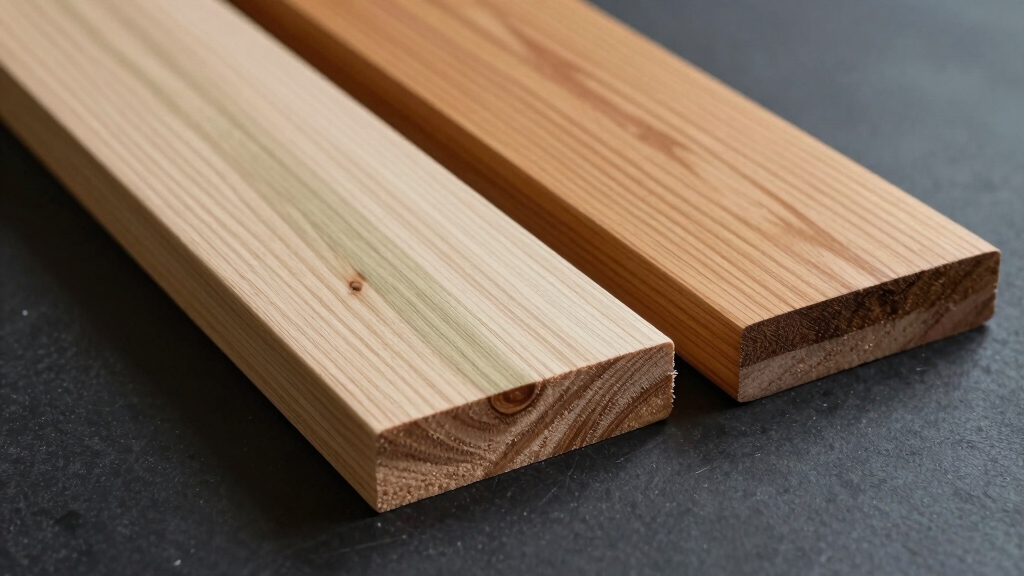
When working with wood, poplar offers greater ease due to its lighter weight and flexibility, making it ideal for intricate joinery and detailed cabinetry.
You’ll find poplar easier to cut, shape, and glue because its lower density reduces tool wear and allows cleaner cuts with less chip-out.
Its softness does cause more denting and fuzzing during machining, but proper sanding mitigates this.
Maple, by contrast, is markedly harder and denser, which demands sharper tools and more effort when working, especially for complex shapes.
However, its strength benefits heavy-duty furniture and flooring.
Both woods remain stable when kiln-dried properly, but poplar’s workability advantages make it the preferred choice for projects requiring fine detail and faster processing without sacrificing sufficient durability.
Choosing tools made from durable materials with precise measurement features, such as those with extruded aluminum blades, can help ensure accuracy and ease when working with both woods.
How Poplar and Maple Take Paint and Stain Differently?
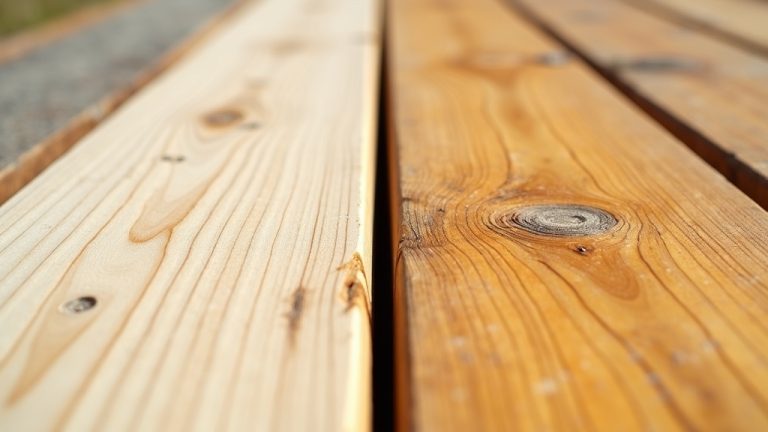
Since poplar has a more porous surface than maple, it tends to absorb paint differently, resulting in a duller finish with less crisp edges.
Maple’s denser grain sands smoothly, creating a non-porous base that holds paint and stain sharply without fuzzing.
Poplar’s lower density causes fuzzing in detailed machining, affecting paint clarity, while maple resists this problem.
When staining, maple’s tight grain accepts color evenly, enhancing its natural beauty.
Poplar often requires a pre-conditioner to avoid blotchy results.
Proper surface preparation, including sanding and priming, is essential to achieve smooth and durable paint finishes on both woods, especially for porous surfaces like poplar that benefit from a high-quality primer to seal the wood.
| Property | Poplar | Maple |
|---|---|---|
| Surface Porosity | High (more absorbent) | Low (smooth, dense) |
| Paint Finish | Duller, fuzzing in details | Crisp, smooth edges |
| Stain Response | Uneven, needs pre-treatment | Even, vibrant coloration |
Best Uses for Maple: When Strength Matters

Choose maple for projects that demand exceptional strength and durability. Its high Janka hardness—up to 1450 pounds for hard maple—ensures resistance to dents and wear.
This makes it ideal for heavy-use items like flooring, tool handles, and work surfaces. Maple’s density (0.63 for hard maple) supports structural stability under stress, reducing deformation over time.
When you need material that withstands impact and maintains integrity, maple outperforms poplar, which is softer and less dense. Additionally, maple’s excellent sanding properties create a smooth, non-porous surface, enhancing finish longevity.
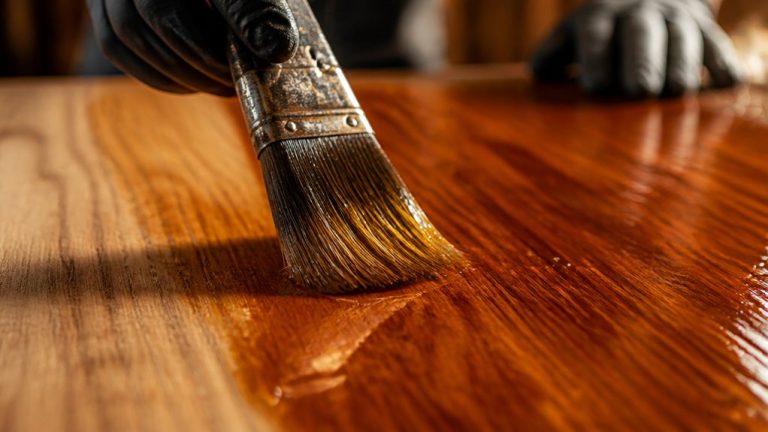
While harder to machine than poplar, maple’s robustness justifies its use in applications subjected to regular heavy loads. Opt for maple when your project prioritizes strength, longevity, and resistance to mechanical damage over ease of shaping or cost. To maintain this durability and natural look, consider applying a durable polyurethane finish that resists scratches and moisture.
Ideal Applications for Poplar: Lightweight and Flexible Options
Poplar frequently serves as the preferred choice for projects requiring lightweight, flexible wood that’s easy to shape. Its lower density (0.42) and softer texture make it ideal for intricate joinery, painted cabinets, and doors where you need precise cuts without heavy-duty strength.
You’ll find poplar easier to glue and less prone to chip-out, though it may fuzz during machining.
| Application | Why Poplar Works |
|---|---|
| Cabinets & Doors | Lightweight, easy to shape |
| Internal Joinery | Flexible, good glue adhesion |
| Painted Surfaces | Accepts paint well, cost-effective |
While not as hard as maple, poplar’s workability and stability when kiln-dried suit many interior applications requiring form and finesse over durability.
Cost Comparison: Poplar vs Maple Prices and Value
While poplar offers excellent workability and affordability for interior applications, understanding how its cost compares to maple helps determine the best value for your project.
Poplar generally costs about half as much as maple, making it an economical choice, especially for paint-grade work. Maple’s higher price reflects its superior hardness, density, and durability, which justify the investment for heavy-use furniture or flooring.
You’ll pay more upfront for maple, but its longevity and resistance to dents can reduce replacement and maintenance costs. Poplar’s softer nature leads to more surface wear, which might increase refinishing frequency.
When budgeting, factor in both material price and expected lifespan. Choosing poplar favors initial savings and ease of work, while maple offers greater long-term value due to strength and resilience.
Choosing the Right Wood: Poplar or Maple for Your Project
How do you determine the best wood for your project? Start by evaluating your needs.
If durability and hardness matter, like for flooring or heavy-use furniture, maple’s high Janka hardness (up to 1450 pounds) and density (0.63) provide superior strength and resistance to dents.
Conversely, if you require ease of machining, flexibility, and cost-efficiency, such as for cabinets or painted surfaces, poplar’s lower density (0.42) and softer nature make it ideal.
Poplar also offers better gluing and less chip-out but may fuzz during detailed work.
Consider finishing too: maple sands to a smooth, paint-ready surface, whereas poplar’s porous texture can dull paint finish.
Ultimately, choose maple for stain-grade, heavy-duty projects and poplar for paint-grade or intricate joinery, balancing performance with budget constraints.
Frequently Asked Questions
Are Poplar and Maple Sustainably Harvested?
Yes, both poplar and maple can be sustainably harvested when sourced from well-managed forests certified by organizations like FSC or SFI.
You should verify the supplier’s certification to make certain sustainable practices are followed, including selective logging and reforestation.
Sustainable harvesting maintains ecosystem health and wood quality over time.
However, availability of certified wood varies regionally, so always check specific product sourcing to confirm sustainable credentials before purchasing either species.
How Do Poplar and Maple Woods React to Moisture Over Time?
You’ll find both poplar and maple react similarly to moisture over time when kiln-dried properly.
They exhibit comparable stability and shrinkage rates. Hard maple shrinks about 9.9%, soft maple 7.2-8.2%, and poplar close to maple.
If moisture content isn’t controlled, you risk hairline cracks and joint issues.
Maintaining proper moisture levels guarantees dimensional stability and prevents warping or checking in both wood types.
Can Poplar or Maple Be Used Outdoors Without Treatment?
Sure, you can leave poplar or maple outside without treatment if you want a quick lesson in wood decay and warping.
Neither is naturally weatherproof; poplar resists warping better but still isn’t rot-resistant.
Maple’s density doesn’t save it from moisture damage.
To keep your wood looking sharp and lasting, you’ll need sealants or finishes.
Otherwise, expect swelling, cracking, and a fast ticket to the compost heap.
Which Wood Has Better Resistance to Insect Damage?
Maple generally offers better resistance to insect damage compared to poplar. Its dense grain and hardness make it less attractive and harder for insects to penetrate.
Poplar’s softer, less dense structure tends to be more vulnerable, especially if left untreated. If you need wood in environments prone to insect activity, choosing maple or applying proper insect-resistant treatments to poplar will improve durability and reduce potential damage markedly.
Do Poplar or Maple Emit Any Allergens or Odors?
You won’t find strong allergens or odors emitted by either wood under normal conditions.
Both poplar and maple are generally low in volatile organic compounds (VOCs), minimizing respiratory irritation risks.
However, when cutting or sanding, you might inhale fine dust that can cause mild allergic reactions in sensitive individuals.
Using proper dust collection and masks prevents this.
Neither wood naturally emits significant odors or allergens that affect indoor air quality.
Build with Purpose, Finish with Pride
Choosing between poplar and maple is like picking the right tool from a well-equipped toolbox: maple offers the strength and durability for heavy-duty tasks, while poplar provides lightweight flexibility for projects needing ease and adaptability.
Understanding their hardness, density, and finish responses helps you match the wood’s character to your project’s demands. By knowing their unique qualities, you make certain your craftsmanship stands strong and looks sharp, no matter which wood you select.