Cross Cut vs Rip Cut: Key Differences for Woodworkers
You’ll want a crosscut blade for clean, precise cuts across the wood grain because it has many small, beveled teeth that slice fibers smoothly.
For fast, aggressive cuts along the grain, choose a rip blade with fewer, flat, chisel-shaped teeth that remove material quickly.
Using the wrong blade can cause rough edges, motor strain, and safety risks. Understanding these differences helps you optimize cut quality and tool longevity for any woodworking task.
Key Takeaways
- Cross cuts cut wood perpendicular to the grain, producing shorter pieces with cleaner edges, while rip cuts run parallel, reducing width with rougher edges.
- Crosscut blades have more teeth (60–80) with alternating bevels for smooth slicing; rip blades have fewer teeth (24–36) with flat tops for aggressive grain biting.
- Rip blades feature large gullets for fast chip removal and speed; crosscut blades have smaller gullets prioritizing surface finish and accuracy.
- Using the wrong blade type risks tear-out, motor strain, and safety hazards like kickback and binding.
- Proper blade selection ensures cleaner cuts, improved safety, and longer blade and tool lifespan.
Cutting Methods Compared: A Quick Look at Their Differences
| Feature | Cross Cut | Rip Cut |
|---|---|---|
| Cut Direction | Across the wood grain | Along the wood grain |
| Primary Purpose | Produces clean, smooth edges for joinery and finish work | Removes material quickly when resizing boards |
| Tooth Style | ATB (Alternating Top Bevel) teeth for slicing fibers | FTG (Flat-Top Grind) teeth for chisel-like cutting |
| Tooth Count | 60–80+ teeth for precision | 24–36 teeth for fast cutting |
| Gullet Size | Shallow for fine dust removal | Large for clearing thick chips |
| Cut Quality | Smooth finish, minimal tear-out | Rougher finish, often needs sanding |
| Best Tools | Miter saws, crosscut saws | Table saws, rip saws |
| Feed Rate | Slower, controlled | Fast, aggressive |
| Typical Use | Trim, cabinetry, furniture parts | Dimensioning lumber, rough stock removal |
Definition and Key Differences
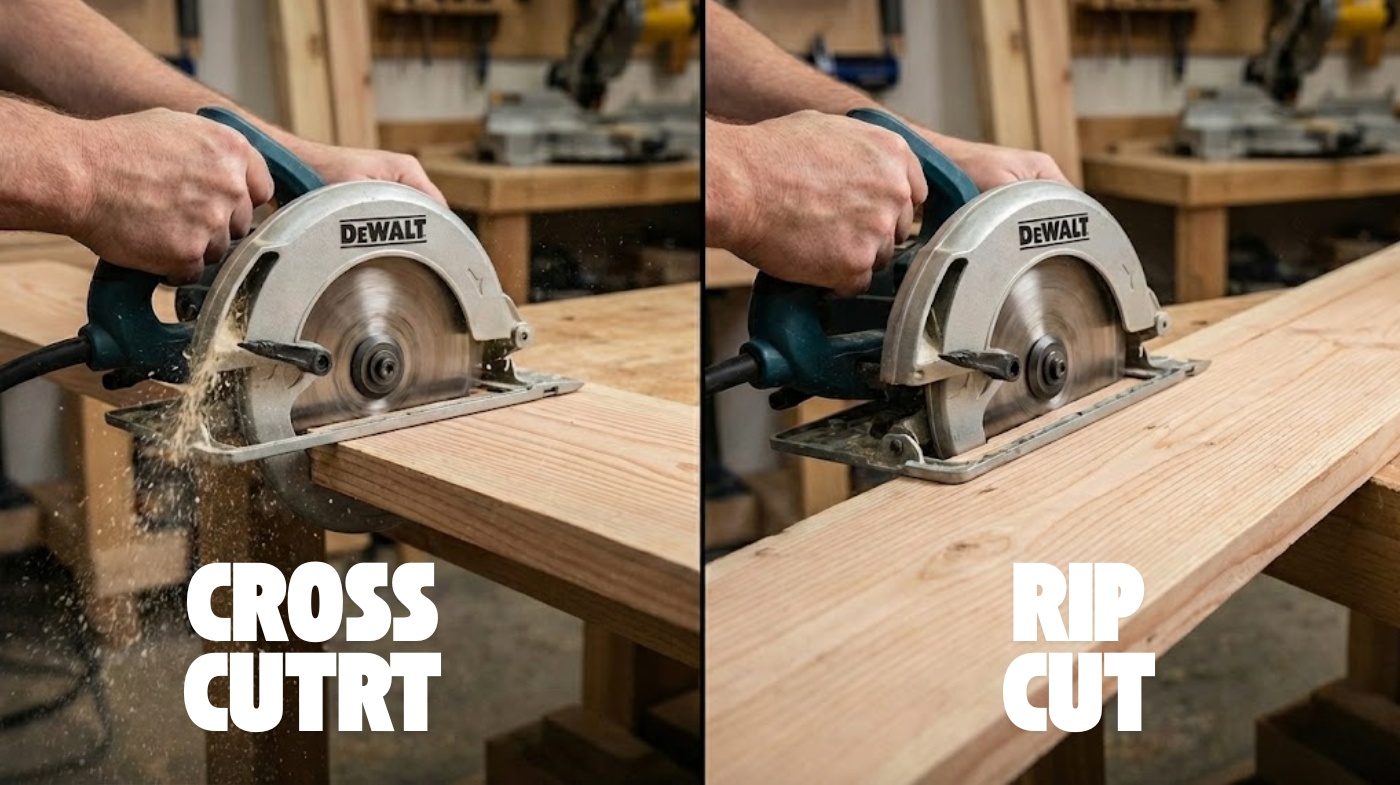
Although both cross cuts and rip cuts involve cutting wood, they differ fundamentally in their direction relative to the grain: cross cuts cut perpendicular to the grain to shorten the wood, while rip cuts run parallel to the grain to reduce its width. Selecting the correct cutting angle can greatly improve the efficiency of these cuts.
Cross cuts slice across the grain to shorten wood, while rip cuts run along the grain to narrow it.
When you perform a cross cut, you sever the wood fibers, resulting in a cleaner and smoother edge, ideal for joinery and visible surfaces. Crosscutting typically requires tools like a miter saw or a crosscut hand saw to achieve the best results.
In contrast, rip cuts follow the wood fibers, producing a rougher edge that often requires extra sanding or planing. Rip cuts are best performed with a table saw and a rip blade designed with fewer teeth to efficiently remove material. Additionally, choosing the appropriate blade material can enhance cutting performance and durability.
Tools and blades vary accordingly: crosscut blades have more teeth for a finer finish, while rip cut blades have fewer teeth to remove material faster.
Tooth Geometry and Blade Design
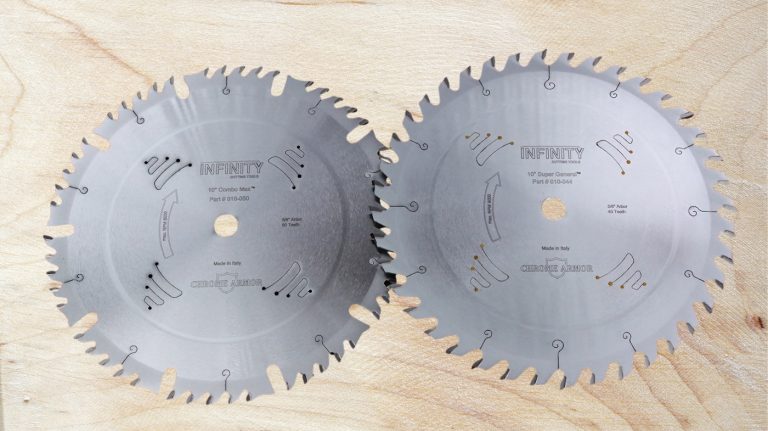
When you’re deciding between crosscut and rip cut blades, it’s important to consider the differences in tooth shape. You see, rip blades have these flat, chisel-like teeth that are designed for efficiency. These blades are often chosen because they work best for making cuts along the grain, which is ideal when using a table saw.
On the other hand, crosscut blades come with alternating bevels, which helps them make smoother cuts. This tooth design is engineered to slice fibers cleanly, reducing tear-out.
Now, let’s talk about tooth count, because that plays a big role too. Rip blades typically have fewer, larger teeth. This design is all about fast material removal, which can save you a lot of time.
In contrast, crosscut blades pack in more teeth, which is what you want for precision cuts.
And don’t forget about chip removal design! Rip blades are designed with deep gullets that help clear out larger chips effectively.
Crosscut blades, however, have smaller gullets, which are perfect for managing finer sawdust.
Tooth Shape Differences
Understanding the distinct tooth shapes between rip and cross cut saw blades is essential for selecting the right tool for your woodworking task. Rip teeth have a flat, chisel-like profile designed to chip along the grain, while cross cut teeth feature an alternating top bevel and sharp pinnacle point, slicing across fibers cleanly.
This difference impacts cutting efficiency and chip clearance. The tooth angles, including rake and fleam, are carefully adjusted to optimize each saw type’s cutting performance. Saw blades with finer teeth and higher TPI, similar to those found in dovetail saws, provide cleaner, more precise cuts ideal for crosscutting.
| Feature | Rip Teeth | Cross Cut Teeth |
|---|---|---|
| Tooth Shape | Flat, square chisel edge | Pyramid point with ATB bevels |
| Cutting Action | Chipping along wood grain | Slicing across wood fibers |
| Chip Clearance | Large gullets for chunky chips | Smaller gullets for fine dust |
| Sharpening | Simple flat file strokes | Complex multi-angle filing |
| Material Focus | Efficient on parallel grain | Effective on hardwood/softwood |
Choose based on grain direction and finish quality.
Tooth Count Impact
The tooth count on a saw blade directly influences its cutting speed, finish quality, and suitability for specific tasks.
Rip blades typically have 24-30 large, square-ground teeth that act like chisels, enabling fast, aggressive cuts with deep gullets for chip clearance. They are especially effective on soft woods 3/4 inch or less but may burn hardwoods if used improperly.
Conversely, crosscut blades feature 60-80 smaller teeth with alternating top bevels, slicing fibers cleanly for smooth finishes but cutting more slowly. These blades produce less resistance and offer a slicing action with ATB (Alternate Top Bevel) teeth ideal for crosscutting, resulting in cleaner edges.
Combination blades strike a balance with 40-50 teeth, mixing ATB and flat-top raker teeth to handle both cuts adequately but with some performance trade-offs.
Using a 60-tooth blade for ripping bogs down your saw and risks burning hardwood, while a rip blade on crosscuts causes tear-out.
Always match tooth count to wood type and cut direction for suitable efficiency and surface quality. Choosing the right blade also depends on the saw’s power and the specific material thickness.
Chip Removal Design
Although tooth count affects cutting performance, the chip removal design, encompassing tooth geometry and gullet size, plays a critical role in how efficiently a saw blade clears waste and maintains cutting stability.
Rip cut blades feature chisel-shaped teeth with large, flat tops that scrape wood fibers along the grain, prioritizing aggressive material removal. Their deep, wide gullets accommodate high volumes of sawdust, preventing binding and overheating. This design aligns with the fact that ripping teeth are ground perpendicular to the blade and function like chisels, optimized for pulling material out when cutting parallel to the grain ripping teeth function.
Crosscut blades, in contrast, have sharp, pyramid-shaped teeth angled to cleanly sever fibers across the grain, enhancing surface smoothness. Their smaller, shallower gullets suffice for the lower chip volume, balancing waste clearance with precise cutting.
Combination blades mix tooth geometries and have intermediate gullet sizes, offering versatility but sacrificing specialized chip clearance and cut quality.
Performance Characteristics of Cross Cut Blades
When you select a crosscut blade, you’ll notice it features a high tooth count, typically between 60 and 100 teeth, arranged in specialized configurations like ATB, Hi-ATB, or TCG.
This design reduces tear-out by removing less material per tooth, producing clean, chip-free cuts across wood grain with minimal splintering. Smaller gullets maintain blade rigidity and minimize vibration, ensuring smooth, precise cuts ideal for finish carpentry. Additionally, crosscut blades produce a finer finish than rip cut blades due to more teeth and less vibration.
Removes less material per tooth for clean, chip-free cuts and minimizes vibration for precise finish carpentry.
The teeth’s hook angles, usually between -2° and 8°, optimize control and reduce pulling forces. While crosscut blades cut slower than rip blades due to high tooth density and smaller gullets, they prioritize surface finish and accuracy over speed. Using proper safety precautions during cutting is essential to maintain blade performance and operator safety.
However, this dense tooth layout can increase heat buildup, so controlling feed rates and saw speed is essential to prevent burning and premature blade wear.
Performance Characteristics of Rip Cut Blades
If you need to rip wood quickly and efficiently, rip cut blades deliver by featuring a large positive rake angle, typically around 20 degrees, that aggressively bites into the grain. This design, combined with flat-top ground (FTG) teeth and large gullets, allows fast feed rates and efficient chip removal. Ripping is performed against the blade rotation to keep the wood stable and prevent dangerous kickback, ensuring safer operation during ripping. For optimal results, maintaining a stable stance during operation is crucial to avoid slips and ensure safety.
Expect fewer teeth (18–36) for a bigger bite per pass, sacrificing smoothness for speed and durability.
| Feature | Performance Impact |
|---|---|
| Positive Rake Angle | Aggressive cutting, fast feed |
| FTG Teeth | Durable, rough cut finish |
| Low Tooth Count | Faster cuts, rougher surfaces |
You’ll want secondary finishing after ripping since surfaces are rough. However, the blade excels at rough stock preparation.
Choosing the Right Blade for Your Project
Understanding the distinct cutting characteristics of rip and crosscut blades helps you select the right blade for your project.
Rip blades, with fewer teeth (24-30) and flat-top geometry, excel at fast, efficient cuts along the grain. They remove chips quickly with deep gullets. Because ripping involves cutting parallel to the grain, it generally takes about three times longer than cross cutting with the same saw. Additionally, the motor power of your table saw can significantly affect the efficiency of rip cuts, with higher horsepower providing better cutting performance.
Crosscut blades feature more teeth (60-80) and alternate top bevels. They produce cleaner, smoother edges by slicing across the grain.
Using the wrong blade risks tear-out, motor strain, or kickback. Combination blades offer versatility with 40-50 teeth but compromise speed and finish quality.
For dimensioning lumber, choose rip blades. For fine joinery or visible edges, opt for crosscut blades.
Always match blade type to cut direction to maximize safety, cut quality, and blade life. Regular maintenance ensures ideal performance regardless of blade choice.
Common Applications for Cross Cut Blades
Although cross-cut blades excel at producing clean, precise edges across various wood grains, their true value shines in specialized applications like furniture making, fine joinery, and finish cutting.
You rely on their fine-tooth design and high tooth count (60-80 teeth) to minimize tear-out and produce ultra-smooth surfaces essential for visible edges and glued joints. Their beveled teeth and alternating bevel reduce blade marks, ensuring strong adhesive bonds in mitered joints.
Additionally, cross-cut blades handle both hardwood and softwood finishing cuts without splintering or burning, thanks to their shallower gullets and optimized hook angles. They operate at slower speeds with a steeper hook angle to ensure smooth, controlled cuts.
- Furniture components and cabinet parts with finished surfaces
- Fine woodworking joinery requiring clean end-grain cuts
- Hardwood and softwood finishing for smooth, splinter-free edges
- Precision cutting tasks demanding minimal surface defects
Common Applications for Rip Cut Blades
While cross-cut blades focus on fine, clean cuts across the grain, rip cut blades are engineered to efficiently cut along the grain, prioritizing speed and material removal. Proper maintenance, including regular lubrication, ensures rip blades perform consistently and last longer.
You’ll find rip blades ideal for dimensioning lumber and rough framing, where their low tooth count and Flat Top Grind (FTG) allow rapid cutting with large gullets clearing chips and reducing motor strain.
They excel in plywood, OSB, and dense hardwoods, maintaining aggressive feed rates without overheating.
Rip blades feature FTG teeth that are shaped like chisels, enabling efficient wood removal during ripping tasks.
For decorative joinery, rip blades produce precise, straight-sided slots, vital for joint alignment.
In high-volume production, gang ripping and thin-kerf variants minimize waste and optimize efficiency.
When working with thick, dense materials, rip blades’ geometry ensures consistent results while reducing vibration and motor loading, making them indispensable for fast, heavy-duty ripping tasks.
Risks of Using the Wrong Blade Type
If you choose the wrong blade type for your cuts, you considerably increase the risk of kickback, poor cut quality, and excessive wear on your saw.
Using a crosscut blade for ripping bogs down the motor, raising kickback chances. A rip blade on crosscuts causes fiber tear and rough edges. Choosing the appropriate blade also depends on factors such as the saw’s arbor speed and motor power.
Using a crosscut blade for ripping bogs down your motor and increases kickback risk.
This misuse demands more feed pressure, accelerating blade and motor wear and risking operator injury due to binding or wood spinning.
- Increased kickback from blade binding and improper feed rates
- Poor surface finish with tear-out or fuzzy edges
- Excessive motor strain from inefficient cutting
- Safety hazards from blade deflection and sudden stops
Selecting the correct blade guarantees clean cuts, tool longevity, and operator safety. Ensuring the saw blade is properly aligned with the type of cut being made also enhances safety and cut quality.
Visual and Practical Indicators of Blade Type
Choosing the correct blade type affects not only performance and safety but also how you identify the blade before use.
You can distinguish rip and crosscut blades by examining tooth count, shape, and gullet size. Rip blades have fewer teeth (around 24), chisel-shaped edges, and deep gullets, ideal for fast material removal. The blade design is optimized for cuts made along the wood grain, making rip cutting easier and faster. Additionally, using the right blade speed and band saw adjustments can enhance cut quality and tool longevity.
Crosscut blades feature more teeth (40–80), pointed teeth with bevels, and shallow gullets for smooth cuts. Labels or packaging often provide confirmation.
| Indicator | Rip Cut Blade | Cross Cut Blade |
|---|---|---|
| Tooth Count | ~24 or fewer | 40–80 |
| Tooth Shape | Chisel-shaped, flat tops | Pointed, beveled edges |
| Gullet Depth | Deep and wide | Shallow and narrow |
| Labeling | Often marked “Rip” or tooth count | Often marked “Crosscut” or tooth count |
Frequently Asked Questions
Can I Use a Combination Blade for Both Cross Cut and Rip Cut?
Yes, you can use a combination blade for both cross cuts and rip cuts.
It offers a balanced tooth count and gullet size, allowing decent performance on both cut types without switching blades.
However, it won’t match the speed of a dedicated rip blade or the clean finish of a specialized crosscut blade.
For general-purpose work and mixed cuts, it’s practical, but for precision or efficiency, consider specific blades.
How Does Blade Maintenance Differ Between Cross Cut and Rip Cut Blades?
You’ll notice rip blades need less frequent sharpening but require regular cleaning of large gullets to prevent clogging during aggressive grain cutting.
Crosscut blades demand more precise, frequent sharpening of multiple small, beveled teeth to maintain smooth, tear-free cuts across fibers.
Both blades benefit from routine resin removal, though crosscut teeth are more delicate.
Proper maintenance preserves cutting efficiency, safety, and finish quality, so tailor your approach based on blade geometry.
What Safety Precautions Are Specific to Cross Cut Versus Rip Cut Operations?
For cross cuts, always use a miter gauge or crosscut sled to stabilize your workpiece. Never guide it with the rip fence to avoid kickback.
Keep your hands behind the blade and use push sticks with short pieces.
For rip cuts, use the rip fence as your guide and maintain firm contact. Employ a riving knife or splitter to prevent kickback.
Always use push sticks for narrow rip cuts under three inches.
How Do Blade Speeds Vary When Performing Cross Cuts Compared to Rip Cuts?
You might expect blade speeds to be the same, but they’re not. When you perform rip cuts, your blade runs faster because fewer teeth and deep gullets allow rapid chip removal.
Cross cuts, however, require slower blade speeds due to higher tooth counts and increased friction slicing across the grain. This slower speed helps prevent tear-out and maintains clean cuts.
Are There Specific Materials Other Than Wood Better Suited for Cross Cut or Rip Cut Blades?
Yes, you’ll find crosscut blades excel on materials like melamine, plastic laminates, soft metals, and veneers, where fine teeth prevent chipping and deliver smooth edges.
Rip blades, meanwhile, are better for dense hardwoods, reclaimed wood, and thick solid stock, where aggressive chip removal and following the grain improve speed and efficiency.
Selecting the proper blade tooth geometry guarantees cleaner cuts and prolongs blade life on specific non-wood materials.
Improve Your Results Today With Better Cut Selection and Blade Choice
Now that you know how cross cut and rip cut blades differ in tooth geometry and performance, the choice seems straightforward. But what if using the wrong blade quietly ruins your project or even your tool?
Don’t underestimate the impact of blade selection. Before you make that cut, pause and consider: which blade will deliver clean, efficient results without unnecessary wear or risk? The right blade isn’t just a preference; it’s a precision you can’t afford to ignore.