Best Circular Saw Blade for Plywood: Precision & Smooth Cuts
A dull or improper saw blade often causes splintering, tear-out, and rough edges when cutting plywood. These issues not only waste material but demand extra sanding and finishing hours.
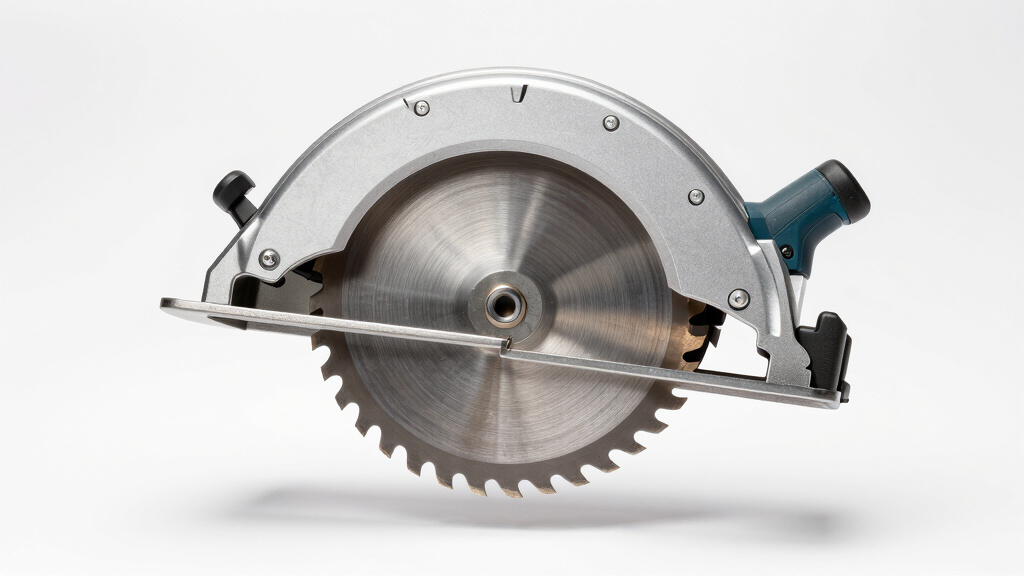
The best circular saw blade for plywood must combine a high tooth count, sharp carbide or steel teeth, and a thin kerf to deliver clean, smooth cuts with minimal splintering and maximum durability.
Most standard blades focus on general woodcutting and lack the fine tooth geometry or materials needed for plywood’s layered structure, resulting in rough edges and faster blade wear. Choosing a blade designed specifically for plywood’s challenges makes a visible difference in cut quality and project efficiency.
| Image | Name | Editor's Rating | Price |
|---|---|---|---|
|
Irwin Tools Irwin 11820ZR 6-1/2-Inch 140 Tooth TFG Plastic, ...
|
|
|

|
Diablo Track Circular Saw Blade for Fine Finish and Plywood ...
|
|
|
|
DEWALT Circular Saw Blade, 7 1/4 Inch, 140 Tooth, Wood Cutti...
|
|
|

|
BOSCH DCB760 7-1/4 in. 60 Tooth Edge Circular Saw Blade for ...
|
|
|
|
IRWIN Tools Classic Series Steel Corded Circular Saw Blade, ...
|
|
Precision Blades for Cutting Plywood Smoothly
Selecting the best circular saw blade for plywood means focusing on smoothness and accuracy. These options offer refined tooth designs to minimize splintering and deliver clean edges on various plywood sheets.
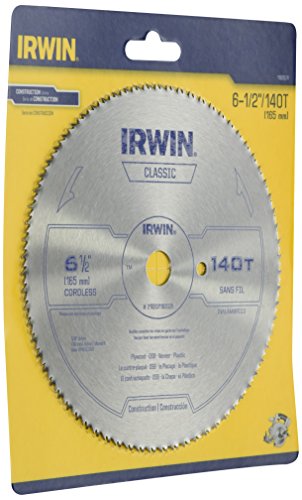
1. IRWIN 6-1/2-Inch 140 Tooth TFG Saw Blade for Precision Cutting in Wood and Plastic
- Irwin Tools Irwin 11820ZR 6-1/2-Inch 140 Tooth TFG Plastic, Plywood, and Veneer Cutting Saw Blade...
Cutting thin materials like plywood demands more than just a sharp edge; it requires a blade that channels precision and smooth finishes. With 140 finely spaced teeth, this IRWIN blade achieves exceptionally clean cuts that reduce splintering and tear-out. Precision-ground teeth provide consistent performance, making even delicate veneer slicing appear effortless.
The blade’s heavy-gauge high carbon steel body enhances durability, holding up well against the stress of repeated use. A fully hardened plate minimizes wobble to keep your cuts straighter and your projects cleaner. It’s designed with a 5/8-inch arbor and a diamond knockout for easy mounting on compatible saws.
Though not carbide-tipped, this blade excels in handling engineered wood and plastics, enabling smooth transitions between materials on job sites or workshops. It has proven practical for light-duty tasks requiring clean edges, such as trimming vinyl, PVC, and similarly soft materials.
IRWIN’s model shows that you don’t always need specialized carbide blades for every plywood job. While it might wear faster on tougher treated wood, it stands out as a cost-conscious choice for many everyday cuts without sacrificing finish quality.
High tooth count and smooth operation deliver value beyond its price, especially when precision matters more than longevity.
Best for: Craftsmen and DIYers focusing on clean, detailed cuts in plywood, plastic, and veneer without heavy-duty requirements.
Pros:
- High tooth density for smooth, splinter-free edges
- Heavy carbon steel construction for rigidity and extended use
- Precision-ground teeth maintain cut accuracy
- Universal 5/8-inch arbor with diamond knockout enhances compatibility
- Effective on plastics and engineered wood beyond plywood
Cons:
- May dull quickly with treated or dense hardwoods
2. Diablo 6-1/2″ Track Circular Saw Blade – 48 Teeth, Hi-Density Carbide for Precision Cuts
- Maximum Performance - Features TiCo Hi - Density carbide for maximum productivity, longer cutting...
- Precision Cuts - The 1.8mm thick laser-cut kerf offers the necessary rigidity for straight, accurate...
- Clean Cuts - The ATB tooth design provides excellent tracking control, Clean cuts, minimal tear-out...
Achieving razor-sharp edges on plywood and fine woodwork often hinges on the quality of your saw blade. The Diablo track circular saw blade offers a sturdy 1.8mm kerf that balances rigidity with precision, helping you maintain straight, fuss-free cuts on sheet goods or cabinetry panels.
Built with Diablo’s TiCo Hi-Density carbide tips, it delivers long-lasting durability and sharpness, standing up to demanding ripping, cross-cutting, and plunge cutting jobs. The 48-tooth design featuring an Alternate Top Bevel (ATB) tooth profile enhances smooth tracking, minimizing tear-out especially important when your project calls for a finished edge.
Laser-cut stabilizer vents reduce vibration during cuts, contributing to heightened accuracy and less wear on both blade and saw. The Perma-SHIELD coating safeguards against heat buildup and corrosion, making this blade dependable over extended use.
Offering wide compatibility with popular track saw brands like Bosch, DeWalt, and Milwaukee, and fitting both 20mm and 5/8-inch arbors, it functions seamlessly on corded and cordless tools alike. Diablo’s engineering translates into efficient cutting performance and clean finishes that many craftsmen rely on for precision projects.
Best for: Woodworkers and installers who require smooth, reliable cuts on plywood and other panel materials using track saws.
Pros:
- Durable TiCo Hi-Density carbide teeth hold sharp edges longer
- 1.8mm thick kerf for precise, straight cutting
- ATB tooth design minimizes tear-out on plywood
- Laser-cut stabilizer vents promote vibration-free operation
- Compatibility with major track saw brands and arbor sizes
Cons:
- Might be overkill for casual hobbyists needing infrequent cuts
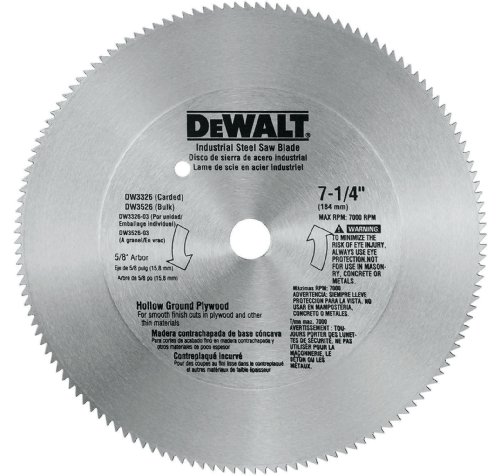
3. DEWALT 7-1/4 Inch 140-Tooth Wood Cutting Circular Saw Blade for Smooth Plywood Cuts
- The product is 7-1/4"140t plywood blade
- Easy to use
- The product is manufactured in China

Achieving clean, precise cuts in plywood often hinges on the blade’s tooth count and quality. This DEWALT saw blade comes with a high 140-tooth design to deliver exceptionally smooth, splinter-free cuts, minimizing tear-out during your woodworking projects.
Crafted from durable alloy steel, the blade features a thin kerf at .065 inches allowing less material waste and easier cutting with less strain on your saw. A coating lowers friction and prevents rust, extending the blade’s life even under heavy-duty use.
The thicker body and fully hardened steel construction reduce warping and binding risks, making it reliable when working on engineered wood or traditional plywood sheets. With a maximum speed rating of 7,000 RPM, it’s tailored for portable construction saws running 7-1/4 inch blades.
DEWALT’s reputation for precision sharpening shows through in the hollow ground teeth, enhancing cut speed and smoothness without sacrificing control. Though designed primarily for plywood, this blade can handle various wood types for added versatility.
Best for: Woodworkers and builders needing clean, controlled cuts in plywood and engineered wood with reduced splintering.
Pros:
- High tooth count for smooth finishes
- Thin kerf minimizes waste and cutting effort
- Rust-resistant coating improves longevity
- Thicker steel body prevents warping
- Compatible with 7-1/4 inch portable saws
Cons:
- May require slower cutting speed for perfect edge on delicate materials
4. Bosch DCB760 7-1/4 Inch 60 Tooth Circular Saw Blade for Extra-Fine Woodcuts
- Brute Carbide – an upgraded C3/C4 micrograin formulation for increased impact damage resistance
- ATB tooth geometry – for fast Cross cutting, cutoff and trim of wood and plywood
- Speed coat – an antifriction finish for faster cutting with no burning or melting
Achieving clean, precise edges on plywood often depends more on the blade than the saw itself. Bosch crafted the DCB760 with a 60-tooth configuration that excels at slicing through wood and engineered panels smoothly, reducing tear-out and splintering.
Constructed from Brute Carbide using a C3/C4 micrograin formulation, this blade resists impact damage better than standard options. Its thin kerf means less material waste and faster cuts, ideal when handling multiple plywood sheets.
Antifriction coating minimizes heat buildup during prolonged use, helping prevent burning or melting of the plywood edges. The extra-hard steel backbone adds rigidity and keeps the blade from deflecting, so you get sharper, straighter results.
Bosch designs these blades with expansion slots to keep warping at bay and employs ATB (Alternate Top Bevel) tooth geometry for quick cross-cutting and trimming. Combining innovation in materials and engineering, this blade maintains sharpness longer even with frequent use on hardwood and plywood alike.
Best for: Woodworkers and DIYers seeking consistent, fine finish cuts on plywood and engineered wood panels.
Pros:
- High-impact resistant Brute Carbide teeth for longevity
- Antifriction speed coat reduces heat and prevents burning
- Thin kerf design enables fast, efficient cutting with less waste
- Extra-hard steel body resists bending for accurate cuts
- Expansion and control cut slots minimize warping and kickback
Cons:
- Could be less suited for ripping thicker hardwoods due to high tooth count
- Might not be ideal for cutting softer materials like MDF or particle board often
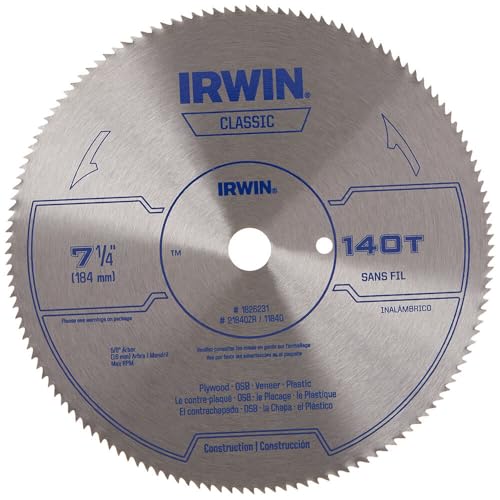
5. IRWIN Tools Classic Series 7-1/4-Inch 140-Tooth Steel Saw Blade for Fine Wood and Plastic Cuts
- Precision-ground circular saw teeth for smooth, accurate cuts
- Fully-hardened circular saw blade plate runs truer, longer
- Heavy-gauge, high-carbon steel construction provides extended circular saw blade life
Achieving clean, accurate cuts in plywood or thin plastic sheets demands a blade that won’t falter under precision requirements. The IRWIN Classic Series blade features 140 precision-ground teeth designed to glide smoothly through materials, minimizing tear-out and splintering.
Crafted from heavy-gauge high-carbon steel, this unit offers enhanced durability and a fully-hardened plate that runs truer for a longer lifespan. The 7-1/4-inch diameter paired with a 5/8-inch diamond arbor fits corded circular saws commonly used in woodworking projects.
Its slim kerf of 0.08 inches reduces waste and demands less power from your saw, delivering smoother cuts without sacrificing strength. IRWIN’s engineering makes it reliable not only for plywood but also for plastics, MDF, and veneer applications.
Users appreciate the blade’s ability to maintain sharpness through repeated use, yielding clean, chip-free edges that reduce sanding time and improve finished results. The steel plate’s high hardness also helps the blade stay free from warping during intense workloads.
Best for: Home workshop enthusiasts and professionals who frequently cut plywood, plastics, or veneered boards requiring fine, detailed results.
Pros:
- Large tooth count for exceptionally smooth cuts
- Robust high-carbon steel extends blunt-resistance and tool life
- Slim 0.08″ kerf reduces material waste and cutting effort
- Precisely ground teeth reduce chipping and splintering
- Universal 5/8″ arbor fits most 7-1/4″ circular saws
Cons:
- May require polishing for optimal heat resistance on some saws
- Packaging can be a bit difficult to open initially
6. GRAFF 6 1/2 Inch 140-Tooth Circular Saw Blade for Smooth, Precision Wood Cutting
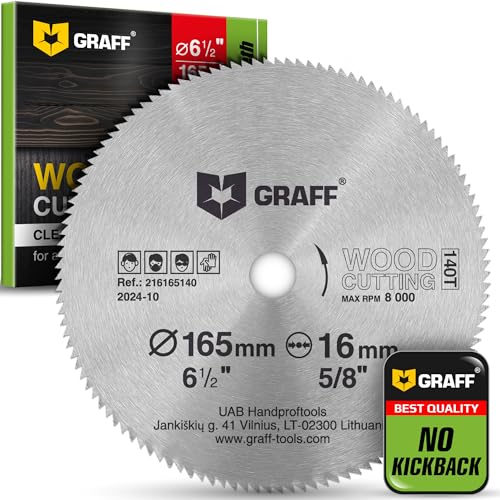
- APPLICATION – GRAFF 6 1/2 circular saw blade is suitable for cutting wood, plywood, drywall, MDF...
- SMOOTH CUTTING – Our wood cutting saw blade provides a smooth and precise cutting and ensures that...
- DURABLE CONSTRUCTION – GRAFF 6 1/2 table saw blade is made from high quality carbon steel to...
Using a blade that can handle multiple materials without sacrificing finish quality changes your whole approach to woodworking. The GRAFF 6 1/2 inch saw blade brings together durability and precision for serious woodworkers facing plywood, laminate, and even drywall.
Crafted from high-quality carbon steel, this blade boasts a long service life and resistance to wear. Its sharp tungsten carbide teeth enable clean, scorch-free cuts even under heavy loads, which reduces time spent on sanding or refinishing edges.
Featuring 140 teeth and carefully engineered expansion slots, the blade minimizes vibration and heat buildup—two factors that can warp blades or harm delicate cuts. This design helps maintain stability throughout longer cutting sessions.
Compatibility with popular brands like Dewalt, Bosch, and Makita makes swapping blades seamless. Its 5/8 inch arbor fits a wide range of circular saws, allowing you to use this durable blade on various power tools without hassle.
Solid performance across wood, plywood, MDF, and plastic means you don’t need multiple blades cluttering your workspace. GRAFF offers a balanced solution that meets the demands of both amateur DIYers and professionals.
Best for: Craftsmen requiring a versatile circular saw blade that delivers smooth, chip-free cuts on plywood and other composite materials.
Pros:
- High tooth count for fine, precise cuts
- Durable tungsten carbide tips extend blade life
- Expansion slots reduce vibration and heat
- Compatible with many major saw brands
- Effective on a variety of non-metallic materials
Cons:
- May require confirmation that 5/8″ arbor matches your tool
- Optimized for softer materials; harsh metals can dull teeth quickly
7. Freud LU79R007 7-1/4″ Thin Kerf Saw Blade for Clean Cuts in Plywood & Laminates
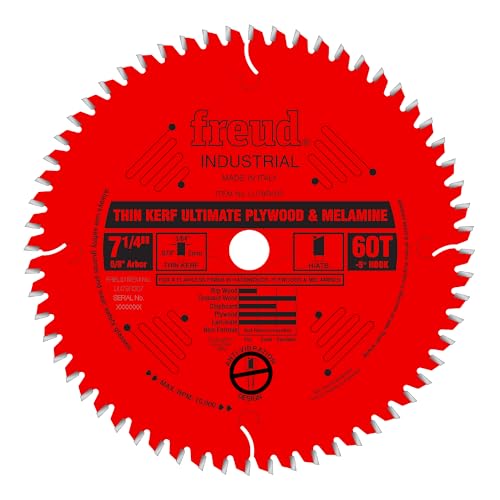
- Specs: Arbor 5/8", Diameter 7-1/4", Grind Hi-ATB, Hook Angle -5°, Kerf .079", Plate .063", Teeth 60
- Premium TiCo HI-Density Carbide Crosscutting Blend for Maximum Performance
- High Alternate Top Bevel (HiATB)Tooth Design produces splinter-free cuts
Cutting through veneered plywood or delicate laminates without chipping often challenges many saw blades. Freud designed this blade specifically to address those fine finishing issues. It features a high alternate top bevel tooth profile that produces remarkably smooth edges, reducing tearout on both sides of your cuts.
Crafted with premium TiCo HI-Density carbide, the blade balances sharpness and durability, delivering long-lasting performance even when tackling dense engineered wood. The 60 finely ground teeth and a thin .079″ kerf combine for precise, clean slicing with minimal waste.
Anti-vibration laser-cut slots minimize noise and blade wobble, keeping cuts accurate and smooth without the need for multiple passes or additional scoring blades. Coated with Freud’s Perma-Shield, the surface stays cleaner longer, resisting pitch buildup and corrosion to help maintain speed through cuts.
The modified triple chip grind tooth design extends lifespan when working through thicker composite materials. Overall, it delivers exemplary cuts for plywood, melamine, laminates, and other engineered boards across handheld or stationary saws, especially with a 5/8″ arbor fit standard.
Best for: Professionals and hobbyists aiming for chip-free, accurate edges on veneered panels, laminated sheets, and fine woodworking projects.
Pros:
- 60 Hi-ATB teeth for clean, splinter-free cuts
- Durable TiCo carbide blend resists dulling
- Laser-cut anti-vibration slots enhance cut stability
- Thin .079″ kerf reduces waste and improves efficiency
- Perma-Shield coating prevents pitch buildup and corrosion
Cons:
- Specialized tooth design might wear faster on rougher woods
- Thin kerf blades may require careful handling to avoid bending in heavy-duty use
8. CRAFTSMAN 7-1/4 Inch 140 Tooth Carbon Steel Circular Saw Blade for Smooth Panel Cuts

- MAINTAIN CUTS: Fully-hardened plate to help maintain true cuts
- PRECISION: Precision-ground teeth for smooth, accurate cuts
- EXTENDED LIFE: Heavy-gauge high carbon steel extend life
High tooth count drives clean, precise slicing through plywood and similar materials with fewer snags and splinters. The fully-hardened steel plate resists distortion, supporting consistent, true cuts over extended use. Compactly designed, the blade fits 7-1/4 inch saws to tackle various paneling tasks.
Precision-ground teeth sharpen each cut’s accuracy, delivering smooth edges ideal for visible surface work where finish matters. Heavy-gauge carbon steel construction extends the blade’s cycle life, preventing premature wear during repeated applications. Flattened blade profile also reduces vibration, translating into fast, controlled cuts and less user fatigue.
Craftsman’s focus on material durability makes this blade suitable not only for plywood but plastic and vinyl as well, increasing its versatility. While some may assume higher-priced blades always outperform, this carbon steel option proves value-friendly blades can offer sharp slicing and dependable performance on fine finishing projects.
Sharpness and smoothness combine to produce clean trims, door adjustments, and baseboard modifications with minimal material tear-out. Maintaining edge integrity longer than typical carbon blades allows for multiple cuts without rapid dulling, enhancing overall efficiency.
Best for: DIY enthusiasts and woodworkers aiming to achieve smooth, precise finishing cuts on plywood, OSB, and light plastics without investing heavily in specialty blades.
Pros:
- High 140-tooth count yields fine, smooth cut surfaces
- Fully-hardened, flattened plate maintains rigidity and accuracy
- Heavy-gauge carbon steel extends blade life for repeated use
- Compatible with multiple materials including vinyl and plastic
- Compact size fits standard 7-1/4 inch circular saws
Cons:
- Blade longevity may be limited under heavy industrial use
9. CMT Orange Tools 10-Inch 80-Tooth Fine Finish Saw Blade with Micrograin Carbide Tips
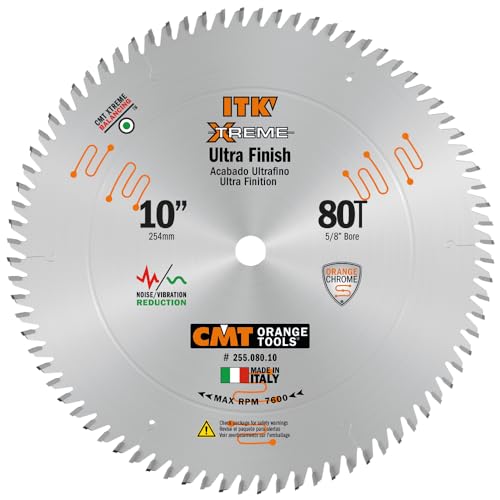
- For fine finish crosscuts. Glass-smooth finish on your miter cuts.
- Cut solid wood, melamine, laminates, plywood, chipboard. Use on radial arm/miter saws, table saws.
- 0.098 kerf thickness, 0.071 plate thickness, 5° Hook Angle, 40° Alternate Teeth Grind.
Handling delicate crosscuts on plywood or layered wood often requires more than just any high-tooth-count saw blade. Achieving glass-smooth edges without splintering demands precise tooth geometry and stable blade construction.
Boasting an 80-tooth count with 40° alternate top bevel teeth, this CMT blade is designed to deliver crisp, clean cuts specifically on engineered wood and laminates. The thin 0.098″ kerf reduces material waste and lessens power draw, fitting saws that might otherwise struggle with thicker blades.
Durability comes from micrograin carbide teeth brazed with a shock-resistant tri-metal bond, which means the blade retains sharpness and cutting consistency longer than standard carbide tips. Laser-cut expansion slots provide noise reduction and anti-vibration stability, keeping cuts accurate and the saw quieter in operation.
With a 5° hook angle and 0.071″ plate thickness, the blade is tailored more to fine finish crosscuts rather than ripping, making it ideal for precision work on veneers, plywood, and melamine surfaces.
The CMT Orange Tools name blends craftsmanship with engineering, highlighting blades suited for demanding woodworking tasks where surface finish and minimal tear-out are priorities.
Best for: Woodworkers requiring meticulous, finely finished crosscuts in plywood and laminate materials on 10″ miter or table saws.
Pros:
- High tooth count with 40° ATB grind ensures smooth, splinter-free edges
- Micrograin carbide teeth last longer and maintain sharper cuts
- Thin kerf reduces waste and power demands on saws
- Laser-cut slots minimize noise and vibration for precision
- Compatible with multiple powered saw types for versatility
Cons:
- May require careful alignment to maximize finish quality
10. WEN 7.25-Inch 60-Tooth Carbide-Tipped Circular Saw Blade with Cool-Cut Coating for Smooth Woodworking

- Features a 7.25-inch diameter (185 mm), a 5/8-inch arbor (15.875 mm), and a 7000 RPM speed rating
- Non-abrasive heat-resistant PTFE cool-cut coating prevents workpiece burns for a higher-quality cut
- Ultra-thin 1/16-inch kerf (1.6 mm) provides clean and efficient cuts
Cutting plywood often presents a challenge when your blade leaves rough edges or splinters. The WEN blade’s 60 sharp carbide teeth feature an alternate top bevel design that scores the wood surface before slicing through, significantly reducing tear-out and leaving a clean, splinter-free finish ideal for detailed projects.
Engineered with an ultra-thin 1/16-inch kerf, this blade ensures efficient, precise cuts that minimize material waste. The non-abrasive PTFE cool-cut coating helps to maintain lower blade temperatures during use, protecting both the wood and the blade’s longevity.
Weighing only 0.26 kilograms and compatible with most 7-1/4-inch miter, chop, and circular saws, this WEN model offers versatile performance for various woodworking tasks. Its 5/8-inch arbor diameter provides easy installation and stable operation up to 7000 RPM.
Users will appreciate the balanced combination of durability and smooth cutting action, making the blade a strong choice for projects that require both quality and efficiency. The wear-resistant carbide tips maintain sharpness longer than conventional blades, reducing downtime on blade changes.
Best for: Woodworkers and DIY enthusiasts aiming for precise and clean crosscuts in plywood and similar sheet materials.
Pros:
- 60 carbide-tipped teeth with alternate bevel design for smooth cuts
- Ultra-thin 1/16-inch kerf maximizes cutting efficiency
- PTFE cool-cut coating reduces heat buildup and prevents burn marks
- Lightweight and compatible with the majority of 7.25-inch saws
- Durable carbide tips maintain sharpness over time
Cons:
- May require careful handling due to the thin kerf to prevent bending
- High tooth count may slow aggressive ripping cuts for some users
Quick Guide: Best Circular Saw Blade For Plywood Feature Analysis
| Product Name | Diameter & Teeth Count | Material Type | Kerf Thickness | Arbor Size |
|---|---|---|---|---|
| Irwin 6-1/2″ 140T TFG Saw Blade | 6.5″, 140 Teeth | High Carbon Steel (Plastic Compatible) | Not Specified | 5/8″ Diamond Knockout |
| Diablo Track 6-1/2″ 48T Carbide | 6.5″, 48 Teeth | Hi-Density Carbide | 1.8 mm (Laser-cut Kerf) | Fits 5/8″ & 20mm Arbor |
| DEWALT 7-1/4″ 140T Wood Blade | 7.25″, 140 Teeth | Alloy Steel | 0.065″ | 5/8″ & Diamond Knockout |
| Bosch DCB760 7-1/4″ 60T Carbide | 7.25″, 60 Teeth | Carbide (Brute Carbide) | Thinner Kerf (Exact not specified) | 5/8″ |
| IRWIN Classic Series 7-1/4″ 140T | 7.25″, 140 Teeth | Heavy Gauge High Carbon Steel | 0.08″ | 5/8″ Diamond Arbor |
| GRAFF 6-1/2″ 16T Tungsten Carbide | 6.5″, 16 Teeth | Tungsten Carbide | ~0.01 mm (likely a typo, very thin) | 5/8″ |
| Freud LU79R007 7-1/4″ 60T Hi-ATB | 7.25″, 60 Teeth | TiCo Hi-Density Carbide Blend | 0.079″ | 5/8″ |
| CRAFTSMAN 7-1/4″ 140T Carbon Steel | 7.25″, 140 Teeth | Carbon Steel | Not Specified | 5/8″ |
What Factors Shape the Best Circular Saw Blade for Plywood?

Selecting the right blade requires attention to multiple key attributes that directly impact cut quality and tool longevity.
Tooth Count and Configuration
The number of teeth on a circular saw blade affects how smooth or rough the cut will be. For plywood, blades with higher tooth counts, like 140 teeth, are preferred to minimize tear-out and prevent splintering, especially on thin or delicate veneers.
Blades such as the IRWIN 6-1/2″ 140 Tooth feature fine, precision-ground teeth designed to slice cleanly rather than rip through wood. The tooth geometry, including Triple Chip Grind (TCG) or Alternate Top Bevel (ATB), helps reduce chip size and controls the cut’s aggressiveness for a smoother finish.
Choosing the right tooth count and configuration means cleaner edges and less sanding afterward. Using blades with too few teeth often results in rough cuts and damaged veneer surfaces, which can ruin plywood projects.
Material and Tooth Tip Composition
The material of the blade body and the composition of the tooth tips play a key role in how well a saw blade performs and how long it lasts. Carbide-tipped teeth, especially Hi-Density or TiCo blends, hold their sharpness longer than regular steel blades. This means cleaner cuts on plywood over extended use.
Take Diablo’s track blade as an example. It features Hi-Density carbide tips that balance toughness with long-lasting sharpness. On the other hand, blades made from high carbon steel cost less upfront but tend to dull quickly. This can cause burning or chipping on plywood edges, which compromises finish quality.
Choosing blades with high-quality materials reduces the need for frequent replacements. It also delivers more consistent, smooth cuts, saving time and improving the overall outcome of woodworking projects.
Kerf Thickness
Kerf thickness is the width of the cut a blade makes. When cutting plywood, choosing a blade with a thin kerf (under 0.08 inches) can reduce waste and demand less power from your saw. This means less effort for both you and the tool.
For example, DEWALT’s 7-1/4″ blade has a 0.065-inch thin kerf, allowing it to slice through plywood smoothly and cleanly. Blades with thicker kerfs remove more wood and often cause more tear-out, especially on delicate or veneered plywood.
Using a blade with the right kerf thickness results in cleaner cuts and less material loss. This helps maintain the plywood’s edge quality and speeds up your work process, making your projects look better and run smoother.
Blade Diameter and Arbor Size Compatibility
The blade diameter and arbor size need to match your circular saw to keep everything running smoothly. Popular blade diameters for plywood are 6-1/2″ and 7-1/4″, while the arbor size typically measures 5/8″.
Many blades, such as those from IRWIN and DEWALT, come with 5/8″ diamond knockouts or dual arbor options. This design helps them fit a wider range of saws without hassle.
Choosing the right size reduces wobbling and keeps cuts clean. It also protects your saw motor from unnecessary strain, leading to better performance and longer tool life.
Hook Angle and Tooth Design
Hook angle refers to the tilt of the blade’s teeth and affects how aggressively it cuts through plywood. For cutting plywood, a neutral to slightly positive hook angle is preferred because it balances smooth cuts with better control over feeding the material.
Blades featuring an alternate top bevel (ATB) tooth design combined with a higher hook angle, like the Freud LU79R007, help produce clean, smooth cuts on veneered plywood and laminates by slicing fibers cleanly rather than tearing them.
Choosing the right hook angle and tooth design can reduce problems like burning, chipping, and rough edges, which are common when cutting engineered wood. This improves the overall finish quality and extends blade life when working with plywood sheets.
Coatings and Heat Resistance
Blade coatings play a key role in reducing friction and preventing rust. They also help manage heat build-up while cutting, which is critical when working with plywood. Low-friction coatings keep the blade sharper longer, especially during extended cutting sessions.
For example, DEWALT’s coated blades are designed to minimize heat generation. This reduces warping and lessens strain on the teeth, leading to better durability. Heat resistance helps maintain the blade’s shape and cutting efficiency over time.
Choosing blades without these coatings often results in faster dulling and rough cuts, with burnt edges that require more sanding and finishing work. Using coated blades can save time and improve the smoothness of your plywood cuts.
Price vs. Longevity
The cost of plywood blades often reflects their durability and cutting performance. Blades with carbide tips and refined tooth geometry usually come at a higher price but offer extended service life.
Choosing mid-to-high price range options like Freud or Diablo means fewer blade changes and more consistent cuts, saving time and effort over multiple projects.
On the flip side, cheaper blades dull faster, causing rough cuts and higher material waste. Spending a bit more upfront can lead to better long-term value through improved finish and reduced replacement frequency.
Frequently Asked Questions
What tooth count is best for cutting plywood?
A tooth count of around 120 to 140 teeth is recommended for plywood to achieve smooth, splinter-free cuts. Higher tooth counts reduce the size of the chips removed per pass, minimizing tear-out on veneered plywood surfaces.
For example, the IRWIN and DEWALT blades both feature 140 teeth, which deliver exceptionally clean edges. Lower tooth counts, like 48 or 60 teeth, can cut plywood faster but increase splintering risk.
Using a blade with insufficient teeth may mean rough edges and additional sanding, so prioritize higher tooth counts for fine plywood work.
How does kerf thickness affect plywood cutting?
Kerf thickness determines how much material the blade removes during the cut. Thinner kerfs, generally below 0.08 inches, cause less waste and require less power from the saw, reducing fatigue and strain on equipment.
Blades like DEWALT’s 0.065-inch kerf and Freud’s 0.079-inch kerf help maintain cut accuracy and speed while preserving plywood integrity. Thick kerfs may cause rougher cuts and lead to faster dulling due to increased blade load.
Choosing a thin kerf blade results in cleaner cuts, less material waste, and smoother operation, especially when cutting thinner plywood sheets.
Are carbide-tipped blades worth the extra cost?
Carbide-tipped blades hold sharper edges longer than steel blades, producing cleaner cuts and lasting through many plywood sheets without frequent sharpening or replacement.
For instance, Diablo’s Hi-Density carbide tips combine durability and cutting precision, enabling clean cuts in plywood and laminates. Steel blades can dull quickly, causing burn marks and splintering.
If you work with plywood regularly or in professional settings, investing in carbide-tipped blades will save time and money over multiple projects.
Can these blades cut materials other than plywood?
Many plywood blades also handle materials like laminates, plastics, and thin hardwoods depending on tooth design and materials. IRWIN’s blade, for example, is plastic-compatible, and Freud’s is designed for laminates as well.
Blade features such as tooth geometry and carbide composition influence versatility. However, using a blade outside its intended range may reduce lifespan or cut quality.
Match blades to the primary material you’ll cut for best results, or select multipurpose blades when working with diverse materials.
What is the effect of hook angle on plywood cuts?
Hook angle affects how aggressively teeth engage plywood. A neutral to slightly positive hook angle (0° to 15°) delivers controlled, clean cuts without tearing delicate veneers.
Freud’s ATB design employs a high hook angle to shear wood fibers smoothly, reducing splintering on both cut sides. Excessively positive hook angles cause rough edges and can overfeed the saw.
Choosing blades with the right hook angle helps maintain clean edges and reduces sanding effort after cutting plywood sheets.
Choosing the Right Blade Changes Your Plywood Experience
Switching to the best circular saw blade for plywood bridges the gap between rough, splintered edges and smooth, professional cuts. High tooth counts, quality carbide tips, and thin kerfs transform how plywood responds to your saw blade.
Professionals working with fine cabinetry and DIYers focusing on furniture should gravitate toward blades with 140 teeth and premium carbide compositions. For faster general cutting on thicker plywood, blades with fewer teeth but durable carbide tips work well.
Testing blade fitment and cutter condition before major projects is wise. Avoid mismatched arbor sizes or dull blades, as these factors cause burns, rough edges, and wasted material. Choose carefully to save time and improve finish quality.
Last update on 2026-04-02 / Affiliate links / Images from Amazon Product Advertising API